
Moses Ali was West Nile's greatest development champion — Museveni
"Now, I want to tell the leaders of West Nile something I often told Ali. The infrastructure is now there, and we are going to expand it... but remember what I always told you during the campaigns: People do not sleep on roads, they sleep in their houses. Therefore, increasing household incomes in West Nile must now become our priority," the President said.
In his remarks, Museveni said Ali never stopped pushing government to invest in roads, electricity, veterans' welfare and economic opportunities for his people. (Credit: Miriam Namutebi)
TRIBUTE
KAMPALA - President Yoweri Museveni has paid glowing tribute to the late Gen. (rtd) Moses Ali, describing him as a champion of development, especially in his sub-region of West Nile.
Speaking at Parliament during a special sitting to honour the late Deputy Prime Minister, Museveni said although Ali would be remembered for his role in Uganda's liberation struggles and national reconciliation, one thing stood out throughout his years in government - his relentless advocacy for the development of West Nile.
The President addressed MPs outside the chambers of Parliament, in a tent from where they paid their last respects. The President first laid a wreath on Ali’s coffin before he signed a condolence book. Museveni later talked to Ali's family members before he left.
In his remarks, Museveni said Ali never stopped pushing government to invest in roads, electricity, veterans' welfare and economic opportunities for his people.
"Another characteristic was that he genuinely loved West Nile. He was always advocating for the development of West Nile—for the tarmacking of roads, the provision of electricity, and the welfare of veterans. He consistently pressed us on these issues, and many of the things he demanded have now been achieved," Museveni said.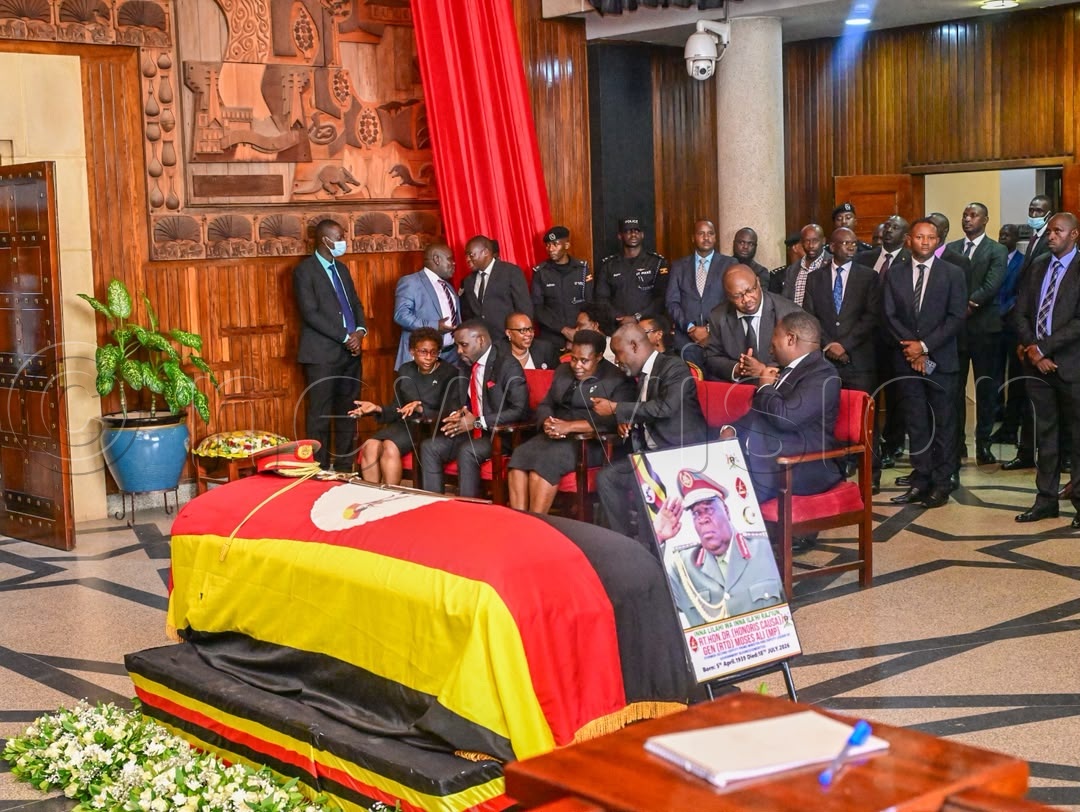
The President noted that Ali's vision for West Nile went beyond politics and was anchored on ensuring that a region once ravaged by war and decades of neglect became fully integrated into Uganda's national development agenda.
Today, Museveni said, many of the projects Ali tirelessly lobbied for have become a reality.
The President announced that government would continue expanding infrastructure in the sub-region, including construction of the Nebi-DR Congo border road, improvements to the Pakwach-Rhino Camp road and other strategic roads along the Nile.
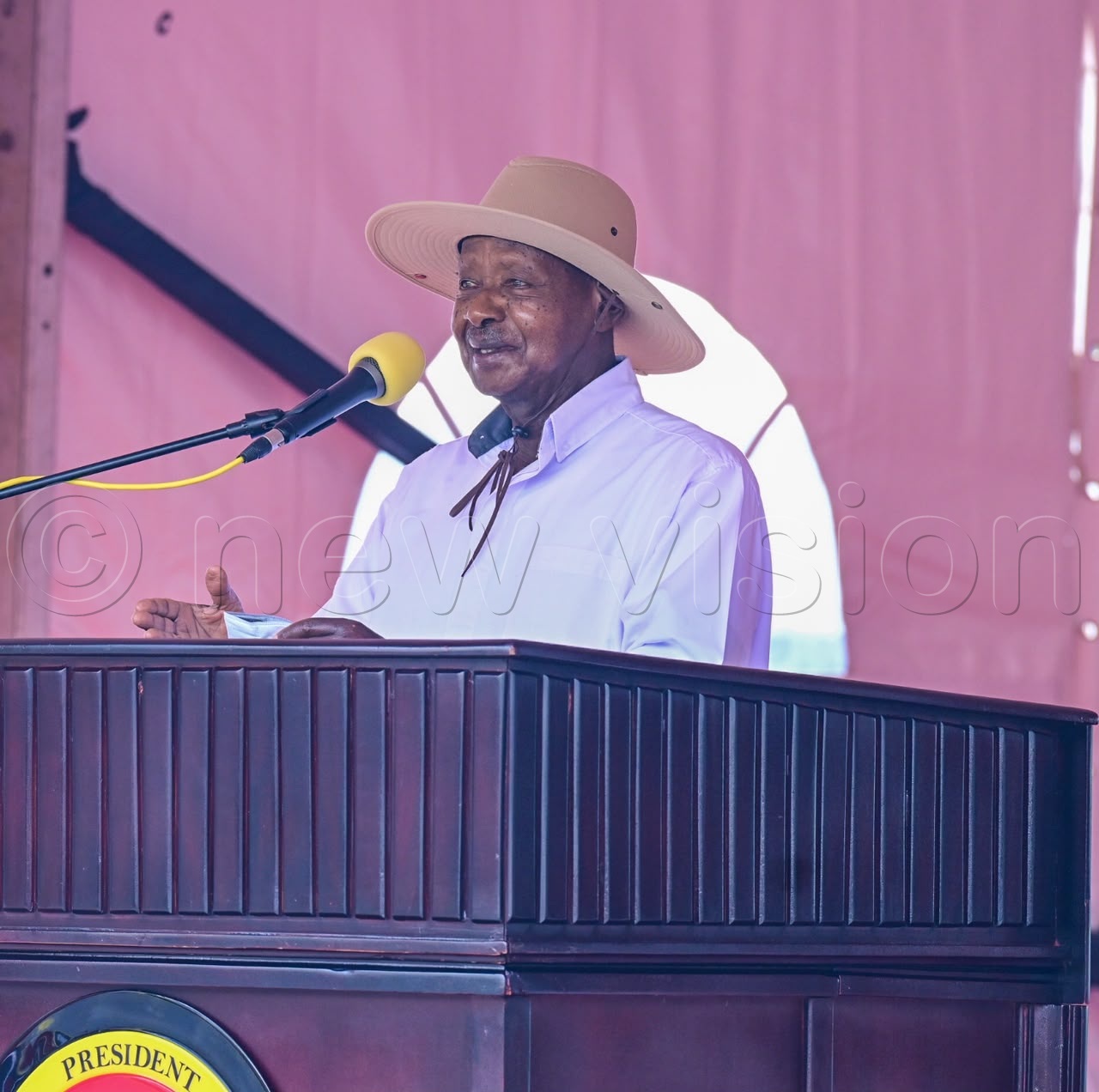
Today, Museveni said, many of the projects Ali tirelessly lobbied for have become a reality. (All Photos my Miriam Namutebi)
However, Museveni said the greatest tribute to Ali would be ensuring that development translates into improved livelihoods for ordinary households.
"Now, I want to tell the leaders of West Nile something I often told Ali. The infrastructure is now there, and we are going to expand it... but remember what I always told you during the campaigns: People do not sleep on roads, they sleep in their houses. Therefore, increasing household incomes in West Nile must now become our priority," the President said.
He added that, following the decline of tobacco as West Nile's main cash crop, Ali consistently engaged with the government to find alternative economic enterprises capable of raising incomes and creating wealth for families across the region.
"Since tobacco declined, the region has needed new economic enterprises, and I have consistently provided guidance on those issues. That is why I came here today—to bear witness to the positive qualities I saw in General Ali," Museveni said.
Museveni also described Ali as a freedom fighter and peacemaker, qualities that often made him clash with former President Idi Amin.
The President told legislators that although Ali served under Amin, he quietly opposed the regime's killings and eventually fell out with the military ruler because of those abuses.
Museveni further described Ali as a peacemaker whose willingness to pursue dialogue with the National Resistance Army during the liberation struggle helped prevent further bloodshed and laid the foundation for reconciliation after years of conflict.
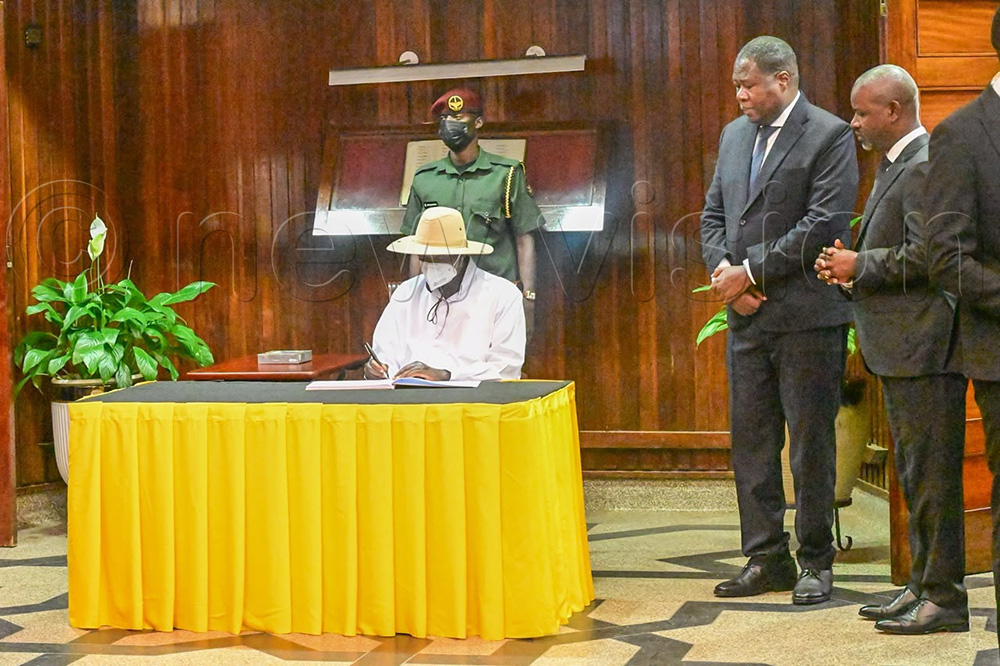
President Museveni signs in Ali's condolence book as Speaker Oboth-Oboth as his deputy look on.
About Moses Ali
Gen. Ali was born in Atabu Parish within Pakele Division, Adjuman District, to the late Mohammad Ali and Veronica Ali in 1939. Ali rose through the ranks of the Uganda Army before serving in Idi Amin's government.
Following the collapse of the Amin regime and years of conflict in West Nile, he became one of the founders of the Uganda National Rescue Front (UNRF), a rebel movement that later negotiated peace with the National Resistance Movement (NRM) government.
The peace agreement paved the way for the integration of former fighters into national institutions and marked the beginning of Moses Ali's long career in the NRM government.
For more than three decades, he served as Deputy Prime Minister and Member of Parliament for East Moyo County, becoming one of Uganda's longest-serving cabinet ministers. At the time of his death, however, he was MP for Adjumani West Constituency.
In 1957, he attained his Primary Leaving Examinations Certificate at Erepi Church of Uganda Junior School. From 1964-1965, he joined Kampala Secondary School, where he attained a Certificate in Education. Between 1968 and 1969, he enrolled in Israel for a cadet training course where he attained a Certificate in Officer Cadet as well as a Certificate in Paratrooper Instructors’ training.
In 1972, he attained a Certificate in Company Command Course. In 2007, he got a Certificate in Law at the University of Wolverhampton in the UK.
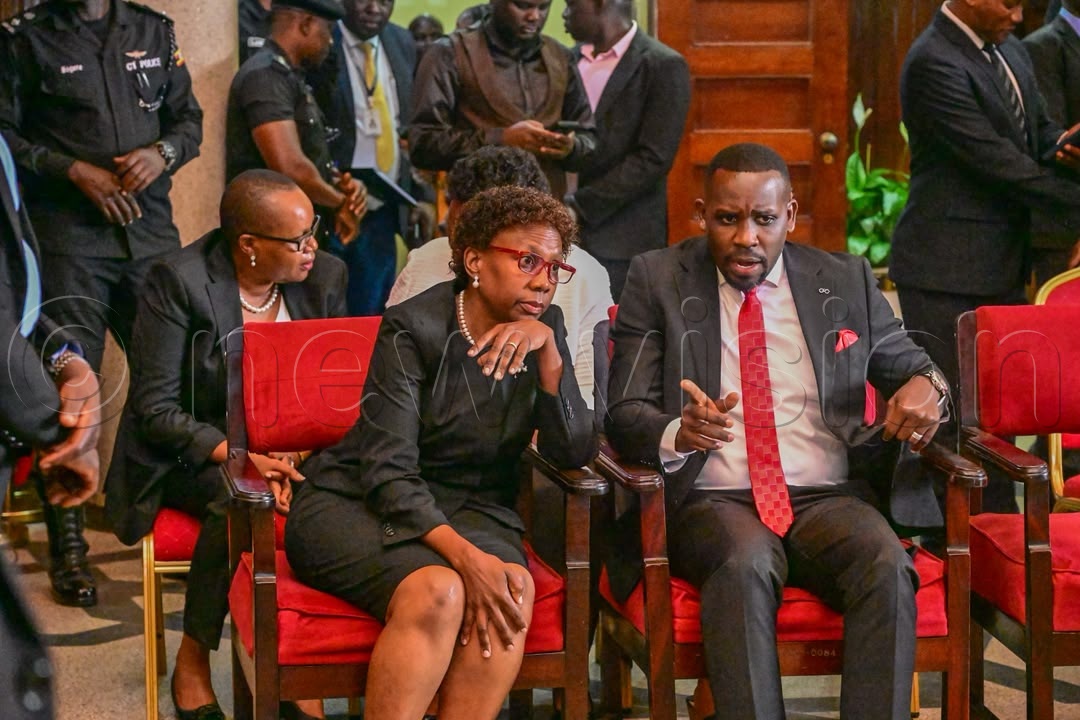
Leader of Opposition Joel Ssenyonyi and NRM's Jene Ruth Acheng.
He successfully graduated with a Bachelor’s Degree in Law at Makerere University Kampala in 2008 and a Post Graduate Diploma in Legal Practice at the Law Development Centre.
For the past 50 years, Gen. Ali’s work experience spanned a broad spectrum covering an illustrious Political, military, and Government service; holding various portfolios including but not limited to: Tourism, Wildlife and antiquities; Disaster Preparedness and Relief; and as Deputy Prime Minister.