
Museveni urges Europe to back Africa's value addition and promote global prosperity
Museveni said Europe has an opportunity to build a new partnership with Africa based on industrial development, economic empowerment and mutually beneficial trade, rather than perpetuating the continent’s dependence on exporting unprocessed raw materials.
President Yoweri Museveni meets resident ambassadors of European Union member states accredited to Uganda. (PPU)
__________________ President Yoweri Museveni meets resident ambassadors of European Union member states accredited to Uganda. (PPU)
President Yoweri Kaguta Museveni has urged the European Union to support Africa’s industrialisation by investing in local processing of raw materials, creating jobs and promoting shared global prosperity.
He said Europe has an opportunity to build a new partnership with Africa based on industrial development, economic empowerment and mutually beneficial trade, rather than perpetuating the continent’s dependence on exporting unprocessed raw materials.
He made the remarks on Wednesday (October 14) while hosting and co-chairing the first Uganda–European Union Partnership Dialogue at State House, Entebbe.
The meeting, held as Uganda and the EU mark 50 years of cooperation, brought together senior government officials and European diplomats to discuss trade, climate action, development cooperation, governance, human rights, security and other regional and global priorities.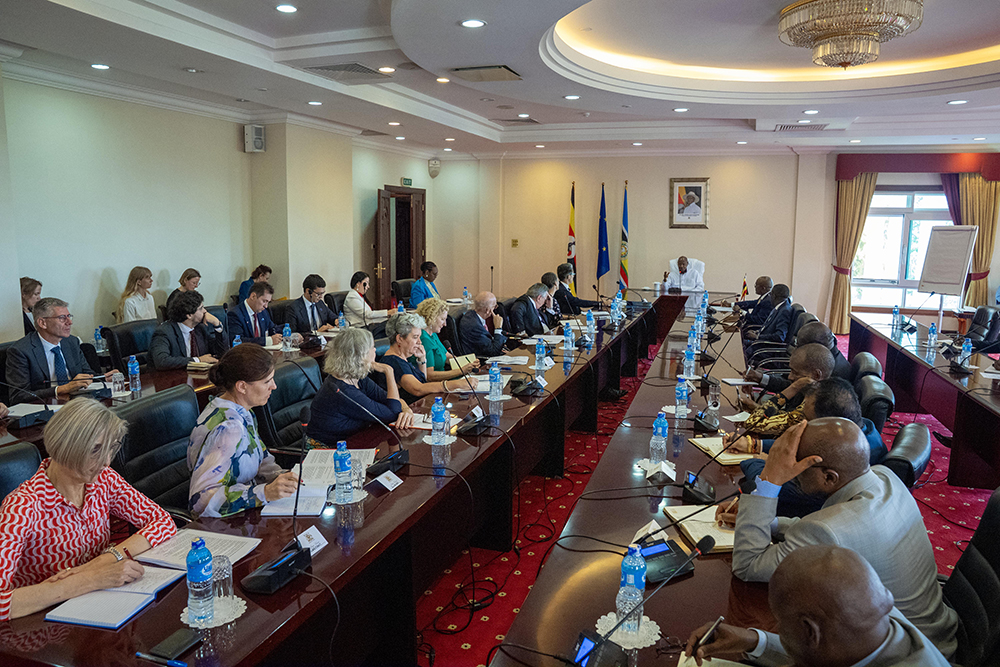
Museveni identified value addition, poverty eradication, irrigation, environmental conservation and affordable energy as key areas in which the EU could strengthen its partnership with Uganda.
He argued that Africa’s continued dependence on exporting raw materials deprives its people of jobs, income and the full benefits of their natural resources.
He said Uganda’s policy of discouraging the export of unprocessed raw materials was intended to retain more economic value within the country and urged the EU to support the approach.
According to the Ugandan president, Africa’s economic potential remains constrained by low levels of industrialisation, despite the continent’s considerable natural resources and growing markets.
He cited Africa’s combined gross domestic product at approximately $3.8 trillion, compared with about $32 trillion for the United States and more than $20 trillion for China.
He argued that broader economic growth across countries would create opportunities for increased trade and investment, benefiting both developed and developing economies.
Museveni believes the world should move away from strategic competition towards shared prosperity, arguing that economic inequalities and the exploitation of weaker economies contribute to international tensions and conflict.
He said Uganda’s exports to Europe, which he put at €1.8 billion, should increase substantially if the country expanded local processing and exported higher-value products.
His argument: Uganda’s increased earnings from value-added exports would enable the country to import more European products, including medical equipment and machine tools, creating opportunities for businesses on both sides.
Museveni proposed that the EU considers becoming an associate member of the African Union, citing the historical relationship and geographical proximity between Africa and Europe.
He asked the EU to support Uganda’s Parish Development Model (PDM), a government programme designed to move households from subsistence production into the money economy.
PDM is central to the government’s efforts to lift at least seven million households out of poverty and expand employment opportunities.
He also called for European support for large-scale irrigation to reduce Uganda’s dependence on rainfall and stabilise agricultural production, saying the recent delay in rainfall had reinforced the need for farmers to adopt irrigation systems to protect production against changing weather patterns.
Wetland conservation
On environmental protection, Museveni urged European partners to support efforts to protect wetlands and forests, which he said were being degraded by encroachment and inappropriate agricultural practices.
He also appealed for support in acquiring earth-moving equipment to construct valley dams and strengthen water conservation.
On energy, he called for private investment backed by patient capital to help Uganda provide affordable electricity for industrial production.
“We need either the private sector with patient capital because we don’t want to have expensive electricity. We are ensuring that for manufacturing it should be five cents."
The President said that while Uganda welcomes dialogue and cooperation with the EU, it expects its sovereignty and domestic decision-making processes to be respected.
On political governance, he defended Uganda’s electoral and representation arrangements, citing constituency-based Members of Parliament and special representation for women, youth and persons with disabilities.
He said Uganda is willing to exchange views with European partners but opposed foreign funding intended to influence domestic political choices.
On social issues, Museveni reiterated the government’s position on homosexuality, saying Uganda did not support its promotion as an alternative way of life.
EU reaffirms commitment
The EU delegation was led by its Ambassador to Uganda, Jan Sadek, who co-chaired the dialogue.
Sadek said the partnership remained important to the EU, estimating that European support to Uganda over the past 50 years amounted to approximately €20 billion.
“Uganda’s voice matters. We ought to work together. We want to be reliable and predictable, working together with Uganda. Fifty years gives us a lot to reflect on and see what to do next in our partnership,” he said.
He highlighted coffee and other value-added products as important areas for future cooperation, saying the EU wants processing and the associated economic benefits to remain in Uganda.
The ambassador cited Ugandan chocolate as an example of a product with potential to attract European investment and enter European markets, linking the opportunity to Uganda’s development ambitions for 2040.
He said the EU was supporting private-sector development and cooperation in mineral development and processing. He also announced €50 million in new support for conservation and tourism.
Europe thanked Uganda for its military contribution to the African Union’s regional security efforts in Somalia and its wider role in regional stability. Sadek also commended the country’s response to Ebola and contribution to disease control, calling for continued information sharing.