
Risk-based vaccination to reduce spread of cross-border livestock diseases
According to Dr Willington Besong, the country team leader for the Emergency Centre for Transboundary Animal Diseases at FAO, the exercise is targeting animals in high-risk areas and hotspots for some of the diseases.
The exercise, which began in mid-February, will ensure that the immunity of livestock on the Ugandan side is boosted to resist diseases that livestock crossing borders could introduce. (Credit: Prossy Nandudu)
Following the recent rains being experienced in different parts of the country, districts in the Karamoja sub-region have accumulated pastures, enough to attract livestock from neighbouring districts and countries.
As cows, goats and sheep move to places with plenty of pasture to eat, chances of spreading diseases are high. Examples of such diseases include Contagious Bovine Pneumonia, as well PPR, among others.
To ensure that healthy livestock don’t catch such disease, the Food and Agriculture Organisation, in partnership with the Ministry of Agriculture, Animal Industry and Fisheries have embarked on a risk-based vaccination drive in the Karamoja sub-region.
The exercise, which began in mid-February, will ensure that the immunity of livestock on the Ugandan side is boosted to resist diseases that livestock crossing borders could introduce.
According to Dr Willington Besong, the country team leader for the Emergency Centre for Transboundary Animal Diseases at FAO, the exercise is targeting animals in high-risk areas and hotspots for some of the diseases.
“We are looking at mobility pathways where animals move to other areas, where they move, they conglomerate around water resources and things like that because those are the areas where diseases can actually pop up,” Besong said.
He further explained that the targeted diseases affect the incomes of farmers who depend on livestock for their livelihoods and can lead to restrictions on access to markets for animals and their products.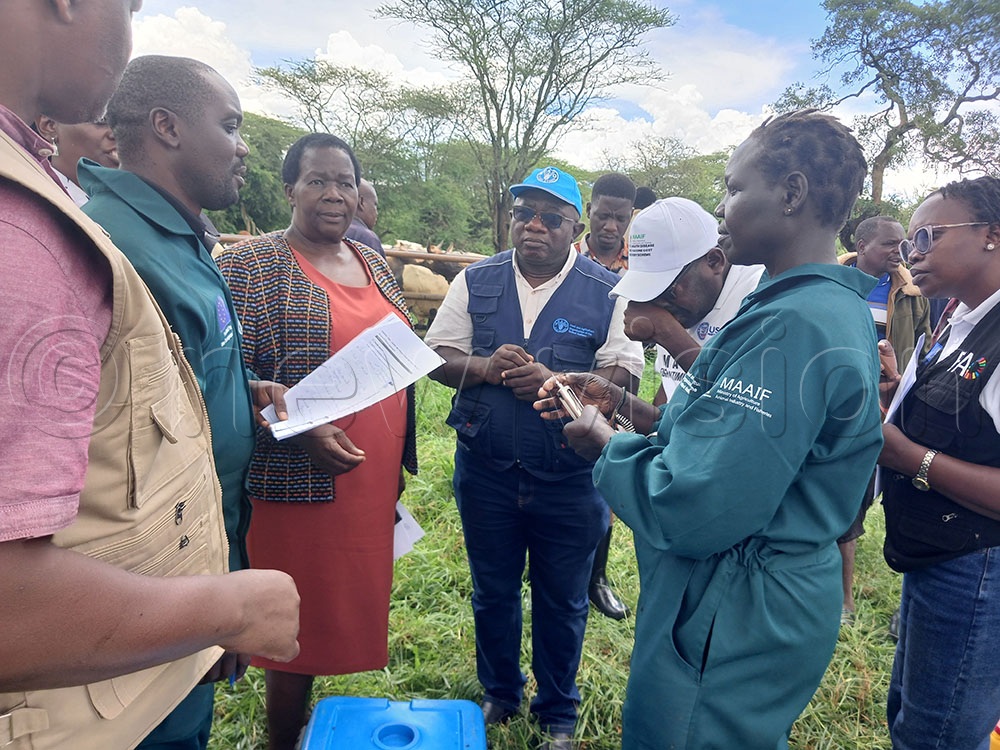
Vaccination exercise for cattle in progress. (Credit: Prossy Nandudu)
“Of course, you know that to export a product out of your country, you have to conform to certain regulatory guidelines, mostly those that are related to ensuring that animal products going out don't export diseases to other countries,” he said.
Besong added that the exercise is being carried out within the context of the PLACE project, which spans several countries with a focus on the Karamoja cluster.
The Karamoja cluster includes Ethiopia, South Sudan, Kenya and Uganda. PLACE stands for Pastoralism and Livestock Adaptation to Climate Change in the Eastern African Programme.
“We are carrying out this activity across the borders. This is going on in other countries. last week, we decided to carry out a monitoring visit where FAO provides support to the government of Uganda.
Besong made the remarks during the conclusion of a one-week monitoring visit of the vaccination exercise, led by Dr Ann Rose Ademun, the commissioner in charge of animal production and health at the Ministry of Agriculture, Animal Industry and Fisheries, accompanied by the FAO team and district officials, among others.
Issues monitored during the exercise included the efficiency of cold chain storage facilities for vaccines, the adequacy of vaccine quantities for livestock, and the use of electronic tools to capture real-time data.
Ademun explained that the exercise aims to vaccinate livestock against major diseases because communities in South Sudan, Kenya and Uganda share pasture and water resources, leading to cross-border movement.
“These animals cross over and, in the process, diseases are also shared. So we agreed together with the support of FAO and these countries to work together as a team and carry out vaccination especially in this region,” Ademun explained.
At the same event, Mzee Amutori, who owns over 2,000 head of cattle, called for an extension of the exercise to ensure all his livestock and those of surrounding communities are vaccinated. According to him, by the end of the third day, only half of his livestock had been vaccinated.