
Tumwebaze appeals to Chinese investors over machinery for smallholder farmers
“Adoption of enabling technology in production should be in weeding, in harvesting, in all those precision farming and abilities, we need to know them. That will be the future of sustainable production. So, we shall be happy to continue this cooperation along these areas,” he said.
The Minister of Agriculture, Animal Industry and Fisheries, Frank Tumwebaze, recieving a gift from the representative of the Chinese Embassy in Uganda at Munyonyo on Thursday. ( Photos by Prossy Nandudu)
________________
The Minister of Agriculture, Animal Industry and Fisheries, Frank Tumwebaze, has appealed to the Chinese government to support Ugandan smallholder farmers with small machines suitable for cultivation.
He made the call on April 16, 2026, during the Final Tripartite Review and Project Closure Workshop of the FAO-China-Uganda South-South Cooperation Project (Phase III) at Speke Resort Munyonyo.
Tumwebaze said that traditional factors such as land and labour have been overtaken by a growing population in need of land for settlement, as well as limited labour, since many youths who previously worked in the fields have moved on.
“Adoption of enabling technology in production should be in weeding, in harvesting, in all those precision farming and abilities, we need to know them. That will be the future of sustainable production. So, we shall be happy to continue this cooperation along these areas,” he said.
Anping Ye, the director of FAO’s South-South and Triangular Cooperation Division, said that since 2009, China has contributed $130 million to three phases of the programme. With the funding, more than 200 technologies and crop varieties have been introduced to farmers, including improved rice and millet varieties.
He explained that crops such as hybrid rice and foxtail millet have been released for commercialisation, adding that good yields have been reported among farmers growing these crops. Other improvements have been recorded in livestock and aquaculture systems.
“FAO attaches high importance to South-South and Triangular Cooperation as an effective way to share knowledge, innovation and solutions among countries of the Global South.
FAO team listening to an agronomist on the progress of sorghum breeds that were introduced to farmers in Luwero district.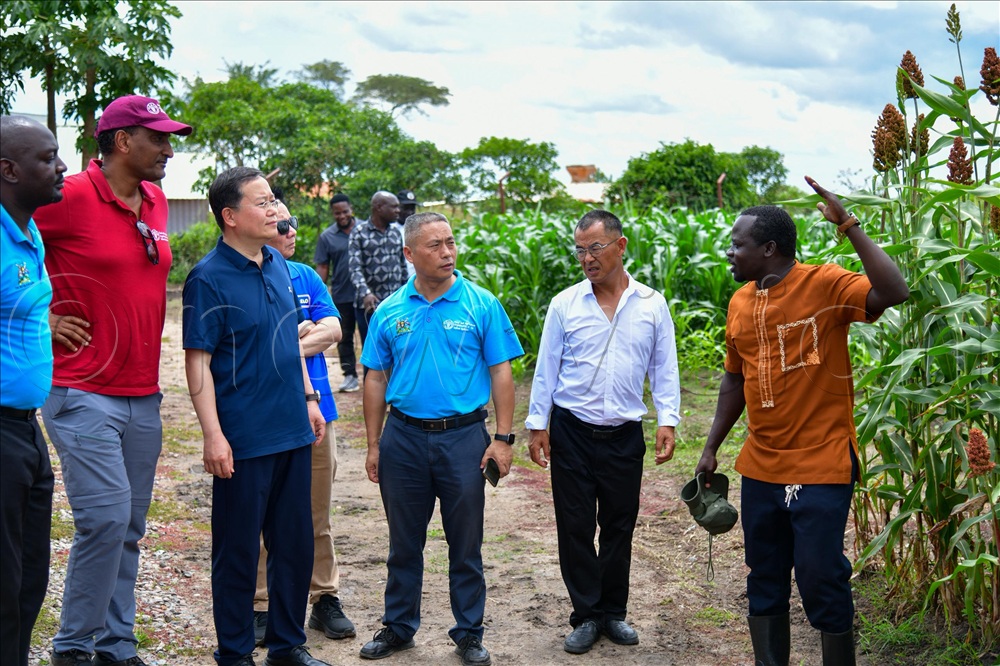
Through this modality, FAO promotes exchanges in climate-smart agriculture, digital agriculture, pest control, soil health and agrifood systems transformation,” he said.
Anping Ye further explained that within this global effort, the FAO-China South-South Cooperation Programme is one of FAO’s flagship initiatives, with China contributing $6.5 million for the three phases.
Impact on the farmers
Anping Ye added that during the implementation of the project, farmers were trained in best farming practices for different enterprises under the project, while extension officers were also retrained.
Opportunities for trade were introduced through value addition on commodities such as fruits like pineapples and vegetables like chilli, which are now being exported mainly to China.
Sustainability of the project
On sustaining the project, he appealed to the Ministry of Agriculture to integrate the technologies and good practices into national extension systems and programmes, in addition to investing in technology hubs to sustain innovation and expand impact.
At the same event, the FAO country representative, Ezana Kassa, explained that the partnership was possible because four years ago Uganda became the first country in the Global South to co-finance such a project through a Unilateral Trust Fund, signalling a new era of national ownership in international partnerships.
He added that the meeting was aimed at consolidating the outcomes of the tripartite review, validating key conclusions, and drawing sustainability plans for the projects and innovations on ground before closing the project.
Beneficiary farmers speak out
Sagula Robert, a rice farmer from Butaleja district, shared his experience, explaining that for the last 25 years, he had been growing rice but harvesting only 500 kilogrammes per acre.
“I love rice farming because you produce what you eat. But the productivity had remained low that is why I was only getting 500kgs of rice from one acre before working with the project,” Sagula said.
After years of low yields, he was three years ago linked to a team of experts under the FAO-China-Uganda South-South Cooperation Project Phase III by district leadership.
Working with the Chinese experts, Sagula was introduced to hybrid rice varieties and improved farming practices such as line planting for easier weeding and water management. These practices increased his harvest from 500 kilograms per acre to 1,800 kilograms.
Based on this success, Sagula has embarked on a mobilisation drive among Butaleja residents to grow more rice, adding that his goal is to make the district a model for rice production and trade.