
Tashobya tips AUSC as Ogwel relinquishes chair
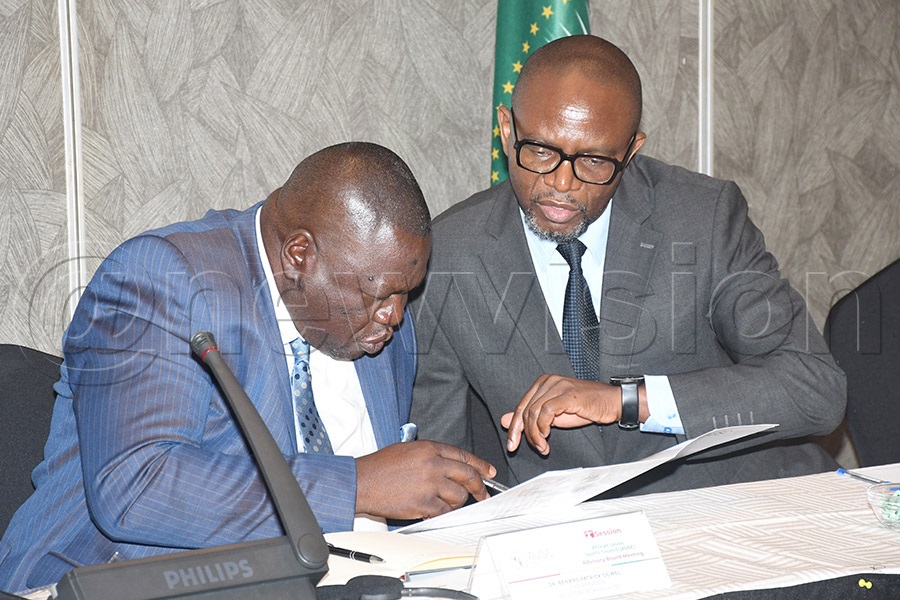
NCS General Secretary Patrick Ogwel is the outgoing chairman of the Advisory Board, who will handle over the chair on Tuesday after the election of the Bureau of the AUSC Sports Advisory Board.
The NCS Chairman Ambrose Tashobya (seated -center), the outgoing chairperson of the AUSC advisory Board Patrick Ogwel African Union Sports Council (AUSC), the Deputy Chairperson for the Technical Committee on Sports for Development Peninah Kabenge (seated-2nd right) and Sports Commissioner Duncans Mugumya (standing-second right) poses with some of the African Union Sports Council (AUSC) members. Photo by Michael Nsubuga
National Council of Sports (NCS) chairman Ambrose Tashobya has advised the African Union Sports Council (AUSC) membership to position Africa as a potential contributor in sports development.
Tashobya was addressing the Second Ordinary Session of the African Union Sports Council (AUSC) Advisory Board meeting which Uganda is hosting at the Mestil Hotel in Kampala, October 19-20.
NCS General Secretary Patrick Ogwel is the outgoing chairman of the Advisory Board, who will handle over the chair on Tuesday after the election of the Bureau of the AUSC Sports Advisory Board.
Tashobya pointed out that when you look at the economic growth rates worldwide, African nations are expanding much faster than most other countries, rivalling places like India, China, and a select few others. This means economic prosperity is coming to Africa, and importantly, the population is growing, which presents both an opportunities and challenges.
He said the sports community has a crucial part to play in ensuring this young population with an average of 17 years becomes highly productive for Africa's future. He tasked the AUSC to amplify the message for nations to make sports a serious priority.
“Because there's an agreed thought that if you have a fit body, a healthy body, probably the mind will be healthy too, and it will be more productive. So, for the productivity of Africa, sport becomes very, very important. But also, for the preservation of these youths from bad vices, sports play a very big role,” he said.
He noted that on the financial side, the reality is that sports represent a massive industry through the billions generated globally, though it is evident that Africa's portion of this revenue is quite minimal. “Our aspiration shouldn't be limited to our children having to leave Africa to find lucrative careers in sports.”
“We need to focus on introducing sports disciplines that attract and retain young people. Otherwise, we face significant competition from other forms of entertainment.”
He also advised them to initiate debates on taxation issues affecting sports properties and equipment. He said temporarily removing taxes on equipment could help boost the industry. “For now, we can consider indirect taxation, with the option to introduce direct taxation later.
“We should discuss these matters in detail and determine immediate actions. If we agree that promoting sports improves public health and reduces communicable diseases, we should consider removing taxes on sports equipment. Since you advise decision-makers at this level, I encourage you to provide thoughtful and well-considered recommendations,” Tashobya stated.
The outgoing chairperson of the AUSC advisory board, Patrick Ogwel, encouraged the incoming board to continue championing the interests of member states and to maintain a strong focus on the African Games.
Egypt will host the 14th African Games in Cairo, from August 27 to September 10, 2027, before Uganda hosts the 2031 edition as confirmed by the African Union Sports Council.
“The African Games remain the flagship multi-sport event of our continent and a powerful symbol of African unity, excellence, and solidarity. Ensuring the sustainability, credibility, ownership, and long-term success of the African Games must remain a strategic priority for the AUSC,” Ogwel said.
He said significant strides have been made in operationalising the governance architecture provided for under the AUSC Statute.
“We have activated the Council's statutory organs, strengthened the work of the Technical Committees, advanced the revitalisation of the AUSC Regions, and enhanced mechanisms that enable Member States to contribute meaningfully to the development of African sport.
“We have also overseen the development of the AUSC Five-Year Strategic Plan (2024-2028), providing a clear framework for the growth and development of sport in Africa and strengthening alignment with Agenda 2063. In addition, the introduction of digital monitoring and evaluation systems has enhanced accountability, reporting, performance tracking, and evidence-based decision-making,” Ogwel stated.
He added that AUSC has continued to advance key continental priorities, including safeguarding in sport, sports integrity, anti-doping, sport for development, gender equality, disability inclusion, capacity building, and the governance of the African Games.
“While these achievements are commendable, more remains to be done. We must accelerate the full operationalisation of the AUSC Regions, deepen collaboration with regional economic communities, continental sports bodies, and international partners, and continue to ensure that the interests of member states remain central to continental and global sport governance discussions. We must also further strengthen the role of sport as a catalyst for youth empowerment, social inclusion, health promotion, economic development, peacebuilding, and African integration.”