
Football unites: Special Olympics Uganda brings hope to refugee learners
One of the children who has benefited from the programme is Joel Bawujo, an 11-year-old orphaned, mute refugee who lives with an intellectual disability.
Bawujo carries the flame of hope with an official
Arsenal manager Mikel Arteta once described a football as a unifying "object" that holds "zero value" on its own but gains meaning through human connection.
This has been the story for Special Olympics Uganda, which, through its Unified Sports programme, has managed to bring together learners with and without intellectual disabilities on the same football teams in the Kyangwali refugee settlement.
"We use football because it is the most accessible sport," says National Director Genevieve Bamwidhukire.
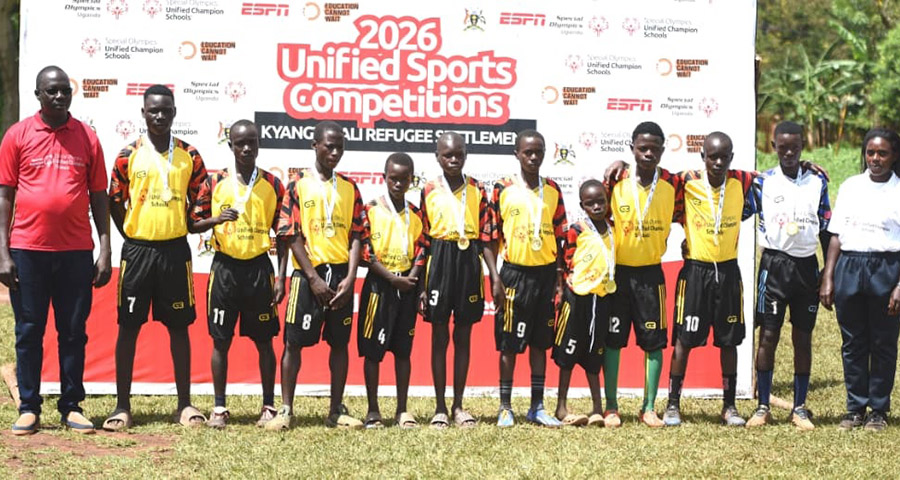
One of the children who has benefited from the programme is Joel Bawujo, an 11-year-old orphaned, mute refugee who lives with an intellectual disability. He is now cared for by his grandparents, Zamba Bulo and Josephine Zwake.
Bawujo, who attends Kentomi Primary School in the settlement, struggled to communicate with schoolmates until he started playing football through the programme.
"They said he cannot play," recalls teammate Byaruhanga Njaba. "But when we played, they saw he was like us."
Bawujo is not the only child who has benefited from the programme, as most of the learners were not frequently attending class in order to take care of chores at home.
"When there is sport, children return," says Kikuube District Education Officer Jonathan Byakagaba.
Bawujo now arrives early with a handmade ball of polythene paper and banana fibre. He participates in class and plays with peers who once excluded him.
"He washes clothes, fetches water and helps at home," says his grandmother Josephine Zwake.
The programme has reached more than 800 learners across 10 schools in Kyangwali. On Saturday, the international community marked World Refugee Day, celebrated on June 20, a day that highlights Uganda's impact on the many displaced people from neighbouring countries.