
Federations seek over sh150b for 2027-2028 as sports budget faces deep cuts
Uganda’s sports budget for the financial year 2025/2026 total allocation under the NCS was over sh503b, but much of it (sh464b) went to infrastructure development, with the national sports federations/associations given sh36.25b.
NCS General Secretary Patrick Ogwel (2nd right) flanked by his staff from the NCS addresses the associations/federation representatives during a budget conference at the Cooper Chimney, October 29, 2026. Photo by Michael Nsubuga
Sports associations and federations have submitted ambitious budgets for the 2027-2028 financial year, which starts on July 1, 2027.
If approved as is, the government would need to allocate more than sh150 billion to cover the financial requests from the 28 associations and federations that presented budgets during a budget conference hosted by the National Council of Sports (NCS) at the Cooper-Chimney on Thursday.
Uganda’s sports budget for the financial year 2025/2026 total allocation under the NCS was over sh503b, but much of it (sh464b) went to infrastructure development, with the national sports federations/associations given sh36.25b.
Although different associations like Netball Uganda, Uganda Cricket Association, Cycling, and Woodball Federation have ambitions of establishing permanent homes for their respective sports, it remains to be seen whether their ambitious plans will be considered in the budget amid anticipated budget cuts to the sports subsector as presented to the assembly by Derrick Namisi, the Principal Economist, Ministry of Education and Sports.
The sports associations/federations have until November 13 this year to have fine-tuned and presented their budgets for 2027-2028.
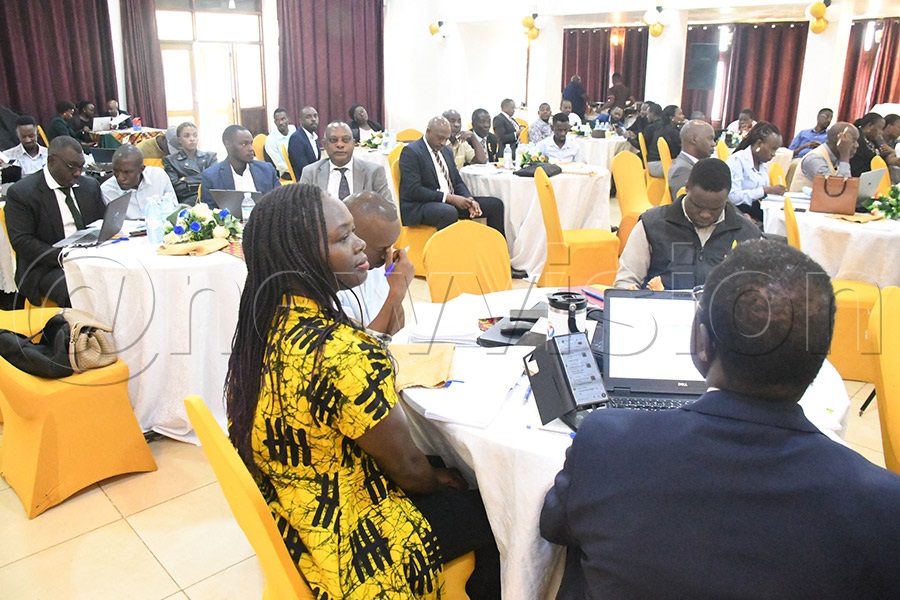
A cross section of association/federation heads during a budget conference at the Cooper Chimney, October 29, 2026. Photo by Michael Nsubuga
Namisi told the congregation that the national resource envelope is shrinking by 6.1 percent while the National Council of Sports budget (Vote 166) had been cut by 67.7%.
“You are budgeting to support Vision 2040 in line with the National Development Plan. As you review the plan, consider your priorities and the institutional objectives of the National Council of Sports,” Namisi advised.
“Your department’s objectives should align with these. If the Ministry finds that your department lacks clear objectives, it may dissolve it or absorb it into another department.
“The same applies to federations. If a federation is not working towards these objectives, it has no justification to continue,” Namisi stated.
“As you prepare your budget, ensure it aligns with national objectives. For example, the National Development Plan focuses on building institutional capacity to deliver sports services, safeguarding talent and talent pathways, and constructing and maintaining standardised regional and international sports infrastructure. In summary, this is AFCON.
He noted that this year, their budget was 84.39 trillion, which has reduced to 79.22 trillion, a development they should take note of as they advocate for more money.
“So before you even begin budgeting and before you begin advocating for more money, you need to know that the overall national resource level has been adjusted downwards. Even the discretionary resource envelope, where the government can make changes towards whatever priorities they want, the money we can actually spend, is reduced from sh50.93 trillion, still a form of negative 6.15%.
“The Human Capital Development Program, where we fall, where we have an (5:11) indicative budget of 12.754 trillion. This is also falling by almost a whole trillion from sh13.562t, and exact figures were falling by sh807.27 million, a 36% fall.
He noted that the biggest challenge that remains is the federation/association's failure to handle compliance. He said even though the government is footing the bill for these federations, they're not being held accountable for their spending or for following through. He advised them to create work plans and submit budgets and their calendars of priority activities.
NCS General Secretary Patrick Ogwel said they will be helping out the federations and associations by using the government's strategy of financing pressing needs first.
“We know the government's resources are tight, but they set these limits, which helps us figure out the most important things to focus on for the next year, just like everyone else does. So, if these groups come with big budget ideas, this same approach will be used."