
UPC distances itself from Mao’s speaker bid
Akena advised Members of Parliament-elect to carefully examine those who have expressed interest in contesting for the position, including their intentions and objectives.
The Uganda Peoples' Congress (UPC) party president Jimmy Akena, addressing the media at UPC's Uganda House in Kampala on Wednesday, Feb. 25, 2026. (Photos by Isaac Nuwagaba)
___________________
The Uganda Peoples' Congress (UPC) party president, Jimmy Akena, has denied allegations that he is backing justice and constitutional affairs minister Norbert Mao for the position of Speaker of Parliament, despite UPC logos appearing on Mao’s promotional materials.
The controversy follows Mao’s public declaration of interest in contesting for the position on February 24, 2026, at the Democratic Party headquarters on Balintuma Road in Rubaga Division. During the event, Mao’s supporters were seen wearing T-shirts and carrying banners printed with logos of opposition parties, signalling possible endorsement.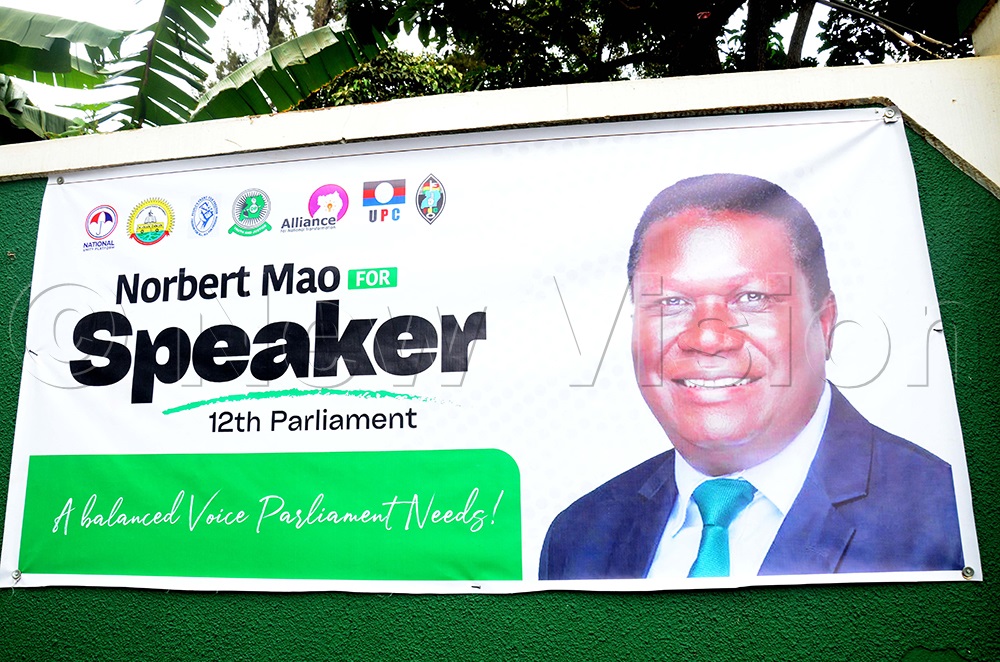
Justice and Constitutional Affairs Minister, Nobert Mao, portrait with opposition party logos at DP party headquarters on Balintuma Road in Rubaga division, Kampala, on Tuesday, Feb. 24, 2026. (Photos by Isaac Nuwagaba)
“As UPC, we have not decided on who to support for the position of speaker. However, the Parliament needs a speaker who understands the importance of Members of Parliament (MPs) and the people they represent,” he said.
Addressing a press conference on Wednesday, February 25, 2026, at the UPC headquarters at Uganda House in Kampala, Akena advised Members of Parliament-elect to carefully examine those who have expressed interest in contesting for the position, including their intentions and objectives.
“Seeing our party logo printed on any candidate's promotion material does not mean that we have a written agreement for our support to any position, and it does not signal that we have backed any to battle the other,” Akena observed.
The appearance of UPC logos on Mao’s supporters’ materials has sparked debate, with some questioning the party’s intentions in allowing its historic rival, the Democratic Party, to use its logos for a competitive position.
The position of Speaker has so far attracted five contenders, including former head of the African Union Mission to Somalia and Mbale City Woman MP-elect Lydia Wanyoto, State Minister for Lands, Housing and Urban Development Persis Namuganza, Aringa South Constituency MP Alioni Yoke Odria, and incumbent Bukedea District Woman MP Annet Anita Among.
Mao, who is also the Democratic Party president general, has been touted as a potential candidate for the position. The presence of UPC logos on his promotional materials has raised eyebrows, with some speculating that Akena is secretly backing him.
Other parties whose logos featured on Mao’s supporters’ materials include the National Unity Platform, the Forum for Democratic Change, the Alliance for National Transformation and the People's Front for Freedom.
The UPC was previously embroiled in a dispute with the National Unity Platform over the use of the red colour, which is a key symbol of the party, accusing it of attempting to hijack the colour for unclear reasons.
Akena also condemned the continued violation of human rights in the country and called for dialogue to find lasting solutions to Uganda’s challenges.
“I also condemn the continued violation of human rights in the country. There is a need for dialogue to find the lasting solution to Uganda’s challenges, including peaceful transition talks,” he insisted.
Understaffing undermines university education
Akena said the education sector needs to be revitalised for all, rather than benefiting only a few, as was the case in the 1980s when UPC was in power.
Universities in Uganda are facing a severe staffing crisis, with some institutions operating at as low as 10 per cent of the required teaching staff, a situation likely to affect the provision of quality education.
Larger institutions such as Kyambogo University and Makerere University are struggling, with staffing levels at 35 per cent and 40 per cent, respectively. Lira University has only one professor, while Busitema and Muni universities have academic staffing levels of just 10 per cent and 11.3 per cent, which presents a worrying trend.
The understaffing crisis has been attributed to inadequate funding, with universities relying heavily on part-time tutors and lecturers, a practice that compromises the quality of education and academic research.
The Government is also struggling to meet its financial obligations to government-sponsored students, forcing universities to divert funds from other budget lines to cover shortfalls and prevent student strikes.