
Edith Byanyima pens open letter to Mao, questions party direction
Byanyima, while addressing journalists in Rubaga division, Kampala, on Monday, April 13, 2026, questioned Mao's attendance at NRM caucus meetings and the pursuitof the speakership position without clear party endorsement.
Edith Byanyima, the daughter of the longest-serving Democratic Party (DP) National Chairman, Boniface Byanyima, clarifying her open letter to Mao. (Photo by Isaac Nuwagaba)
________________
Edith Byanyima, the daughter of the longest-serving former Democratic Party National Chairman, Boniface Byanyima, has written an open letter to party president general, also justice and constitutional affairs minister Norbert Mao, expressing concerns about the party's direction, internal consultation, and coherence.
In the letter, Byanyima, who described herself as a ‘concerned DP member’, highlights several issues, including limited internal communication, ineffective use of party structures, and questionable participation in the ruling National Resistance Movement (NRM) party caucus ongoing at the National Leadership Institute, Kyankwanzi, which Mao attended as the top opposition DP party leader.
“Key organs such as parliamentary representatives, district chairpersons, delegates and national council members (whose composition has been the subject of ongoing contestation among sections of the membership), and party elders do not appear to be meaningfully engaged in guiding the party’s current direction,” Byanyima said in her robust letter.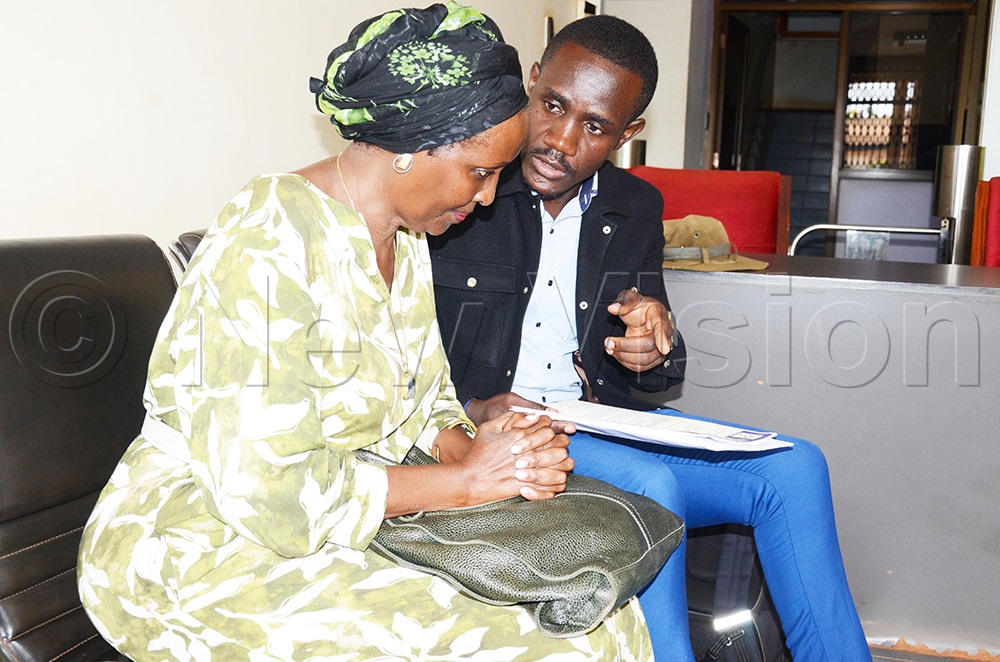
Edith Byanyima, the daughter of the longest-serving DP National Chairman, Boniface Byanyima, with DP member Julius Ddumba, before the release of the letter on Monday, April 13, 2026. (Photo by Isaac Nuwagaba)
Byanyima, while addressing journalists in Rubaga division, Kampala, on Monday, April 13, 2026, questioned Mao's attendance at NRM caucus meetings and the pursuit
of the speakership position without clear party endorsement.
“Such involvement raises important questions about the scope of the DP-NRM cooperation arrangement, whether party structures were consulted, and how this aligns with the Democratic Party’s independent identity,” she insisted.
The party’s organisational foundations appear to have weakened, a situation she said is reflected in declining coordination, limited engagement, and increasing disengagement among members.
Byanyima called for clarification on the expiring cooperation agreement with the ruling party, internal disputes, and the party's independent direction.
“I appeal to Mao to prioritise structured consultation, resolve internal conflicts, and ensure transparency.”
Byanyima emphasised the need for accountability, consultation, and institutional consensus to strengthen the party, with key demands for clarification on the cooperation agreement.
A week ago, supporters of DP issued a strong statement condemning Mao's intention to attend the NRM caucus, describing it as “unacceptable” and a “direct affront to the independence of DP party.”
Charles Lwanga, a long-time party member who joined DP in 1962, said this is a wake-up call for the party leadership.
“The issues raised by Byanyima are legitimate and reflect the concerns of many members. We need to introspect and address the gaps in our internal processes and communication.”
“The DP's strength lies in its principles and members; let's not lose sight of that,” Lwanga added.
According to Julius Ddumba, another DP member, Members of Parliament currently attending training at Kyankwanzi were on April 12, 2026, provided with copies of the NRM-DP cooperation agreement.
“Mao was expected to deliver a presentation on the agreement along with other national matters during the training. The session was expected to take place in the presence of President Yoweri Kaguta Museveni, but I am still consulting my sources for an update on that,” he said.
DP-NRM cooperation
The cooperation agreement between DP and NRM was signed in 2022 and aims to foster collaboration on governance issues, including electoral reforms, national dialogue, and institutional strengthening.
Mao has defended the agreement, stating it is a strategic partnership that benefits the party and the country. He emphasised that the cooperation has helped de-escalate tensions and allowed DP to influence governance decisions.
The Constitutional Court upheld the agreement, ruling it does not violate Uganda's Constitution, with DP and NRM in talks to renew it beyond 2026.
With the agreement reaching its expiry period in 2026, it remains to be seen how a new pact will be negotiated and on what terms, especially amid concerns about the limited involvement of party structures in decision-making.