
Regional journalists urged to rethink migration reporting
The call came at the conclusion of a three-day regional media training on reporting and communicating free movement of persons in the context of migration governance and regional integration, held at Imperial Golf View Hotel in Entebbe Municipality.
SCP Fred Enanga, Deputy Director of INTERPOL and International Relations in the Uganda Police Force, sensitises journalists and government communicators from the IGAD region on migration reporting. Photo by Julius Luwemba.
_________________ Some of the journalists and government communicators from the IGAD region pose for a group photo at the close of a three-day workshop on migration reporting held in Entebbe. (Photo by Julius Luwemba).
Journalists and government communication officers from across the Intergovernmental Authority on Development (IGAD) region have been challenged to move beyond portraying migration largely as a security threat and instead report free movement of persons as part of the region's wider economic and social integration agenda.
The call came at the conclusion of a three-day regional media training on reporting and communicating free movement of persons in the context of migration governance and regional integration, held at Imperial Golf View Hotel in Entebbe Municipality.
The training, which started on August 24, 2026, brought together 28 media and communication professionals from IGAD member states. It was organised by IGAD with support from the International Labour Organisation (ILO) under the Free Movement of Persons and Transhumance Phase II (FMPT-II) project.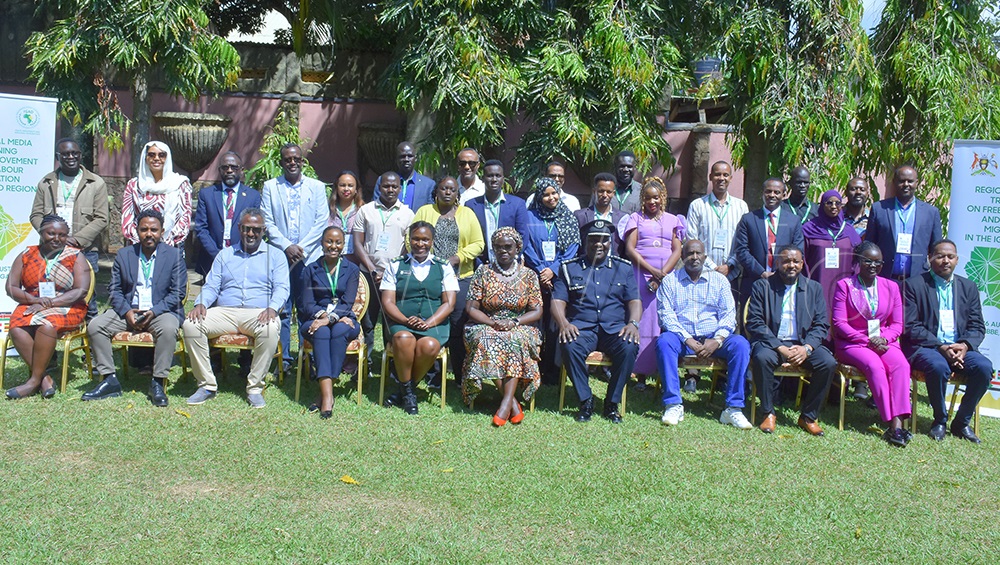
The training sought to strengthen the capacity of media professionals to accurately and responsibly report on free movement, migration governance and regional integration while addressing myths, misinformation and misconceptions surrounding migration.
Participants were introduced to the IGAD Protocol on Free Movement of Persons and its implications for movement, residence, employment and economic activity across member states.
Ephrem Getnet, the ILO chief technical adviser on free movement of persons and transhumance, said understanding labour migration dynamics was critical for journalists because migration is influenced by factors including unemployment, poverty, conflict and climate change, as well as the search for better employment, education and security.
Training materials indicated that an estimated 4.3 million international migrant workers are in the IGAD region, with labour mobility occurring through regular and irregular channels by land, sea and air.
Getnet highlighted some of the challenges affecting migrant workers, including deceptive recruitment, wage theft, discrimination, limited access to social protection and difficulties in accessing justice.
He also emphasised the importance of bilateral labour agreements, ethical recruitment and international and regional frameworks in protecting migrant workers.
Lucy Daxbacher, the senior programme coordinator for support to free movement of persons in IGAD's health and social development division, provided an overview of the regional free movement agenda and the role of communication professionals in creating informed public understanding of migration.
She said the IGAD Protocol on Free Movement of Persons provides for a visa-fee-free region, as well as the right of entry, stay and exit for citizens across the region.
"It also provides for the right of mobility of labour, residence and the right of establishment of the citizens in the IGAD region," Daxbacher noted.
She added that the 1986 agreement enjoins member states to progressively establish a free-movement regime allowing people to move for trade, access to basic services, safe places of abode and protection from disasters.
Juliet Akello, a senior immigration officer in Uganda's Ministry of Internal Affairs, used Uganda's National Migration Policy 2025 as a case study to demonstrate how national migration policies can support broader regional integration objectives.
The policy, approved by Cabinet in August 2025 and launched in March 2026, identifies the IGAD Protocol on Free Movement of Persons as one of its core legal pillars. It seeks to manage internal, intra-regional and international human mobility while strengthening border governance, protecting migrant workers and enhancing national security.
Akello said effective border governance requires a balance between facilitating legitimate movement and controlling risks associated with irregular migration, human trafficking, smuggling and other transnational crimes.
She urged journalists to contextualise migration stories within existing policies and avoid language that dehumanises migrants.
Balancing movement and security
Fred Enanga, deputy director of International Police (INTERPOL) and international relations in the Uganda Police Force, further oriented participants on the security dimensions of cross-border movement and the importance of cooperation in addressing transnational crimes.
Enanga said the media plays a critical role in shaping public understanding of migration, security and free movement.
"Responsible reporting can prevent exploitation, protect victims and counter misinformation," he emphasised.
Enanga noted that while free movement supports regional integration, economic activity and social connections, criminal networks can exploit legitimate human mobility for profit. He urged journalists to distinguish migration from criminal exploitation.
The former police spokesperson described transnational crime, its perpetrators and possible victims. He distinguished between free movement of persons, irregular migration, smuggling of migrants and trafficking in persons, as well as how trafficking networks operate.
Participants said the training had equipped them with a better understanding of migration issues and would improve the quality of their reporting.
Grace Wafubwa of Kenya Broadcasting Corporation said the training helped her appreciate the need to look beyond the movement of people itself and examine the policies and opportunities surrounding migration.
Nasil Lubwama of Uganda Broadcasting Corporation called for greater engagement and popularisation of the Protocol on Free Movement, saying many citizens remain unaware of its provisions.
Wol Mapal of South Sudan's Eye Radio and a member of the Union of Journalists of South Sudan raised concerns over corruption by some immigration officers at border points, saying the vice undermines the spirit of free movement within the region.
The workshop concluded on Wednesday, with participants expected to develop follow-up stories and reporting plans that address misinformation while highlighting the opportunities, rights and responsibilities associated with free movement of persons across the IGAD region.
According to Daxbacher, the media training is the first of its kind aimed at equipping journalists and communicators as cadres who can promote free movement of citizens across the IGAD region.