
Persons with albinism call for fairness in employment opportunities
“A few who get jobs are not promoted. We request you to look at our abilities, not the colour of our skin. Please make us proud in our skin,” Ogik said,
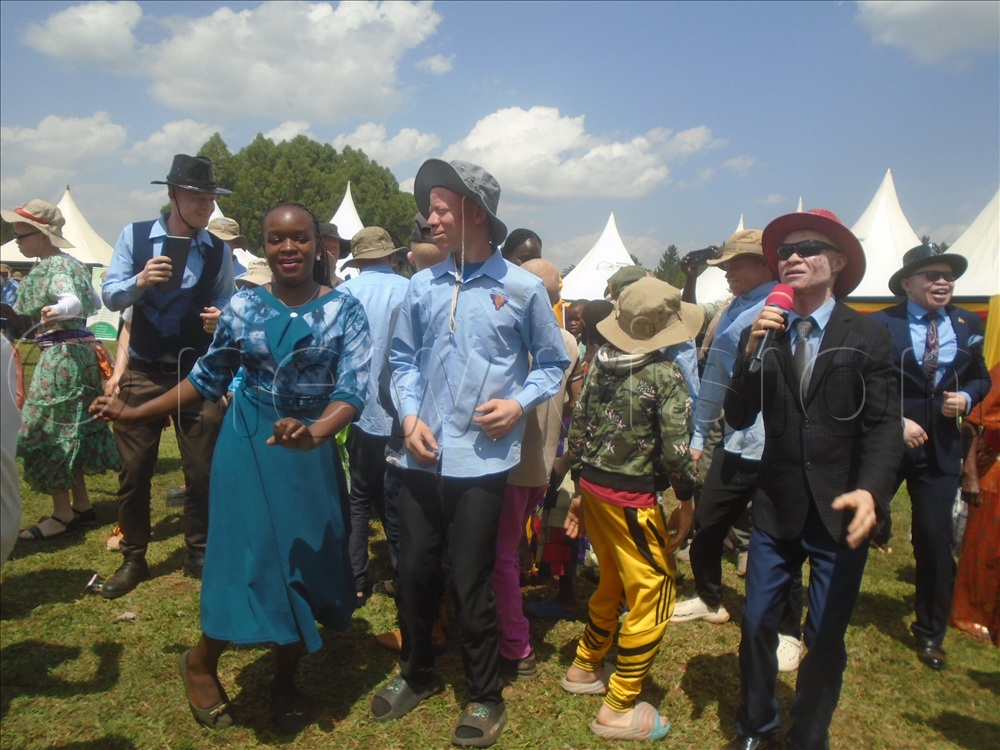
The first deputy prime minister and minister for East African Affairs, Rebecca Kadaga (middle), with some of the people with albinism after celebrations to mark the International Albinism Awareness Day (IAAD) in Kamuli district on June 13, 2026. Second left in a blue suit is Peter Ogik, the executive director of Source of the Nile Union of Persons with Albinism (SNUPA). (Photos by Charles Kakamwa)
________________
Persons with albinism (PWAs) have appealed to the government and employers to ensure fairness in recruitment, saying many qualified individuals continue to face discrimination despite meeting job requirements.
Peter Ogik, the executive director of the Source of the Nile Union of Persons with Albinism (SNUPA), said many PWAs have benefited from the government's Universal Primary Education (UPE) and Universal Secondary Education (USE) programmes and attained the qualifications needed for employment, only to face exclusion during recruitment.
“Over the years, we have mobilised our people to enrol into schools and get an education so as to improve their fortunes, but unfortunately, once they qualify, they are not recruited by employers on account of their skin colour,” he said.
“A few who get jobs are not promoted. We request you to look at our abilities, not the colour of our skin. Please make us proud in our skin,” he said, adding that their umbrella association boasts of all categories of professionals.
Ogik made the remarks during celebrations to mark International Albinism Awareness Day at Kamuli district headquarters on June 13, 2026.
The national event, which attracted members of the albinism community from across the country, was held under the theme: ‘Proudly in My Skin, Celebrating All Skin Tones’.
He cited a case in Mayuge district where a man arrested for allegedly attempting to cut hair from a child with albinism for ritual purposes was charged with trespass.
According to Ogik, it took the intervention of SNUPA and other child rights activists to have the charge amended.
He also referenced reports of similar incidents in Kyotera district, saying they highlighted the continued abuse of the rights of people with albinism and the need for greater protection.
Ogik further appealed to the government to recruit more dermatologists, include sunscreen lotions in the minimum healthcare package and train health workers in the basics of caring for people with albinism.
Rebecca Kadaga, the First Deputy Prime Minister and Minister for East African Community Affairs, who was the chief guest and a long-time advocate for the rights of people with albinism, questioned why critical needs such as sunscreen lotions had not been prioritised.
She said sunscreen lotions had been included in the minimum healthcare package during her tenure as Speaker of Parliament and wondered how they had subsequently been removed.
“These are not mere lotions but real medicine for these people and need to be given the necessary attention,” said Kadaga, who is also the Kamuli District Woman MP.
She urged Ogik and his colleagues to write to Speaker of Parliament Jacob Oboth-Oboth reminding him about funds Parliament had previously collected for the construction of a shelter for people with albinism.
During the celebrations, Kamuli LC5 chairperson Kaloli Dhizaala pledged that his administration would recruit at least one person with albinism into the district workforce.
According to Ogik, findings from the 2024 National Population and Housing Census show that Uganda has 78,876 persons with albinism aged above two years.
“It was the first time that persons with albinism were included as a distinct group category. This evidence provides a basis for better planning, budgeting and service delivery,” he observed.