
Albinos petition UCI over inadequate skin cancer funding
Jude Sebyanzi, the UAA executive director, said there has been minimal progress in implementing the National Action Plan on Albinism 2020-2025, a situation he said has been worsened by limited cancer screening services and the high cost of radiotherapy treatment.
Jude Sebyanzi, the Uganda Albinos Association (UAA) Executive Director guiding other albinos shortly before the procession. (Photo by Isaac Nuwagaba)
__________________
The Uganda Albinos Association (UAA) has presented a position paper on cancer prevention and treatment to the executive director of the Uganda Cancer Institute (UCI), Dr Jackson Orem, highlighting what it describes as inadequate funding for skin cancer prevention and treatment.
The association, which had planned to hold a procession to the UCI headquarters in Mulago, Kampala, on June 10, 2026, to press its concerns, was initially blocked by police due to Ebola prevention measures in Kampala. The number of participants was subsequently reduced to five.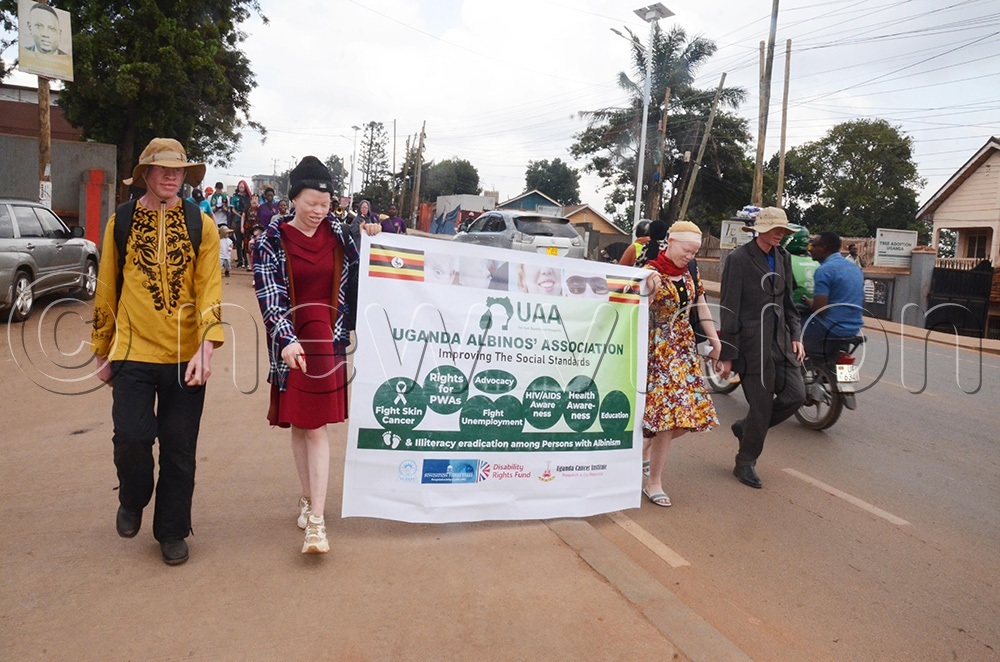
Members of Uganda Albinos Association (UAA) matching to hand over their petition to the to the executive director of the Uganda Cancer Institute (UCI), Dr Jackson Orem on Wednesday June 10, 2026. (Photo by Isaac Nuwagaba)
Jude Sebyanzi, the UAA executive director, said there has been minimal progress in implementing the National Action Plan on Albinism 2020-2025, a situation he said has been worsened by limited cancer screening services and the high cost of radiotherapy treatment.
“There are limited resources allocated to skin cancer prevention and treatment, which has left people living with albinism so marginalised at the verge of death, " Sebyanzi said after handing over the petition.
According to Sebyanzi, the petition emphasises Uganda's ratification of the United Nations Convention on the Rights of Persons with Disabilities (UN CRPD), particularly Article 25, which guarantees inclusive health services and access to adequate healthcare.
“Although sunscreen lotions were approved by the World Health Organisation (WHO) in 2025 for inclusion on the global essential medicines list, they remain difficult to access in health facilities, including UCI regional centres,” Sebyanzi highlighted in a four-page petition.
Allan Musoke, who hails from Magilita village in Kangulumira subcounty, Kayunga district, appealed to the government to increase funding to address the shortage of specialised healthcare professionals and improve access to sunscreen lotions and other essential medicines.
“We call upon the government to reduce taxes on the skin screens which we use on a daily basis. I come from a family of 4 children who were albinos when our parents were dark-skinned, and we are treated as luxuries when we demand for these ‘essential’ drugs in society.” Musoke emphasised.
“It is only the Missionaries of the Poor Organisation in Busega that helped me since I was still living in an orphanage. The government should consider us for free cancer screening, subsidised treatment and tax-free sunscreens,” he insisted.
Research conducted by Albinism Umbrella in 2022 indicates that up to 80% of persons with albinism die from skin cancer, highlighting the urgent need for improved prevention and treatment.
Diana Fridah, a community leader from Kayunga District, said the cost of sunscreen remains prohibitive, with prices ranging from sh150,000 to more than sh300,000, making it unaffordable for many families.
“UCI only prioritises breast cancer, cervical cancer, prostate cancer, cancer of the oesophagus and Kaposi sarcoma without putting in mind that melanoma of the skin affects our lives so much,” she noted.
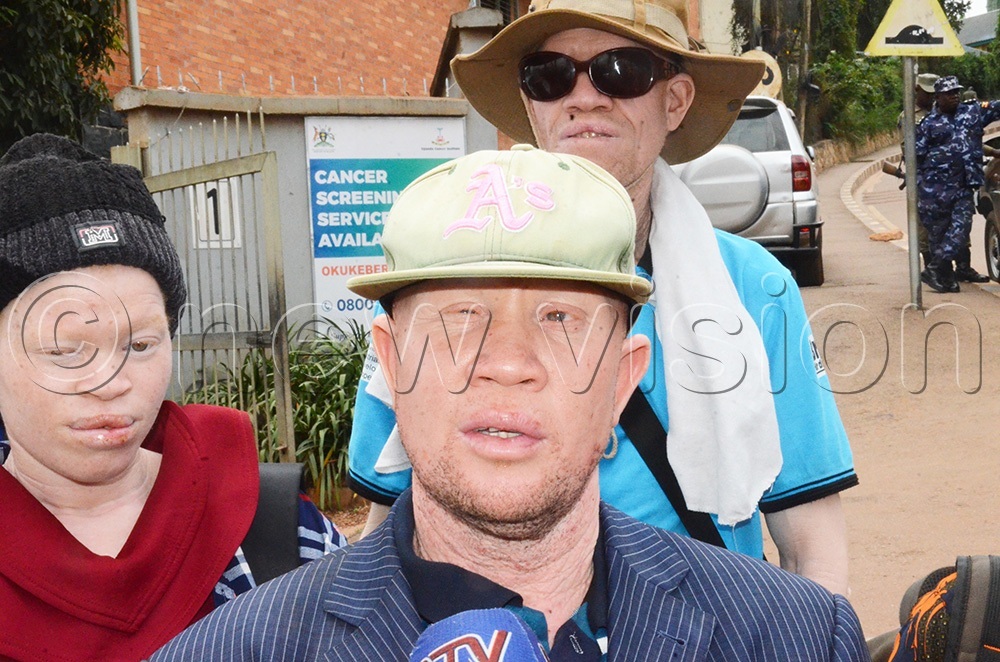
Jude Sebyanzi, the Uganda Albinos Association (UAA) Executive Director addressing the media about the issues affecting albinos before handing over the petition to the executive director of the Uganda Cancer Institute (UCI), Dr Jackson Orem on Wednesday June 10, 2026. (Photo by Isaac Nuwagaba)
“The census report highlighted persons with albinism to comprise 37,579 being male, while 41,297 being females which is a big number to consider due to the risk of losing life,” Fridah added.
Uganda Cancer Institute responds
Dr Orem said decisions on resource allocation fall under the mandate of Parliament, which appropriates funding according to national priorities.
“World over, the medical principle guides us to focus on the biggest number of patients regarding treatments before allocation of the meagre budget is passed,” he said.
“We are aware of the albinos, but we have been giving them free cancer screening, only that many do not reach us here for guidance,” Orem added.
He said the institute handles 35,968 patients annually, but noted that regional centres still lack some of the medical equipment and capacity needed to manage complicated cases.