
New faecal sludge plant to cut sanitation costs in Wakiso
Engineer Peter Nyakana, Manager of the Water and Sanitation Development Facility Central, representing the Commissioner for Urban Water Supply and Sewerage Services, said the facility has a treatment capacity of 60 cubic metres of faecal sludge per day and is expected to serve between 60,000 and 80,000 people in Busukuma, Kiwenda and surrounding communities.
Officials emptying a cesspool emptier truck at the Busukuma Faecal Sludge treatment facility. This was during the facility commissioning in Busukuma division, Nansana municipality, Wakiso district on August 27, 2026. (Credit: Lawrence Mulondo)
WAKISO - For years, emptying a lined pit latrine in Busukuma, Gayaza, Kasangati, Kiira and surrounding areas has been a luxury many families could not afford.
Private cesspool emptiers charged between sh400,000 and sh500,000 per trip, forcing households unable to raise the money to resort to dangerous methods, including scooping faecal sludge by hand and illegally dumping it into the environment, especially during the rainy season.
The Ministry of Water and Environment says the high cost also pushed some households away from waterborne toilets and back to traditional pit latrines, which are often covered when full and replaced with new ones. The practice wastes land and increases the risk of faecal contamination and disease.
To address the challenge, the Ministry of Water and Environment, in partnership with the Korea Environmental Industry and Technology Institute (KEITI), has commissioned a faecal sludge treatment facility in Busukuma Division, Nansana Municipality, Wakiso District.
The facility, funded through a sh25b grant from the Government of Korea, is expected to improve sanitation, reduce illegal dumping and protect groundwater and wetlands from contamination.
Speaking at the commissioning ceremony on Thursday, Engineer Peter Nyakana, Manager of the Water and Sanitation Development Facility Central, representing the Commissioner for Urban Water Supply and Sewerage Services, said the facility has a treatment capacity of 60 cubic metres of faecal sludge per day and is expected to serve between 60,000 and 80,000 people in Busukuma, Kiwenda and surrounding communities.
He said the project followed a 2019 Memorandum of Understanding between the Ministry and KEITI to prepare an Environmental Management Master Plan for Wakiso District. Completed in 2020, the plan identified improved faecal sludge management as a priority.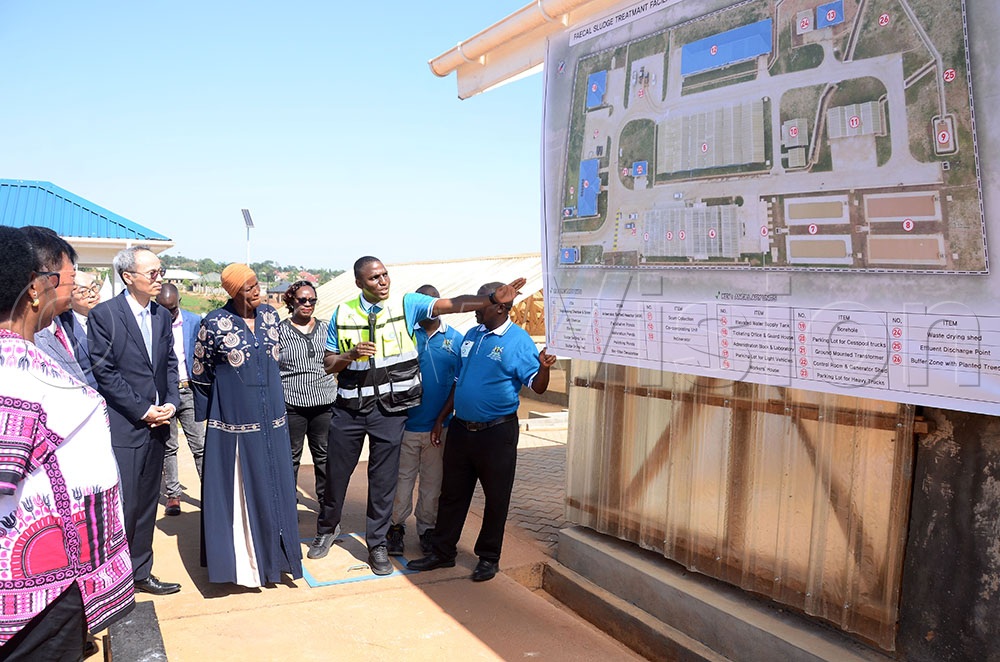
H.E Lee Sang-ho (in black suit front) the Korean Ambassador to Uganda, Aisha Sekindi (in dress front) the Minister of State for Water and Environment and other officials listening to Eng. Douglas Davis Kiggundu explain about the Busukuma Faecal Sludge treatment facility. This was during the facility commissioning in Busukuma division, Nansana municipality, Wakiso district on August 27, 2026. (Credit: Lawrence Mulondo)
In November 2022, the Ministry signed an implementation agreement with the Korea Environment Corporation (K-eco), with physical construction beginning in July 2024. The main works were substantially completed by December 2025, followed by testing, commissioning and trial operations in 2026.
The treatment system consists of an anaerobic baffled reactor, sludge-drying beds and maturation ponds, supported by administration, laboratory and public sanitation facilities.|
Nyakana said the plant will reduce unsafe disposal of faecal sludge, protect groundwater and wetlands, safeguard the Lake Victoria basin and minimise public-health risks.
Mark Tugume, Head of Sanitation Services at the Ministry of Water and Environment, said residents had previously relied on treatment plants such as Lubigi, which were far from many communities and therefore costly to access.
“We want to cut down on costs and make the service affordable for people in the community,” Tugume said.
He said cesspool trucks would be used to empty lined latrines, while the Ministry would continue encouraging households with traditional pits to improve their sanitation facilities.
Tugume said the Ministry expected emptying fees for residents in the targeted areas to remain below sh200,000, significantly reducing the burden on households.
He also warned against illegal dumping and said the Ministry would conduct awareness campaigns targeting residents, local leaders and private emptiers.
“We want to desist from these acts and utilise the facility. We encourage LC1 leaders to be vigilant and follow up on anyone emptying a facility to find out where they are taking the faecal waste,” he said.
Minister of State for Water and Environment Aisha Ssekindi said the facility was a practical expression of Government's commitment to improving sanitation and environmental protection.
She said safely managed sanitation in urban areas stood at approximately 41%, while the figure remained below 10% in rural areas.
“We must therefore invest not only in toilets, but in the complete sanitation service chain: safe containment, emptying, transport, treatment, disposal and, where quality standards permit, beneficial reuse,” Ssekindi said.
Engineer Enoch Mwanje, Branch Manager of the Central Umbrella of Water and Sanitation, said the organisation was ready to operate the facility and had already been running it on a trial basis.
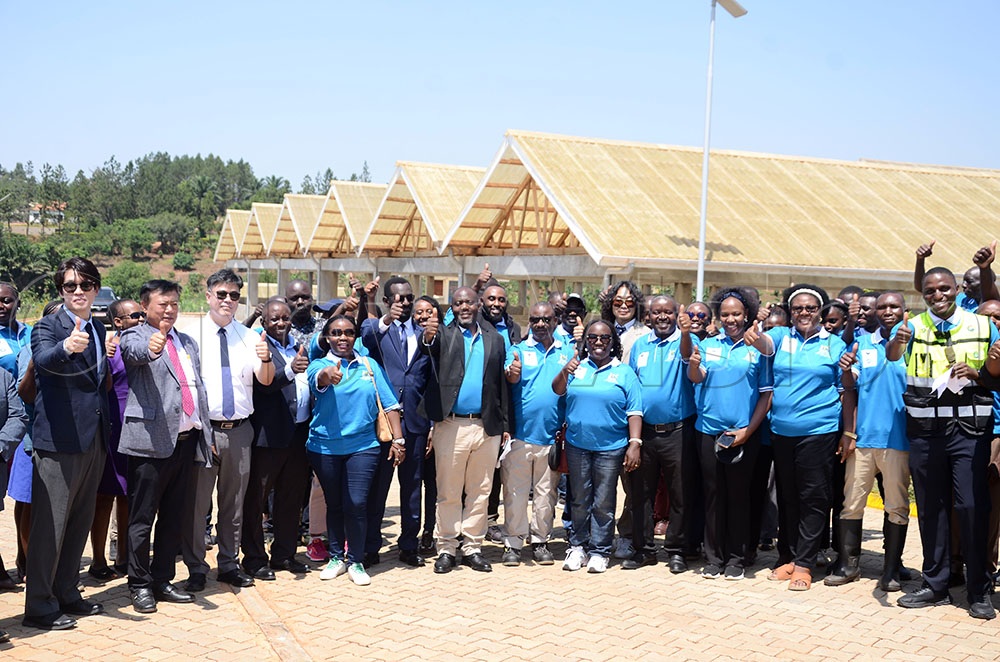
Officials from the Ministry of Water and Environment and those from the Korean embassy pose for a group picture during the commissioning of the Busukuma Faecal Sludge treatment facility in Busukuma division, Nansana municipality, Wakiso district on August 27, 2026. (Credit: Lawrence Mulondo)
He said 16 staff had been deployed and that community sensitisation had begun. In the first two months, the facility had received about 26 truckloads of faecal sludge and generated approximately sh600,000 in revenue.
“What we would do is dig a hole at the back and use a bucket to empty the pit, dropping the sludge in a nearby pit so we could continue using the latrine,” he said.
He said the new facility represented a major shift in sanitation practices and thanked the Korean Government for its support.
The Korean Ambassador to Uganda, Lee Sang-ho, said the project was more than a treatment plant, describing it as a step towards a cleaner, healthier and more sustainable environment.
“Korea is pleased to share its experience and technology in environmental management with Uganda. We believe that cooperation in this area can make a real difference in people's lives,” he said.
The project also provided operational equipment, including two one-tonne payloader trucks, a four-wheel-drive double-cabin pickup, laboratory and office equipment and furniture.
The Government, through the National Agricultural Research Organisation (NARO) and the National Crops Resources Research Institute (NaCRRI), provided land for the facility.
Community interventions included construction of a patient waiting shed at Namulonge Health Centre III, rehabilitation of the old health centre building, construction of four-stance and six-stance toilets and opening of an access road to Ubuntu Secondary School.
Village Health Teams welcomed the facility, saying its proximity would reduce transportation costs and encourage households to construct lined and waterborne toilets.
Wilberforce Were, a VHT in Busukuma Town Council, said high charges had previously left some residents with little choice but to dispose of sludge illegally.
Samuel Sekatawa, another VHT, said most residents still relied on traditional pit latrines.
“We are going to encourage lined pit latrines because they can minimise pollution of the environment,” he said.
He added that the new facility could help reduce sanitation-related diseases while creating employment opportunities and potentially enabling the recovery of useful products such as manure and energy from faecal sludge.