
Museveni tasks content creators with champion historical missions for Africa's transformation
Museveni said that Africa’s transformation depends on fulfilling five historical missions: liberation, democracy, economic prosperity, strategic security and African unity.
Museveni tasks content creators with champion historical missions for Africa's transformation
________________
President Yoweri Museveni has challenged African content creators to use their platforms to promote the continent’s history, identity, achievements and development aspirations.
Meeting a group of content creators from Ghana, Zambia, Tanzania, Kenya and Sweden who he hosted on Thursday, November 12, Museveni said that Africa’s transformation depends on fulfilling five historical missions: liberation, democracy, economic prosperity, strategic security and African unity.
The President made the call on Thursday, November 12, 2026, while meeting a delegation of international content creators from Ghana, Zambia, Tanzania, Kenya and Sweden.
The delegation hosted at State House Entebbe the group comprised: Berthold Kobina Ackon (Ghana), Masiliso Mutumba ( Zambia) Salim Athumani Kikeke (Tanzania) , Daniel Wambua Ndambuki (Kenya) and Christine Lynghamar Kia from Sweden.
A release from the Presidential Press Unit states that President Museveni said he invited the content creators after watching some of their television discussions on the similarities among African languages. He said the meeting was intended to share historical knowledge and insights that could enrich their understanding of Africa and inform how they tell the continent’s story.
“I decided to invite you here so that I share the content of the Jjajas, the old people. The content I want to give you is something we have been talking about for a long time,” he said. Using the analogy of a patient and a doctor, the President explained that societies are like patients, while leaders are like doctors who must correctly diagnose societal challenges before prescribing appropriate solutions.
PPU reports that Museveni noted that Africa had strong foundations for wealth creation, including: agriculture, craftsmanship, traditional medicine and other forms of indigenous knowledge. He also highlighted the continent’s rich cultural heritage and linguistic diversity as important resources for development.
He added that however, Africa's historical challenges were compounded by tribal chauvinism, poor governance and conflicts among neighbouring communities and kingdoms, which weakened the continent and left it vulnerable to external domination.
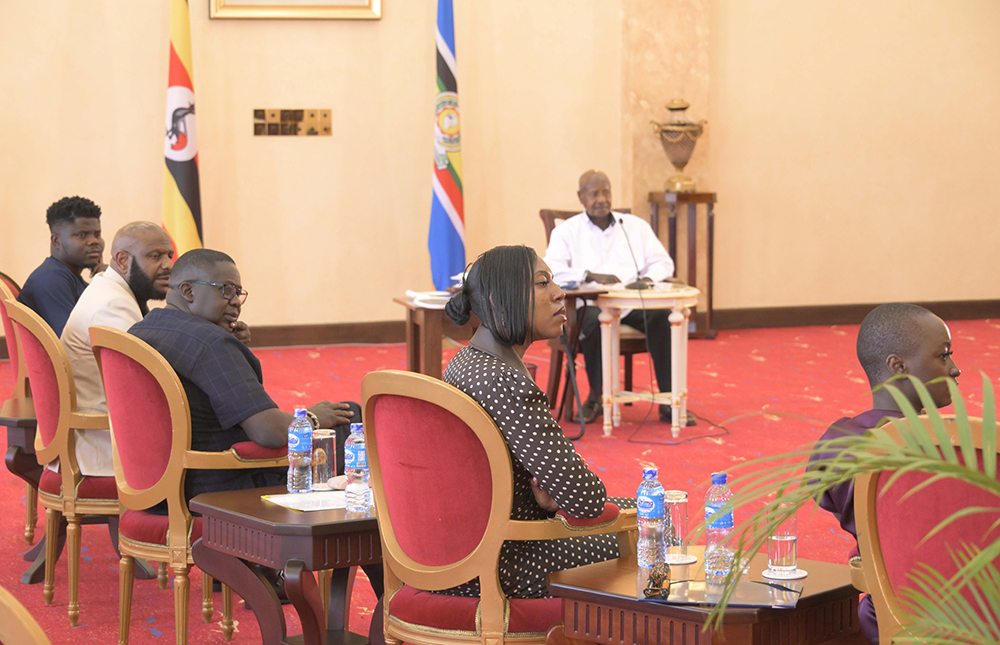
President Museveni criticised pre-colonial African leaders for failing to unite their people against external threats, arguing that internal divisions and rivalries undermined the continent's ability to resist colonial expansion. Drawing lessons from this history, he said Africa's current generation of leaders and citizens must understand and work towards fulfilling the five historical missions.
The first mission, he explained, was liberation from colonial rule. He recalled the struggles of African freedom fighters and the role of international developments, including support from the Soviet Union and the weakening of European colonial powers during the two World Wars, in advancing the liberation struggle.
He cited the formation of liberation movements, including the African National Congress (ANC) in 1912, as an important milestone in the struggle for independence. The process eventually culminated in independence across much of the continent, with South Africa attaining majority rule in 1994.
The second historical mission is democracy, which President Museveni said requires African countries to be governed through systems that reflect the political will and interests of their people. The third mission is economic prosperity.
He argued that sustainable prosperity cannot be built on dependence on foreign as sistance but must be driven by the production of goods and services for viable markets.The President said Africa has the natural resources, human potential and productive capacity to create wealth but must overcome the limitations imposed by fragmented and small domestic markets.
“Your prosperity depends more on the whole of Uganda than on your tribe,” he said, emphasising the importance of patriotism and rejecting tribal chauvinism.
He explained that producers require sustainable markets for their goods and services, adding that when production exceeds domestic demand, businesses must be able to access markets beyond their national borders.
In this regard, he underscored the importance of regional and continental economic integration through frameworks such as the East African Community (EAC) and the African Continental Free Trade Area (AfCFTA). He said larger markets would stimulate production, attract investment, create employment opportunities and support industrial growth.
He argued that political integration would strengthen Africa's collective capacity to defend its interests across land, air, water and space, capabilities that individual African countries may struggle to develop independently.
The fifth mission is African unity, which he described as fundamental to achieving both economic prosperity and strategic security. President Museveni challenged contemporary African leaders to learn from the mistakes of their predecessors and pursue greater cooperation and integration instead of allowing tribal, national and other divisions to undermine the continent's shared interests.
“If the past kings made mistakes in uniting us, what are the African leaders doing?” Museveni added. He further urged Africans to recognise their historical, cultural and linguistic connections, noting that the continent's people share significant commonalities that should be harnessed to advance their collective interests.
The content creators welcomed the engagement, saying it had provided them with a deeper understanding of Africa's history, development journey and future aspirations.
They expressed particular interest in Uganda's growing industrial capacity, saying they were impressed to learn about the range of products manufactured locally, including buses produced by Kiira Motors Corporation.
The group observed that many people in Europe and other parts of the world continue to hold outdated perceptions about Uganda and Africa, often overlooking the continent's industrial progress, investment opportunities and development potential.
They also raised concern that some young Africans, both on the continent and in the diaspora, tend to portray African countries negatively, sometimes without adequately understanding or appreciating their history, achievements and ongoing transformation.
PPU reports that the content creators expressed interest in establishing platforms through which young Africans can share their stories, cultures and experiences, promote mutual understanding and help reshape negative perceptions about the continent.
They pledged to share President Museveni's message with their respective audiences in Africa and beyond, highlighting the importance of African unity, economic transformation and the need for Africans to take ownership of their narrative.