
MPs demand for missing Kampala-Entebbe Expressway toll records
According to the audit findings, 586 vehicles could not be accounted for in November 2024, translating into an estimated revenue shortfall of sh407 million.
Physical Infrastructure Committee chair Mwine Mpaka Rwamirama (Mbarara South Division, NRM) and his deputy Eng William Tiyo. (Photos by Maria Wamala)
________________
The Parliament Committee on Physical Infrastructure on Thursday, August 6, grilled the ministry of works officials after the Auditor General's Report for the Financial Year 2024/25 revealed that 10,446 vehicles could not be reconciled in the toll collection system, raising fresh concerns about the integrity of Uganda's first toll road.
The committee, chaired by Mwine Mpaka, summoned Works and Transport Minister Fred Byamukama, senior ministry officials, representatives of expressway operator EGIS and contractor Pinnacle to explain the inconsistencies.
The members of Parliament tasked the Ministry of Works and Transport after an internal audit uncovered discrepancies in the Kampala-Entebbe Expressway toll system, with more than 10,000 vehicles failing to match electronic toll records and suspected revenue losses running into billions of shillings.
To lawmakers, the missing records were more than figures on paper. They represented cracks in a system entrusted with safeguarding public revenue.
The findings cast doubt on the reliability, security and accountability of the electronic toll collection system at a time when Government is relying on toll collections to recover part of the investment in the expressway.
According to the audit findings, 586 vehicles could not be accounted for in November 2024, translating into an estimated revenue shortfall of sh407 million. The number rose to 2,860 vehicles in December 2025 before surging to more than 7,000 vehicles in May 2026, representing suspected revenue losses of over sh1 billion.
Ministry of Works and Transport (MOWT) Minister Fred Byamukama and acting Permanent Secretary Barbra Namugambe.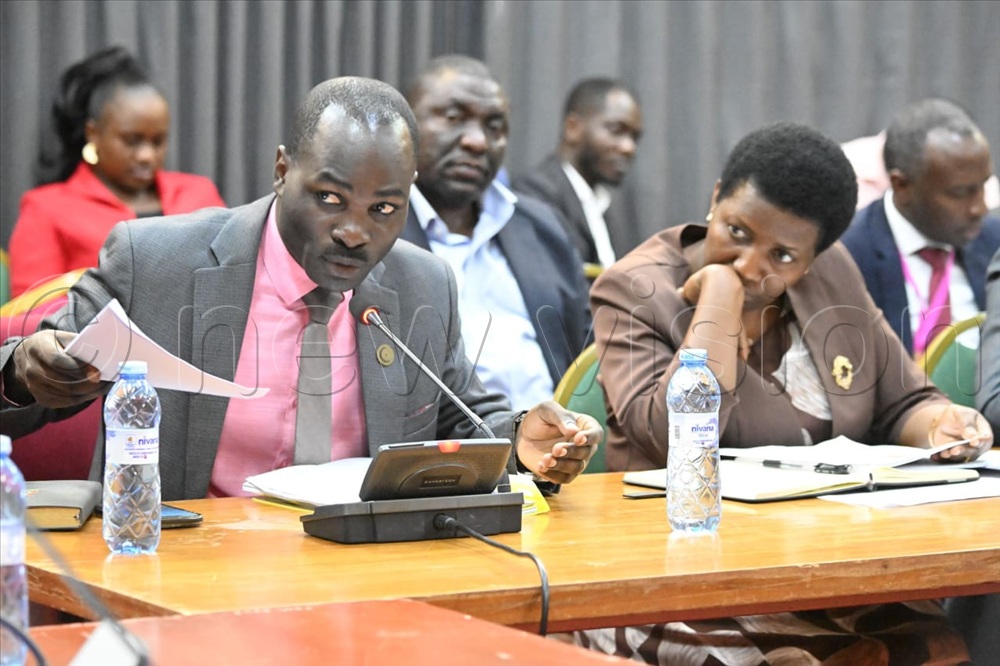
Leading his team before the committee, Byamukama said that Government secured a $350 million (sh1.2 trillion) loan in 2021 to finance construction of the Kampala-Entebbe Expressway. Members of Parliament then turned their attention to whether taxpayers were receiving value for money.
The ministry disclosed that since tolling commenced, Government has collected sh129 billion in toll revenue, while approximately sh122 billion has already been paid to the contractor managing the tolling system under a performance-based maintenance contract.
James Waluswaka (Bunyole West County, NRM) questioned whether the arrangement served the public interest. "When almost as much money goes to the contractor as what Government collects from motorists, Parliament must ask whether Ugandans are obtaining value for money from this investment," said the legislator.
Officials explained that payments to the contractor depend on performance against agreed Key Performance Indicators (KPIs), with deductions imposed where contractual obligations are not met.
The ministry cited penalties arising from non-functional street lighting, damaged guardrails, defective road signs, poor road cleanliness and delays in implementing the overload control system.
Whereas Works officials revealed that about sh55 million has consistently been deducted because the overload control system has not yet been completed.
Ministry engineer Isaac Wani attributed the delay to unsuitable terrain near the existing toll plazas.
He explained that the funds had since been rolled into a subsequent contract covering fixed weighbridges at the toll plazas and weigh-in-motion equipment along the Northern Bypass.
Committee members argued that axle-load control is central to protecting the expressway from premature deterioration and questioned why such a critical safeguard had been postponed while other project components were completed.
Lawmakers widened their scrutiny to vehicles exempted from paying toll fees, seeking clarification on whether the exemptions complied with the law and were supported by the necessary statutory instruments.
They warned that exemptions granted without a clear legal framework could weaken transparency and create loopholes for revenue leakages. Another issue attracting attention was the Automated Payment Collection Unit account, which temporarily receives electronic toll payments before the money is transferred to the Consolidated Fund.
Ministry Undersecretary Barbara Namugambe requested more time to reconcile the financial records. "I need more time to compile and submit all the factual reports required by this committee," Namugambe told MPs.
Questions were equally raised over expenditure on overseas training. William Tiyo (Ayivu Division East, Independent), the committee's deputy chairperson, questioned why the ministry spent more than sh200 million on training officials in India when the supervising contractor is a French company.
He challenged the ministry to demonstrate that the training had strengthened management of the toll road. The committee directed the ministry to submit a comprehensive report by Wednesday, August 12, 2026, detailing the beneficiaries of the training, course content, expenditure incurred and measurable outcomes, alongside explanations for the toll collection discrepancies and other issues raised during the hearing.