
Makerere's Prof Kasaija calls for stronger African role in global peace
Africa must strengthen its diplomatic interventions by pairing its peace initiatives with detailed and practical proposals if the continent is to have greater influence in resolving conflicts beyond its borders, a Makerere University professor has said.
Prof. Phillip Kasaija Apuuli delivers his remarks during his inaugural professorial lecture at Makerere University. (Courtesy)
_________________
A renowned Makerere University don has advised that Africa needs detailed mediation proposals, not just opinions, to be taken seriously in global conflicts.
Phillip Kasaija Apuli, a professor of political science and mediation at Makerere University, made a call during his inaugural Professorial lecture that took place at Makerere University in the main building on Friday (August 21), where he reflected on the 2023 African Peace Mission [APM] to Russia and Ukraine.
The lecture examined what Africa’s intervention in the Russia-Ukraine conflict revealed about the continent’s diplomatic influence, agency and role in international peacebuilding.
The mission, he argued, failed to gain sufficient traction party because its 10-point peace proposal lacked the detail necessary to guide the negotiations between Russia and Ukraine.
“The peace plan was underdeveloped. The 10 points were just points; there were no details,” Kasaija said.
The mission had neither sufficient incentives nor the ability to exert pressure on the parties, making it difficult for the proposal to influence the negotiations. Kasaija further attributed the limited impact of the mission to the timing of its intervention. He referred to the theory of ripeness in mediation, which holds that negotiations are more likely to succeed when parties believe they cannot achieve their objectives through continued fighting.
At the time of the African mission in 2023, Russia and Ukraine still believed they could improve their positions on the battlefield. The mission should not be dismissed because it demonstrated African agency and showed that the continent could take an interest in resolving conflicts beyond its borders.
Kasaija added that the Russia-Ukraine war affected Africa through disruptions in food and fertiliser supplies, higher energy prices, inflation and wider economic pressures.
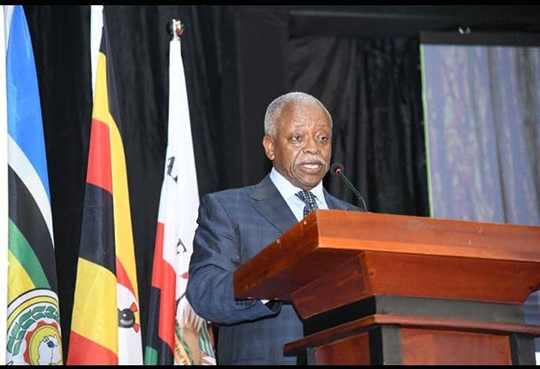
Former Prime Minister Patrick Amama Mbabazi delivers his remarks during the function at Makerere University. (Courtesy)
Contributing to the debate, the former prime minister Hon. John Patrick Amama Mbabazi said African leaders were justified in engaging both Kyiv and Moscow because the consequences of the war extended beyond Europe. The decision by African leaders to travel to the two countries was significant because it enabled them to put African perspectives directly before the parties to the conflict.
He described the mission as an important demonstration that Africa has a legitimate voice in international peace and security. “Africa therefore had every justification to say we to have a stake in the restoration of peace,” Amama Mbabazi said.
He also praised Kasaija's contribution to international affairs, recalling how the professor had helped him prepare for engagements on foreign and security policy. “I benefited greatly from his knowledge of international affairs and particularly from his ability to place African perspectives within the wider global debate,” Mbabazi added.
Minister of State for Internal Affairs Juma Witonze Kisekka said Kasaija's work contributed to the understanding of mediation and how external actors can intervene in conflicts. Witonze said the APM provided an important example of African countries stepping beyond the traditional approach of seeking African solutions to African problems. The mission demonstrated that African countries could also participate in resolving conflicts outside the continent.
Even though the mission did not resolve the Russia-Ukraine conflict, it generated lessons that could improve future African mediation efforts.
“Even if African countries fail in Ukraine and Russia, there is a learning experience that we get from this kind of mediation,” Witonze said. He added that the experience could be applied to conflicts on the African continent, including Sudan. Witonze said the mission also contributed to the concept of African agency by showing that African countries could take independent initiatives and participate in global peacebuilding.
Prof. Sara Sally, Makerere University's Deputy Vice Chancellor for Academic Affairs, congratulated Kasaija on the milestone and described his achievement as a reflection of qualities he had demonstrated since his student days.
She recalled their days as Political Science students at Makerere, describing Kasaija as hardworking, energetic and committed to intellectual debate.
Kasaija's academic journey, she added, was not accidental, noting that he had consistently demonstrated a strong interest in ideas, research, and discussion.
The vice chancellor of Makerere, Prof. Barnabas Nawangwe, noted the significance of this new generation of Makerere professors fulfilling the requirement of delivering an Inaugural Professorial Lecture.
“Apuuli has therefore not merely attained the title; he has stepped forward to publicly account for the scholarship behind it,” Prof. Nawangwe said.
And what a subject on which to do so: Africa's diplomacy, peace-making and place in an increasingly complicated world.
The function was graced by different people from different places, like the former prime minister Hon. Patrick Amama Mbabazi, the minister of internal affairs Hon. Juma Witonze Kisekka, the vice chancellor of Makerere Prof. Barnabas Nawangwe and many others.
Highlights at the event included the Vice Chancellor, Prof. Barnabas Nawangwe, presenting Prof. Phillip Kasaija Apuuli with a plaque and certificate as a sign of appreciation for his hard work.
Background
Professor Philip Kasaija is an academic and scholar whose work focuses on political science, international affairs, conflict resolution and mediation. His research and professional engagements have involved questions of peacebuilding, mediation and Africa's role in international affairs.
His inaugural lecture used the African Peace Mission to Russia and Ukraine as a case study to examine African agency, mediation and the continent's place in global peace and security.
The lecture ultimately called for Africa to move beyond simply seeking a seat at international discussions and to develop the preparation, unity and diplomatic capacity needed to make its interventions more effective.
While the 2023 African Peace Mission did not achieve its immediate objective of resolving the Russia-Ukraine conflict, Kasaija said its attempt remained significant because it demonstrated that Africa can contribute to global solutions rather than being viewed only as a continent whose problems require solutions.