
KCCA has rescued 365 street children in three months — Buzeki
KCCA also confirmed that 193 of the rescued children have since been transferred to Napak district in Karamoja sub-region, with 183 enrolled at Ladoi Primary School.
Speaking at the Uganda Media Centre on Wednesday, KCCA executive director Sharifah Buzeki said the children included 202 girls and 163 boys. (Credit: Juliet Kasirye)
KAMPALA - Kampala Capital City Authority (KCCA) says it has rescued at least 365 street children over the past three months as part of a wider enforcement and social intervention campaign aimed at restoring order in Kampala.
Speaking at the Uganda Media Centre on Wednesday, KCCA executive director Sharifah Buzeki said the children included 202 girls and 163 boys.
She said they were placed under structured care programmes focused on rehabilitation, education, and reintegration into their communities.
The children were taken to Masulita Children’s Home, where they are undergoing counselling, receiving medical attention, and being prepared for either family reunification or resettlement.
KCCA also confirmed that 193 of the rescued children have since been transferred to Napak district in Karamoja sub-region, with 183 enrolled at Ladoi Primary School.
The operation is part of a broader effort to address the root causes of streetism while improving public order in the city.
“We are not only removing children from unsafe street environments but also ensuring they are supported through systems that offer long-term solutions,” said Buzeki, adding that they have also taken legal action against negligent guardians, with 12 parents already presented before court for failing to care for their children.
KCCA has cautioned the public against giving money or handouts to children on the streets, warning that such practices perpetuate exploitation and discourage sustainable rehabilitation efforts.
The Ministry of Gender, Labour and Social Development has consistently framed street children as a child protection issue requiring structured intervention rather than informal support.
Government programmes, according to ministry policy, focus on rehabilitating children, tracing their families and reintegrating them into communities and schools, with additional support such as counselling and skills training provided through designated centres.
Restoring city order
The street children intervention is running alongside intensified enforcement of trade order regulations, which have seen illegal street vending cleared from major business corridors and public spaces reclaimed for safer urban use.
KCCA is also pushing forward with major reforms in public transport aimed at reducing congestion and modernising mobility in Kampala.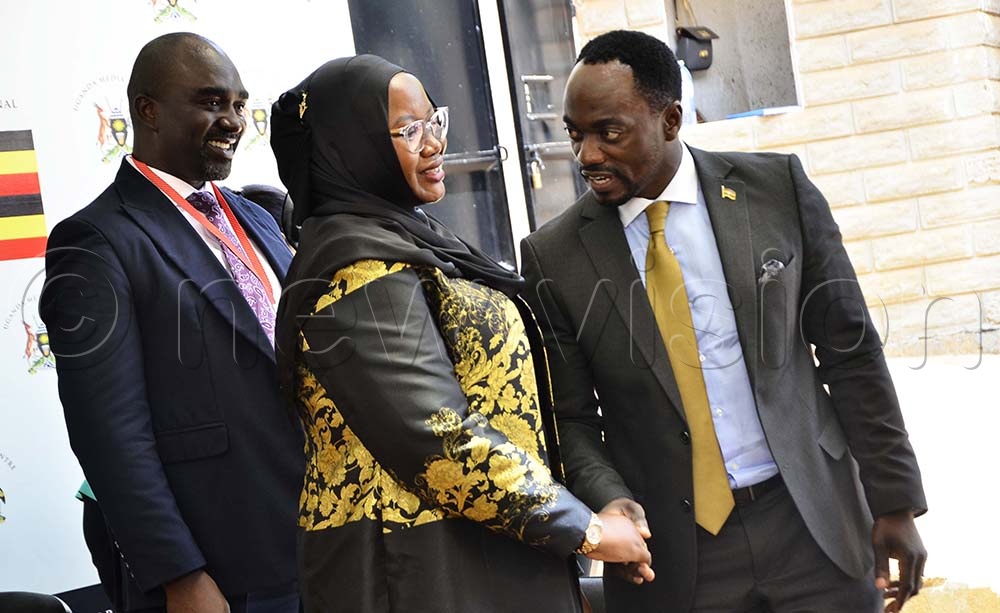
Hajjat Sharifah Buzeki, KCCA Executive Director interacts with Abu Mwesigwa, President of the Republic of Uganda photographer during a press conference at Uganda Media Centre, in Kampala on 6th May 2026. (Credit: Juliet Kasirye)
The government has authorised Kiira Motors Corporation to deploy electric buses in the city, marking a shift toward cleaner and more efficient mass transit systems.
Under the pilot phase, eight electric buses are expected to begin operations by the end of May, running along two circular routes connecting key areas including Constitutional Square, Lugogo, Nakawa, Ntinda, Bukoto, Kwamwokya and Wandegeya.
It is hoped the buses will help ease pressure on existing transport systems, cut emissions, and improve connectivity across the city.
Informal transport reforms
KCCA is also formalising informal transport sectors, including boda boda operations, through registration, designated stages and stricter enforcement of operating guidelines.
Taxi operators have similarly been directed to operate strictly from gazetted parks and terminals in a move aimed at eliminating roadside stages and improving traffic flow.
“These reforms are necessary if we are to build a safer, cleaner and more efficient city,” Buzeki said, urging transport operators to embrace the transition to organised mass transit.
At the same time, KCCA is undertaking large-scale infrastructure projects to support the city’s growth and improve living conditions.
Among the flagship developments is the construction of a 9.1-kilometre road linking Mpererwe to Kiteezi and Kiti, funded by the African Development Bank.
The project is expected to significantly enhance mobility, open up surrounding communities and stimulate economic activity.
The works are being executed by China Communication Construction Company, with supervision from MBW Consulting Engineers, and are scheduled for completion within three years.
'Deliberate transformation'
Enforcement of environmental standards has also been intensified, particularly on noise pollution, with businesses warned that exceeding permitted decibel levels could lead to licence revocation.
Buzeki said Kampala’s transformation is being driven by a coordinated strategy that combines law enforcement, social services, infrastructure development, and economic reforms.
She urged residents to support ongoing initiatives by complying with regulations and engaging with structured programmes designed to improve livelihoods.
“Kampala is undergoing a deliberate transformation that requires the participation of all stakeholders."