
Unicef launches five-year strategic framework for Uganda
“Children face risks in terms of nutrition, communicable diseases and outbreaks, climate change and poverty. Some are pulled out of school and pushed into labour, while girl children remain at risk of teenage pregnancies and early marriage. Then there is the justice system, where children who suffer abuse need protection,” Nandy said.
Robin Nandy UNICEF Country Representative and Yves Willemot Chief Communication UNICEF addressing journalists during a press conference at the UNICEF offices on May 26, 2026 in Kampala. (Credit: Nancy Nanyonga)
KAMPALA - The United Nations Children’s Fund (UNICEF) has unveiled a new five-year strategic framework for Uganda aimed at tackling persistent challenges affecting children, including teenage pregnancies, malnutrition, violence, poor sanitation and limited access to quality education.
The UNICEF-Government of Uganda Country Programme 2026–2030 was launched during a press conference held at the UNICEF-WFP Complex in Mbuya, Kampala on Tuesday (May 26, 2026).
Speaking at the launch, the UNICEF country representative, Dr Robin Nandy, accompanied by the chief of communication, advocacy and partnerships, Yves Willemot, and UNICEF communication specialist, Catherine Ntabadde, said children in Uganda face multiple and interconnected risks that require a coordinated national response involving government, communities and families.
“Children face risks in terms of nutrition, communicable diseases and outbreaks, climate change and poverty. Some are pulled out of school and pushed into labour, while girl children remain at risk of teenage pregnancies and early marriage. Then there is the justice system, where children who suffer abuse need protection,” Nandy said.
He said UNICEF would continue working across several government ministries, including health, education, justice and gender, to ensure children’s rights are protected.
“This is a multi-pronged approach because the risks children face are complex. There are risks at household level, community level and within government systems themselves. We work with parents, communities and leaders to change behaviours and strengthen systems that safeguard children,” Nandy said.
One of the centrepieces of the new programme will be addressing teenage pregnancy, which UNICEF says remains widespread across Uganda.
“We are very concerned about teenage pregnancies because girls drop out of school when they become pregnant, and many do not return. These girls are not ready physically or emotionally for motherhood, and many risk repeat pregnancies during their teenage years,” Nandy said.
He warned that teenage pregnancy has long-term consequences not only for individual girls but also for Uganda’s broader economic development.
“It impacts their lives, impacts communities and in the future affects economic growth,” he added.
UNICEF also plans to intensify efforts to reduce malnutrition among children, despite Uganda’s relatively strong agricultural production.
“There is no shortage of food in Uganda,” Nandy said. “But malnutrition levels remain high because of household feeding practices, lack of dietary diversity and poor nutrition awareness. Children are eating, but not eating the right kind of food.”
The organisation says changing behaviour at household and community level will be critical to reducing child malnutrition and improving overall child wellbeing.
UNICEF has also pledged to continue supporting the Sauti 116 Child Helpline established in partnership with the Ministry of Gender, Labour and Social Development, allowing children and community members to report abuse and seek support.
Nandy said the organisation was especially concerned about vulnerable children living on the streets, particularly those from the Karamoja sub-region.
He said UNICEF had worked with Kampala Capital City Authority (KCCA), local governments and social welfare agencies to reunite children living on Kampala streets with their families and return them to school.
“When I visit Karamoja, I meet girls who were once on the streets of Kampala but are now back in school,” he said. “You can see their confidence improve. They feel safe and secure and are eager to learn.”
He said solving the problem requires sustained engagement with families and communities.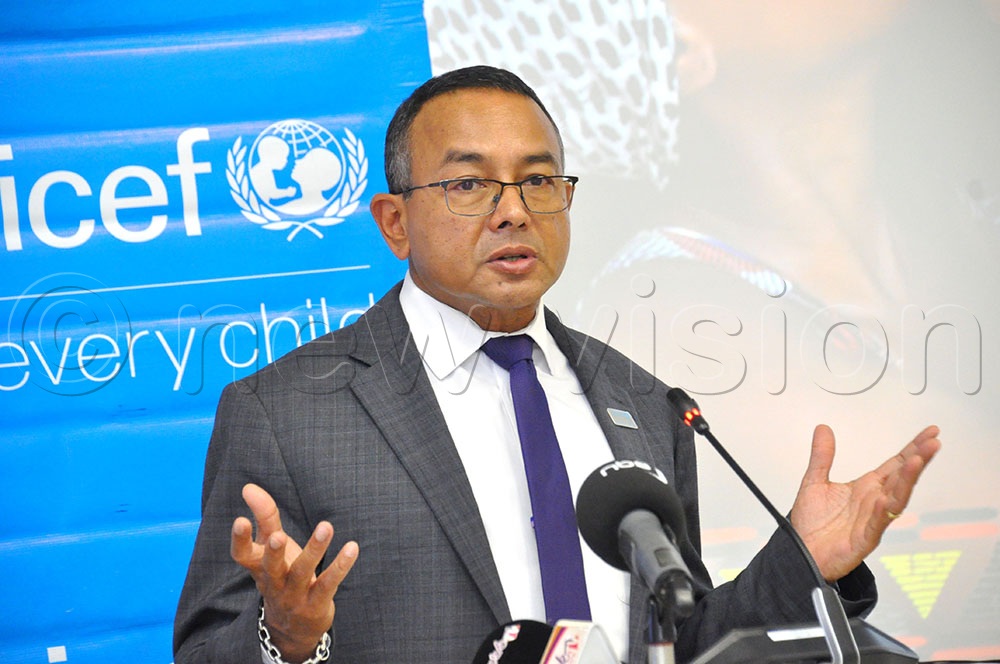
Speaking at the launch, the UNICEF country representative, Dr Robin Nandy, accompanied by the chief of communication, advocacy and partnerships, Yves Willemot, and UNICEF communication specialist, Catherine Ntabadde, said children in Uganda face multiple and interconnected risks that require a coordinated national response involving government, communities and families. (Credit: Nancy Nanyonga)
“Sometimes the families themselves send these girls to urban centres,” he said. “Our message is that girls belong in school because education empowers them to protect themselves and contribute to the economy.”
The launch of the programme comes against the backdrop of renewed Ebola concerns in East Africa.
UNICEF used the occasion to praise Africa’s growing leadership in responding to disease outbreaks, particularly the current Ebola situation affecting Uganda and the Democratic Republic of Congo (DRC).
Nandy said African governments and institutions were increasingly taking ownership of health emergencies instead of relying entirely on foreign assistance.
“This Ebola outbreak is an important example of Africa taking leadership,” he said. “Africa CDC, African leaders and African philanthropists have stepped forward. Uganda contributed five million dollars on the first day of the outbreak, while DRC committed 20 million dollars.”
“We cannot depend indefinitely on Western donors,” he added. “Africa is beginning to support its own development, and that shift is important.”
According to health authorities, Uganda has registered at least seven confirmed Ebola cases linked to cross-border transmission from eastern DRC, with at least one death reported and several active cases under treatment and isolation.
The outbreak in DRC was first confirmed in May 2026 in Ituri Province, where health officials recorded clusters of unexplained haemorrhagic illness and deaths. Since then, hundreds of suspected infections and more than 170 deaths have been reported in DRC.
Health experts say Ebola symptoms include fever, severe weakness, headaches, vomiting, diarrhoea, muscle pain, stomach pain and unexplained bleeding.
The virus spreads through direct contact with infected bodily fluids such as blood, vomit or sweat.
UNICEF says it is supporting Uganda’s Ebola response through risk communication, community engagement, water and sanitation programmes, infection prevention and support to village health teams.
“We are prioritising 37 high-risk districts, especially those bordering DRC, because of the movement of people across the border,” Nandy said.
Under the 2026–2030 framework, UNICEF will focus on policy reforms, strengthening national systems and increasing financing for child-centred programmes.
Willemot said the strategy builds on UNICEF’s long-standing partnership with Uganda dating back more than six decades.
“Since 1960, UNICEF has worked hand in hand with the Government of Uganda to ensure the well-being of children. Over the years, our work has evolved from direct service delivery to supporting policy reforms, systems strengthening and financing for children,” Willemot said.
He said the organisation was now shifting away from concentrating on selected districts to supporting nationwide systems capable of reaching all children.
“The 2026–2030 Country Programme is about supporting Uganda to create stronger national systems that benefit every child regardless of where they live,” Willemot said.
The programme will prioritise improving access to quality healthcare, early childhood development services, education, immunisation, safe water and sanitation.
UNICEF also plans to support Uganda’s education sector by helping improve school attendance, retention and completion rates while preparing young people for employment opportunities.
“Education remains central to ensuring children can transition into productive adulthood and contribute to national development,” Willemot said.
The organisation will also continue advocating for child protection reforms, including strengthening birth registration systems and promoting child-friendly justice mechanisms.
“We want to build stronger systems to protect children from violence, exploitation and abuse,” Willemot said.
He added that part of the programme will focus on improving social protection systems and reducing child poverty by supporting vulnerable households and advocating for better public financing for children.