
Japan boosts Uganda’s disaster response with 30 emergency vehicles
Japan’s Ambassador to Uganda, H.E. Sasayama Takuya, said the support reflects a broader commitment to strengthening Uganda’s emergency systems through both equipment and long-term cooperation.
Takuya Sasayama, the Ambassador of Japan to Uganda, flags off the ambulances with Jane Ruth Aceng, the Minister of Health, at the event in Kampala on Tuesday, May 5, 2026. (Photos by Bridget Ahurira)
________________
Uganda’s emergency response has received a major boost after Japan handed over 30 ambulances and fire trucks to help tackle fires, road crashes and medical emergencies.
The fleet, comprising 23 ambulances and seven fire trucks, was handed over on May 5 at the Ministry of Health, strengthening frontline response in districts that have long struggled with limited rescue capacity.
The vehicles will be deployed to health facilities and fire stations across several districts and cities, including Hoima, Masindi, Oyam, Bushenyi, Kabale and Lira City, among others, with AFCON hosting communities like Hoima considered first.
Funded under Japan’s Grant Assistance for Grassroots Human Security Projects (GGP), the donation worth over sh3.37 billion ($ 936,095) is expected to ease pressure on both the health system and emergency services, particularly in urban centres where demand is rising.
Japan’s Ambassador to Uganda, H.E. Sasayama Takuya, said the support reflects a broader commitment to strengthening Uganda’s emergency systems through both equipment and long-term cooperation.
“These vehicles are only one part of our cooperation. We have also focused on training and management systems so that Uganda can maximise their use and sustain these services for the long term. We are also supporting training and management systems so that these services are efficient and sustainable,” he said at the handover ceremony in Kampala.
He added that Japan has, over the years, expanded its support to include hospital management improvements and collaboration between emergency response teams in both countries.
“These projects are part of our continuous cooperation. We have seen strong partnerships grow between Japanese and Ugandan teams, and we believe this will translate into better services for the people,” he said.
Inspector General of Police Abasi Byakagaba said the addition of seven fire trucks will significantly strengthen the Uganda Police Force’s capacity to respond to fires and disasters, particularly in upcountry districts.
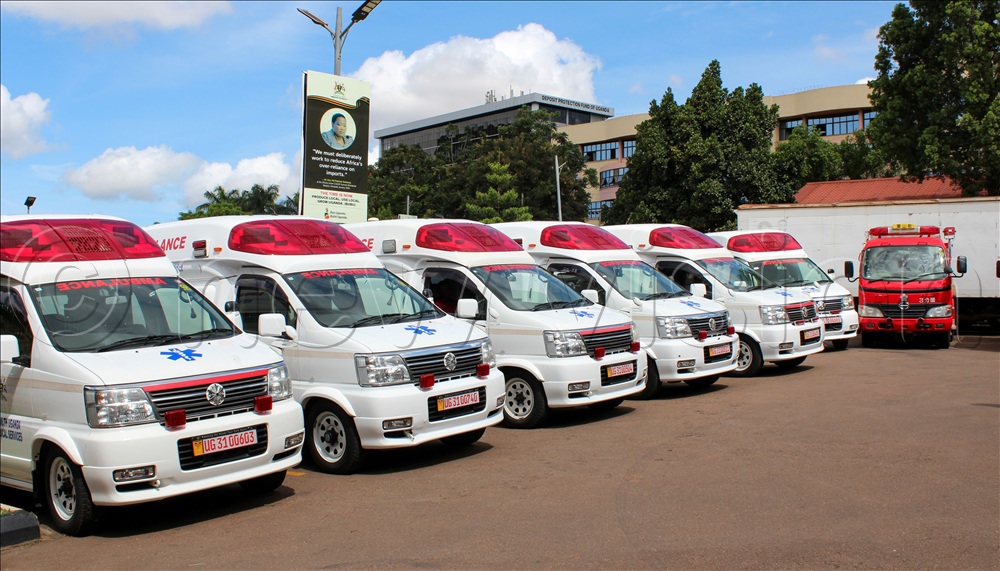
“This support is a serious addition to our capacity. It makes us better in terms of response. We are energised, and we are committed to taking good care of these facilities,” Byakagaba said.
The fire trucks will be deployed in districts including Tororo, Mpigi, Kiryandongo, Lira, Bundibugyo, Iganga and Luweero.
Byakagaba noted that although Uganda has recorded a 31.3 percent decline in accidents, the severity of incidents, especially fires, remains high.
“You may hear that accidents have reduced, but the intensity is still very high. With this support, we expect to reduce not just the numbers, but also the severity,” he said.
He added that the equipment will reinforce the police’s sub-county policing model, which aims to bring emergency services closer to communities.
Health Minister Dr Jane Ruth Aceng described the donation as timely, noting that Uganda still faces a significant shortage of ambulances despite recent improvements.
“With this addition, we now have 296 ambulances countrywide, but we still have a gap of 274. We are grateful to the Government of Japan for consistently supporting us since 2020," she said.
She said ambulance coverage has improved from less than 2% in 2020 to about 54% currently, contributing to better health outcomes, including reduced maternal mortality.
“About 61% of ambulance transfers are for emergency obstetric and neonatal conditions, which has improved survival through timely referrals,” she said.
The ambulances, she added, have been upgraded to meet national standards and will be managed under a centralised emergency medical services system.
The hidden burden of accidents
Beyond emergency response, Dr John Baptist Waniaye, the Commissioner for Emergency Medical Services, said the country continues to face a heavy and costly burden from road traffic injuries, noting that hospitals handle far more accident cases than police records indicate.
“At health facility level, we record about 160,000 injury cases every year, which is three to four times what police reports. In terms of deaths, we register between 9,000 and 12,000 annually, compared to about 5,000 reported by police,” he said.
He explained that while official statistics show improvements, hospitals continue to deal with a steady stream of severe cases, many of whom survive with long-term disabilities. Waniaye added that the cost of treating accident victims places a significant strain on the health system.
“The burden is still very high. Many patients survive but are left unable to work or support themselves,” he said.
"A mildly injured patient may cost about sh1.6 million to treat, moderate cases about Shs3.6 million, while critically injured patients can cost up to Shs13.6 million per person,” he added.
At Mulago National Referral Hospital alone, about 400 severe trauma cases are handled annually, costing nearly sh5 billion. Overall, Uganda is estimated to lose about 5% of its Gross Domestic Product due to road traffic injuries.