
Ireland pledges renewed investment in Karamoja over next five years
Kotido district chairperson Paul Lote Komol thanked the Irish government for its long-standing partnership with Karamoja, saying the investment had transformed lives across the region.
Irish Ambassador to Uganda Mags Gaynor said Ireland has invested more than sh250 billion in Karamoja over the past five years and intends to build on those gains under its Foreign Development Programme Strategy for 2027 to 2032. (Credit: Olandason Wanyama)
KARAMOJA - The Irish government has pledged to deepen its investment in the Karamoja sub-region over the next five years, with a renewed focus on education, skills development, climate resilience, healthcare and social protection.
Irish Ambassador to Uganda Mags Gaynor said Ireland has invested more than sh250 billion in Karamoja over the past five years and intends to build on those gains under its Foreign Development Programme Strategy for 2027 to 2032.
Speaking during a debriefing at Yellowstone Hotel in Moroto following a five-day tour of Karenga, Kaabong, Kotido, Moroto and Abim districts, Gaynor said Karamoja remains a priority because of its long-term development potential.
"We want to emphasize education and skilling in the sub region," she said, noting that education remains critical in addressing poverty and low literacy levels among the region's estimated 1.5 million people.
The ambassador said Ireland will continue supporting initiatives aimed at consolidating peace in a region once affected by conflict, while strengthening service delivery and reducing poverty.
She said the new strategy places particular emphasis on improving the region's resilience to future shocks through stronger climate adaptation, disaster preparedness, humanitarian response and social protection.
"Over the years, we have been focusing on climate action now in practice," Gaynor said. "Acting early reduces suffering, protects development gains and also lowers the costs of response to future humane crises."
"The challenges that face Karamoja require solutions that connect climate information, disaster preparedness, humanitarian action and social protection," she added, noting that no single institution can achieve those objectives alone.
Gaynor said Ireland's support for Karamoja dates back to the mid-2000s, when it supported the implementation of Universal Primary Education through teacher training and bursaries for needy students, programmes that continue today.
She said Ireland has also made significant investments in healthcare, with its international development policy prioritising stronger health systems, particularly maternal and child healthcare.
"This challenge has been identified in the Karamoja sub-region," Gaynor said, referring to the difficulties caused by long distances, poverty and shortages of specialised health services that often delay life-saving treatment.
She said Ireland's support now extends beyond health infrastructure to include training health workers, strengthening referral systems, providing transport vouchers, promoting community engagement and supporting quality improvement initiatives.
The ambassador also highlighted Ireland's support for the Social Assistance Grants for Empowerment (SAGE) programme, describing it as the country's largest bilateral investment in social protection.
She said more than 10,000 older people across Karamoja's nine districts are receiving cash transfers under the programme to help improve their livelihoods.
During her visit, Gaynor also commissioned outputs of reproductive, maternal, neonatal and adolescent health (RMNACH) projects implemented by Doctors with Africa-CUAMM.
She said the latest investment builds on earlier interventions by strengthening infrastructure and supporting faster decision-making by local governments to improve service delivery.
The ambassador also commended development partners, particularly Doctors with Africa-CUAMM, for their contribution to improving healthcare in Karamoja.
"Let's not think about medics and ambulances but a reliable supply of medicines and health commodities," Gaynor said. "Without medicines and storage facilities even the most skilled worker cannot provide effective treatment."
She reaffirmed Ireland's commitment to working with the Ugandan government to strengthen healthcare services and improve the lives of vulnerable communities.
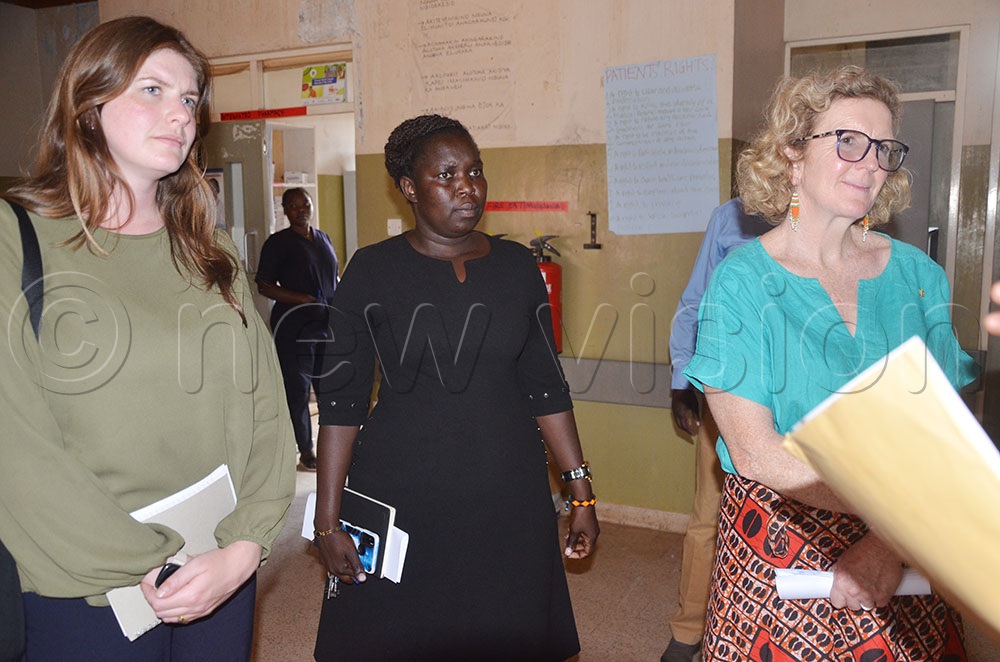
Irish Anbassador to Uganda Mags Gaynor speaks to Karita Health Centre and local government staff before commissioning the district drug store. (Credit: Olandason Wanyama)
Local government leaders welcomed Ireland's continued support but appealed for additional investment in critical sectors.
Dr Anthony Okengo of Abim district praised Ireland for transforming lives across Karamoja but said Abim General Hospital still faces significant challenges.
He appealed for an additional ambulance to meet growing demand for health services, as well as investment in electricity infrastructure to improve neonatal care and theatre operations.
Dr Eunice Akello of Kaabong Hospital also commended Ireland for its continued support but appealed for assistance in renovating the ageing hospital infrastructure.
She said inadequate funding and continued reliance on external partners remain major challenges affecting the hospital's long-term sustainability and service delivery.
Kotido district chairperson Paul Lote Komol thanked the Irish government for its long-standing partnership with Karamoja, saying the investment had transformed lives across the region.
"You have pumped lots of money in education, skilling, water and health," Komol said.
He appealed for more scholarship opportunities for needy students in Kotido and Moroto municipalities.
"The entire sub-region is covered with over 200 children benefiting from Irish scholarships," Komol said. "There is a need to place Karamoja on map because it's peaceful."
Responding to the requests, Gaynor said Ireland's development programmes are guided by the country's values and noted that Irish taxpayers contribute about sh50 billion annually towards Karamoja's development.
She said her visit to northern Karamoja enabled her to assess ongoing Irish-funded projects while engaging local government leaders on future development priorities.