
Govt plans to build homes for older persons at regional level
“The history of Africa required that older persons are supposed to be part of the family until the recent studies when we discovered that there are older persons who are completely landless and because of the current land grabbing, we are seeing older persons on the streets,” said Menya.
State Minister for Labour Simon Mulongo says the idea will not come cheaply. (Photos by Dedan Kimathi)
________________
The government plans to build homes for elderly Ugandans in response to changing social dynamics that have left some older persons without family care.
Patrick Menya, the assistant commissioner for elderly and disability affairs in the Ministry of Gender, Labour and Social Development (MGLSD), disclosed this on November 19, 2026.
He was speaking during an interaction between members of Parliament (MPs) on the Foreign Affairs Committee, chaired by Grace Freedom Kwiyucwiny, and officials from the gender ministry, including labour state minister Simon Mulongo and his counterpart for disability affairs, Acan Joyce Okeny.
“The history of Africa required that older persons are supposed to be part of the family until the recent studies when we discovered that there are older persons who are completely landless and because of the current land grabbing, we are seeing older persons on the streets,” said Menya.
“So, the policy for older persons 2009 was revised, and it now gives us a go-ahead to start homes for older persons. That is why the honourable minister for older persons is out of the country. They have gone for a benchmark on how we can start homes for older persons. But we are proposing that we can have homes at the regional level,” he added.
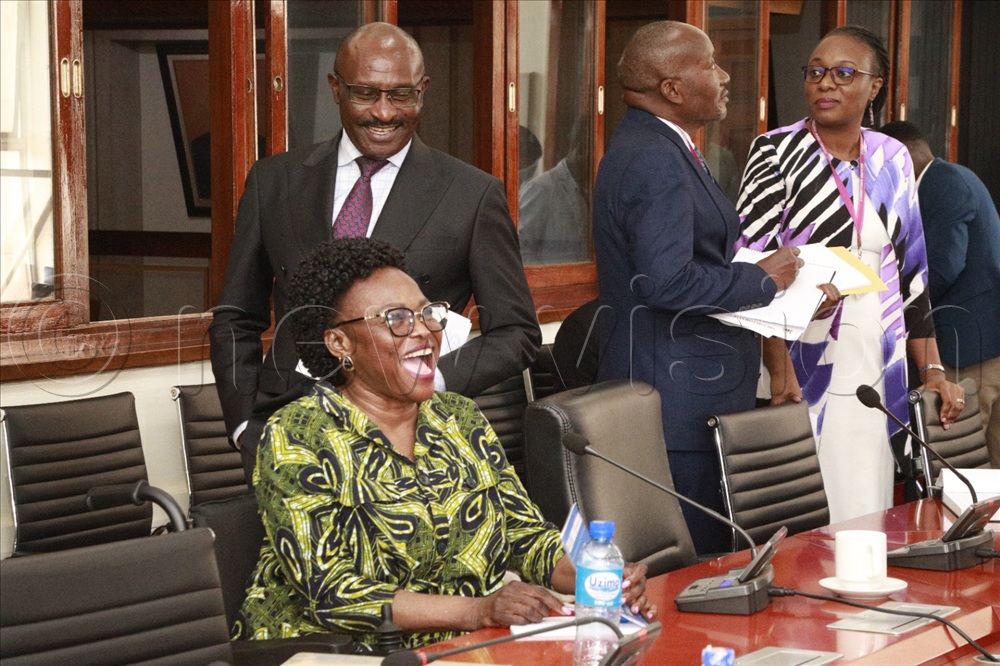
State Ministers Mulongo and Acan share a light moment at the end of thee engagement
Menya's proposal was supported by minister Mulongo, who also pointed out that African societies have traditionally relied on family and community support systems to care for older people, but that these structures appear to be gradually weakening.
He attributed this largely to modernisation, which has seen younger members of society find employment far from their homes, as well as capitalism, which has deepened individualism.
“The issue of the homes, as some members have said, is a debate we can have because African societies are sort of self-sustaining. Our societies take care of their own and don’t abandon them to some institutions. People would like to see their loved ones age gracefully with the grandchildren. Even when they die, they are buried in a place where people want to recognise that my great-grandfather was buried here and this is my father and this is whatever I am going to be,” Mulongo alluded.
“We are yet to get to that scale, but possibly as we go, it looks like we are going towards that. Where people go to school, get employment away from home, have no time to be at home. Grandchildren those days would come and stay with you forever, but now people tell you they are coming for only three hours and then they take them (grandchildren) away. In that case, time with the elderly is becoming less and less. Probably in the coming years, we may take that direction and possibly with our economies becoming better,” he observed.
However, he warned that implementing the proposal would come at a considerable cost, given that Uganda's economy is still growing, unlike those of affluent countries, mainly in the Western world, which are able to sustain even unemployed people through benefits.
“The elderly from 80 years and above are above 500,000 in this country, and if we lower the age to 65 years, they are close to 2 million out of the 46 million. That is quite a number,” Mulongo cited.
Pauline Nansamba Mutumba of the Uganda Human Rights Commission (UHRC) said the proposal to accommodate older persons in institutional homes needed to be carefully examined before the policy was adopted.
Mutumba is the director of complaints, investigations and legal services and acting director of monitoring and inspection.
“We are aware that some churches and religious institutions run elderly homes on a small scale. How are those supposed to be sustained? Actually, we are planning in this financial year to visit those homes and provide a human rights assessment of whether these elderly homes are actually something that can support us,” she pointed out.
Protocol on the rights of older persons
Uganda ratified the Protocol to the African Charter on Human and Peoples' Rights on the Rights of Older Persons in Africa on November 6, 2024, eight years after it was adopted by the African Union.
The protocol seeks to protect the dignity, independence, participation and welfare of older persons by eliminating discrimination against them, ensuring access to justice and guaranteeing equal protection before the law.
It also provides protection against discrimination in employment, social protection and access to pensions, as well as protection against abuse, among other safeguards.