
Govt bets on electric bus rollout to cut sh800m daily traffic losses
Works and Transport Minister Edward Katumba Wamala said the programme is already underway, with a small fleet of buses currently operating on selected routes in Kampala and Jinja.
Minister of science, technology and innovation Dr. Monica Musenero (left) and Minister of Works and Transport Maj. Gen. Katumba Wamala (right) launching electric buses during the National Science Week. (Photos by Sharon Nabasirye)
________________
Uganda is losing up to sh800 million every day to traffic congestion, a growing economic drain that government now hopes to cut through a rollout of electric buses across the country’s major cities.
While closing off National Science Week today, Sunday (May 3), at Kololo Ceremonial Grounds, government laid out that the transition to electric mobility will begin modestly but scale rapidly, with plans to deploy up to 1,500 electric buses across 14 cities by June 2030.
In the short term, between 30 and 300 buses are expected on the road by June this year, marking the first phase of a long-term shift away from conventional transport systems.
Works and Transport Minister Edward Katumba Wamala said the programme is already underway, with a small fleet of buses currently operating on selected routes in Kampala and Jinja.
He described the initiative as part of broader efforts to reduce national expenditure, particularly on fuel and inefficient urban transport.
“The programme has started. We already have 16 buses operating, and this is just the beginning of a transition that will improve efficiency and reduce costs because all the routes cost sh2000 regardless of your final destination, and this is paid electronically,” Katumba said while officiating the closure of the science week.
The electric mobility programme was officially unveiled at the close of Science Week at Kololo, where government leaders framed it as a turning point in Uganda’s push toward modernisation and innovation-led growth.
Electric mobility push
Science, technology and innovation state minister DR Monica Musenero said the rollout represents years of work to connect scientific research to practical economic solutions.
“For me, today represents the fulfilment of a dream. This is about ensuring that science is not just theoretical, but something that directly improves how people live and work,” Musenero said.
She pointed to research from Makerere University as a key driver behind the innovation, noting that transport is one of the most critical sectors for transformation.
Kampala City and transport leaders pose for a photo during the closure of the National Science Week at Kololo.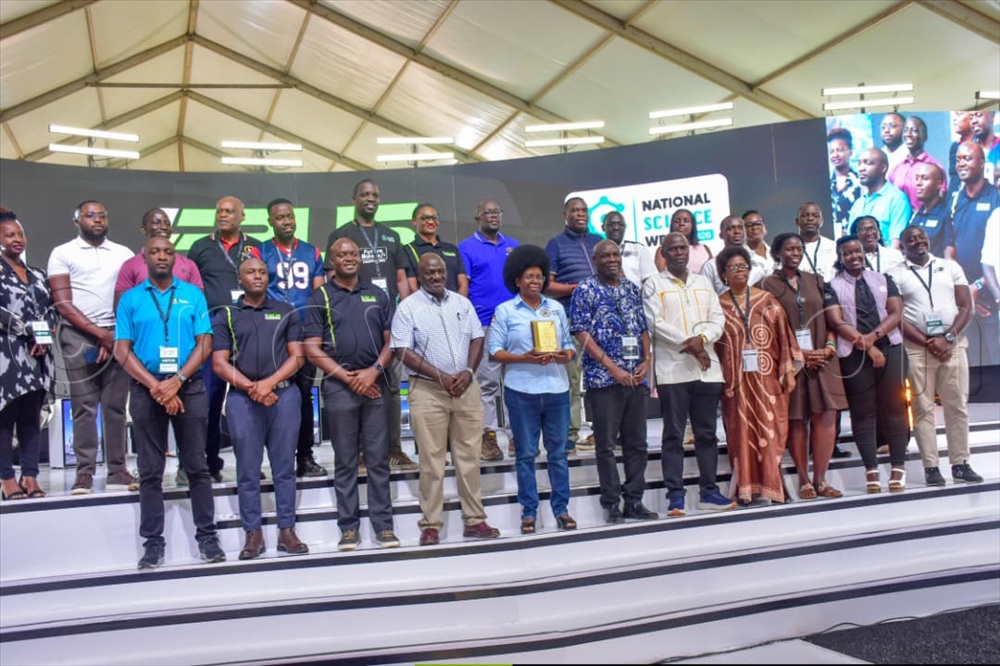
“How people move affects productivity, mindset and the overall performance of the economy. If we improve transport, we improve everything else,” she said.
Reducing road pressure
Government estimates show that congestion in urban centres, particularly in the Greater Kampala Metropolitan Area, is costing the country hundreds of millions of shillings daily in wasted time and fuel.
Musenero noted that a reliable, high-capacity bus system could significantly ease pressure on roads currently dominated by taxis and private vehicles.
The new electric buses are expected to play a central role in reorganising public transport, especially in Kampala, where more than 300 routes serve a rapidly growing population.
Katumba said each bus has the potential to replace nearly three traditional taxis, reducing the number of vehicles on the road while increasing efficiency.
So far, operations have begun with eight buses running along the Kampala–Ntinda corridor via Nakawa and Wandegeya, alongside another fleet in Jinja, bringing the total number of buses in service to 16. Within the next two months, an additional 30 buses are expected to be deployed.
Plans are also underway to expand services to Entebbe using both the old road and the expressway, as the government gradually integrates more routes into the system.
Investment model opens
Katumba insisted that the transition will not displace existing transport operators but instead create new opportunities within a more structured system.
The programme is an investment structure that allows individuals to participate financially without directly operating buses. According to E-Bus Express managing director Ian John Kavuma, investors can buy into the system and earn passive returns based on operations.
“This model opens up public transport as an investment opportunity. You don’t have to drive a bus to benefit from it,” Kavuma said, adding that a minimum investment period of six months is recommended to realise meaningful returns.
Clean energy transition
The nationwide rollout is expected to cost approximately $315 million (sh1.17 trillion) and will include the installation of about 260 fast-charging stations to support operations. Officials say building this infrastructure will be critical to ensuring reliability and scaling the system beyond pilot routes.
Kampala state minister Kabuye Kyofatogabye said the electric bus system offers a long-awaited solution to the capital’s transport challenges.
“We have struggled with public transport for years, but this is a step in the right direction. It may take time, but the foundation is now in place,” he said.
He highlighted that plans are also in the final stages to sort out the boda boda challenges in the city now that electric buses are already operational.
Energy state minister Sidronius Opolot Okasai said the initiative also aligns with Uganda’s broader energy efficiency and conservation agenda, which promotes a shift from fossil fuels to cleaner alternatives.
“This is a major milestone. We are moving from dirty energy to clean energy, and transport is one of the biggest areas where this change is needed, and this is a program recommended in all cities globally,” Okasai said.
He noted that Uganda’s renewable energy potential, particularly in solar, provides a strong foundation for electric mobility, although significant investment will be required to support charging infrastructure and grid stability.
Beyond buses, government is also exploring the electrification of other transport systems, including rail and motorcycles, with electric boda bodas already emerging as a cheaper and more sustainable option for urban commuters.
Despite the optimism, city leaders acknowledged that the transition will take time and require close collaboration across sectors, from science and technology to transport and energy.