
Govt approves construction of sh184.4b medical manufacturing facility
Beyond improving healthcare services, the investment is expected to employ over 6,000 youths across manufacturing, logistics, research, and related value chains and skills development, among other contributions.
According to the management, construction of the first phase of the project is expected to take 12 months, marking the beginning of what is anticipated to become a strategic healthcare manufacturing hub for Uganda and the wider region.
MUKONO - The Government of Uganda has approved the establishment of a medical reagent manufacturing facility project worth sh184.4b (approx. $50m) as a major step towards strengthening local manufacturing and improving healthcare delivery.
The multibillion-dollar project is undertaken by ELSTOP (U) Limited, and through Elstop Healthcare Solutions, the company supplies essential health and laboratory products, operating in Uganda and across the East African region.
In Uganda, the company is scheduled to set up a reagent manufacturing plant in Seeta, Mukono district, where the government has plans to establish a medical industrial park.
The proposed medical industrial park will focus on manufacturing laboratory reagents and other essential health products locally, which is aimed at reducing Uganda's dependence on imports while improving access to affordable healthcare supplies.
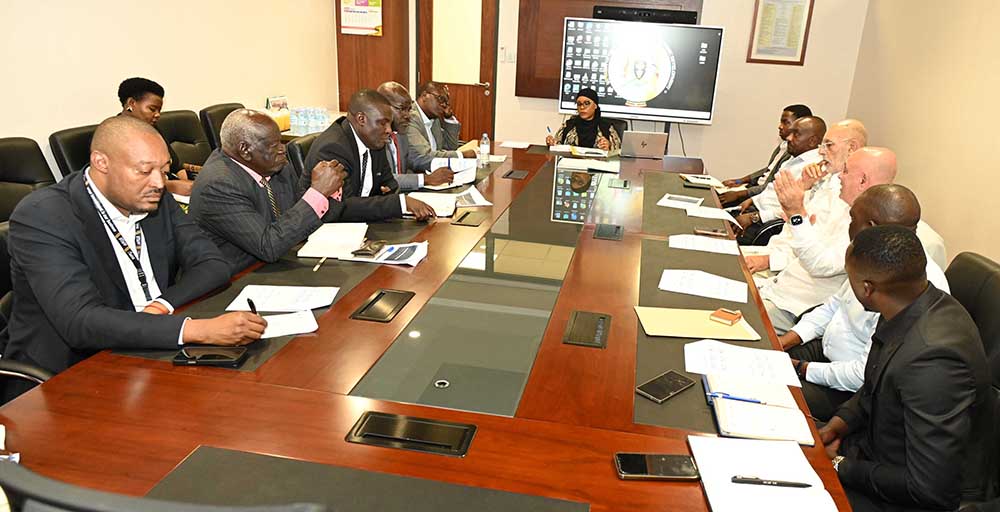
Hajati Aminah Mukalazi, the finance state minister (privatisation and investment), on Wednesday met and held discussions with the top management of Elstop Uganda Limited at her offices in Kampala to finalise the approvals and allocation of space in the medical industrial park.
The meeting was attended by Yitzark Shemesh, the company's managing director, who led a team of top officials and the director general of the Uganda Investment Authority (UIA), Robert Mukiza, among others.

Mukalazi welcomed the investment and tasked UIA to coordinate all the required social amenities for the establishment of a functional medical industrial park.
Mukalazi welcomed the investment and tasked UIA to coordinate all the required social amenities for the establishment of a functional medical industrial park. She wants the authority to provide the necessary infrastructure and social amenities required to support the setting up of the park.
She explained that industrial parks should have anchor investors and industries to be viable and globally competitive.
“The government of Uganda gladly welcomes these investors; we will do our best to support and facilitate such investments because they contribute to Uganda's economic transformation,” she said, adding that the investment aligns with the Government's commitment to promoting local content, increasing value addition, attracting quality investments, and expanding domestic manufacturing capacity.
It also demonstrates the growing investor-confidence in Uganda's business environment and reinforces the country's ambition to become a preferred destination for strategic, high-value investments that eventually create jobs and drive sustainable economic growth.
Speaking during the meeting, Shemesh said the venture would significantly reduce the cost of laboratory tests by enabling the production of laboratory reagents locally, which he said are currently imported at high cost.
He told the meeting that producing the reagents locally would save the country substantial foreign exchange on importing the products.
According to the management, construction of the first phase of the project is expected to take 12 months, marking the beginning of what is anticipated to become a strategic healthcare manufacturing hub for Uganda and the wider region.
The project is expected to strengthen healthcare resilience, improve supply chain security, reduce import dependence and position Uganda as a regional centre for medical manufacturing.
According to Shemesh, the company generally focuses on three main medical domains, including diagnostic imaging, where it supplies advanced radiology and scanning devices like Magnetic Resonance Imaging (MRI) scans and X-rays.
It also equips health facilities with cancer treatment technology like Linear Accelerators and Brachytherapy, and furnishes clinical laboratories with automated analysers for haematology, Polymerase Chain Reaction (PCR) and infectious disease screening.
Others are turnkey projects that include handling health facilities from the initial conceptual design through planning, construction, equipment procurement, and clinical staff training.
“Through supplying, installing and servicing the analysers and equipment that national, regional and district facilities rely on. To establish local diagnostic reagent manufacturing, Elstop is committing substantial investment, funding the build, the technology and the capability to run it,” a statement issued by the management stated.
The company asked the government to avail them of 10 acres of serviced land for the manufacturing facility, a ten-year offtake commitment to purchase their locally manufactured reagents, a 10-year tax holiday, amenities like roads, water and electricity to the site, among other needs.