
Experts show farmers how to make profits in piggery
Dr Emma Naluyima, the Best Farmer 2024, highlighted feeding as the backbone of pig production.
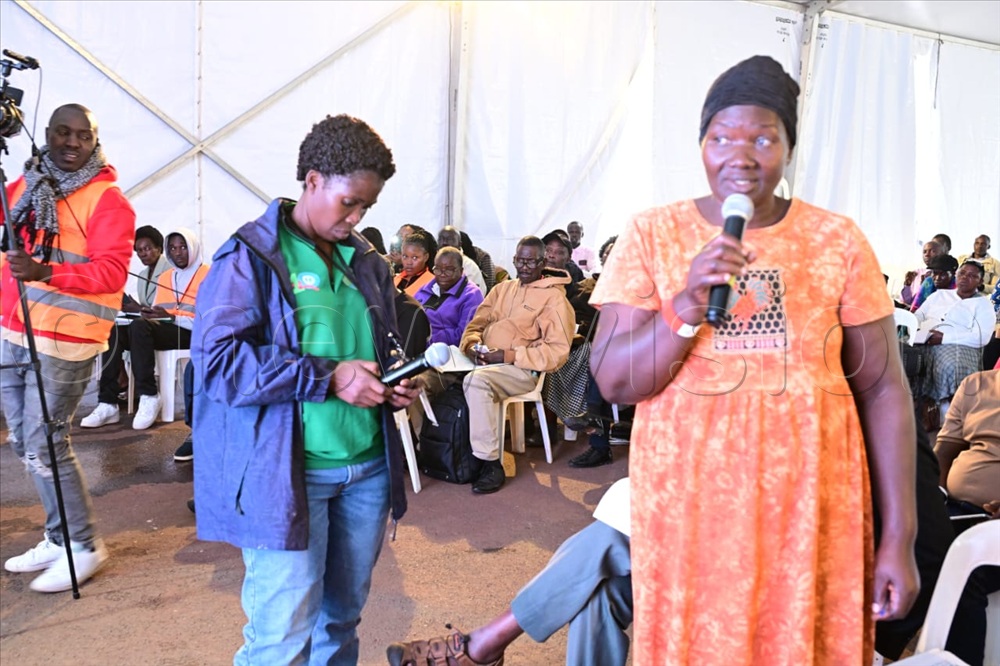
Dr. Esther Nakajubi from NAGRC training people on piggery during the Harvest Money Expo. (Photos by Eddie Sejoba)
________________
Farmers can turn piggery into a multi-million-shilling enterprise if they focus on disease prevention, proper feeding, record-keeping and market-driven breeding, experts revealed during the 10th edition of the Harvest Money Expo.
Held at Kololo Ceremonial Grounds under the theme Farming as a Business, the second day of the expo attracted excited farmers seeking practical solutions to boost productivity and profits. Entrance to the expo is sh10,000, with an additional sh10,000 for specialised training sessions.
Start small, think big
Dr Esther Nakajubi, the head of Non-Ruminants at the National Animal Genetic Resources Centre and Data Bank (NAGRC&DB), challenged the common belief that pigs are expensive to feed.

“People assume pigs eat a lot. They actually eat less if the feed is properly mixed. Between 2 and 2.5 kilogrammes per day is enough, provided they get clean water to help utilise all the nutrients,” she said. Nakajubi encouraged farmers not to give up on sows after the first farrowing.
“Many farmers sell off a sow after the first birth because it produces fewer piglets. But later size improves as the sow matures and adapts,” she explained.
Accordingly, a farmer can start with as few as five pigs and earn up to sh20m annually if production is market-oriented and management is sound.
Breed for the market
Nakajubi emphasised that piggery success begins with understanding demand. “What drives pig breeding is the market. If the market wants fatty pork, produce that. If it wants lean meat or breeding stock, align your production to that,” she advised.
She noted that meat breeds such as Hampshire, Pietrain and Duroc are suitable for pork production, but stressed that farmers must have clear breeding objectives.
“Produce with purpose. When management is good, buyers will always come.” Profits, she added, begin at the first farrowing when piglets are sold and increase steadily with proper reinvestment.
Disease prevention is cheaper than treatment
Experts underscored vaccination and prophylactic (preventive) treatments as critical in controlling pig diseases.
“Diseases can be prevented through timely vaccination and preventive treatments,” Nakajubi said. Farmers are advised to select pigs based on growth rate, feed efficiency and reproductive performance to improve herd productivity.
The 80% rule
Dr Emma Naluyima, the Best Farmer 2024, highlighted feeding as the backbone of pig production. “Feed accounts for up to 80% of production costs. Good feeding is the most important factor in piggery,” she said. She stressed that water should never be overlooked.


“Water is a vital nutrient. It must be available at all times, preferably through nipple drinkers to ensure cleanliness and consistency.”
Naluyima provided water consumption guidelines as follows: boars and sows with piglets require 15-35 litres daily; pregnant sows require 15 -25 litres; 30kg pigs require about 2.8 litres; 70kg growing pigs require 8 -12 litres; and 110kg heavy growers require 12-20 litres. On housing, she advised farmers to construct simple, but strong structures that provide shade and regulate temperature.
“Pig housing must protect animals from thirst, hunger, pain, fear, extreme heat or cold and disease. Listen to your pigs. Those in pens depend entirely on you,” she said.
Recommended temperature ranges include:
• Farrowing sows: 15–18°C
• Sows: 13–21°C
• Piglets: 21–26°C
• Porkers: 15–21°C
• Baconers: 13–18°C
Keep records or lose money
Both experts emphasised meticulous record-keeping as a non-negotiable practice. Farmers are urged to maintain identification records, service and farrowing records, litter records, feed records, stock purchases and sales, births and deaths, weekly weight records and all variable costs.
“Know the weight of your pigs before selling,” Naluyima cautioned. “If you don’t, buyers will take advantage of you.”
She also warned against feeding pigs rotten food or giving them dirty water.
“Treat pigs well if you want the best results and profits. Maintain cleanliness in their housing.”
Farmers speak out
Rogers Nyiiro Muwanguzi from Kamuli, Mbulamuti, said the training has sharpened his business approach to farming.
“I have learned how to identify the right breed, plan properly, keep records and budget well. This is my third expo, and I now want to start a piggery project.”
For first-time attendee, Steven Kyeyune from Nakasongola, the expo provided critical foundational knowledge.
“I came to get first-hand information before starting. The knowledge I have gained here will help me succeed,” he said.
With proper feeding, disease prevention, market-driven breeding and disciplined record-keeping, farmers can turn small-scale pig projects into sustainable, high-profit enterprises.