
Deputy Chief Justice demands for 'clear judgments' to enhance public confidence
“I support a vote recount even when the ballot boxes have been tampered with because I am interested in knowing what is inside the boxes, but the magistrate in Masaka made a mistake. You cannot refuse to do a vote recount in one case over tampered ballot boxes, but you allow the vote recount in another case. This kind of inconsistency affects public trust in the judicial system and should be avoided,” Mwagutsa said.
Deputy Chief Justice designate Moses Kazibwe Kawumi interacts with former Deputy Chief Justice Richard Buteera at the closing of the workshop on Friday June 5, 2026. (Credit: Farooq Kasule)
KAMPALA - Deputy Chief Justice urges Court of Appeal justices to deliver clear judgments to enhance public confidence in the justice system.
In a maiden speech to the justices of the Court of Appeal, Deputy Chief Justice-designate Justice Moses Kazibwe Kawumi has urged them to deliver clear, coherent and well-reasoned judgments to enhance public confidence in the justice system.
Kawumi said clear, coherent and well-reasoned judgments by the court not only resolve disputes but also strengthen public trust and provide guidance to lower courts through the doctrine of precedent.
Kawumi, who also heads the Court of Appeal, made the call at the closing of the two-day training for the justices of the Court of Appeal on the management of election appeals at the Court of Appeal conference hall on Friday, June 5th.
“The quality of judicial decisions remains one of the most enduring measures of judicial excellence. Clear, coherent, and well-reasoned judgments not only resolve disputes but also strengthen public trust and provide guidance to lower courts through the doctrine of precedent,” Kawumi noted.
Organised by the Judicial Training Institute, the training was aimed at strengthening judicial capacity in the adjudication of election appeals to ensure effective, timely and technology-driven administration of electoral justice.
Kawumi commended the Judicial Training Institute for organising the training, saying it reaffirmed the judiciary’s commitment to delivering timely, fair and credible electoral justice.
“Election petitions differ from ordinary disputes because of their direct impact on governance and democratic legitimacy. The courts, therefore, play a vital role in safeguarding the integrity of the electoral process by ensuring that disputes are resolved fairly, independently and in accordance with the law,” Kawumi said.
As electoral processes evolve, Kawumi said judicial officers must remain equipped to evaluate electronic evidence, digital records, and emerging technologies that may influence electoral outcomes.
Underscoring the importance of the training, Kawumi said elections lie at the heart of democratic governance and election petitions directly affect public confidence in democratic institutions and the rule of law.
“The discussions on vote recounts, affidavit evidence, voter bribery, electoral offences, the substantiality test, voter disenfranchisement and other recurring issues have enriched our understanding of the evolving principles governing electoral disputes,” Kawumi noted.
Kawumi also called for consistency in the decisions of the court to ensure predictable outcomes, which, in the long run, restores people’s confidence in the justice system.
Consistency in the decisions was echoed by retired Supreme Court justice Eldad Mwagutsa.
Using an example of Masaka Chief Magistrate Albert Asiimwe, whom he blamed of shifting goal posts in regard to the vote recount, Mwagutsa urged the Court of Appeal justices to avoid such scenarios.
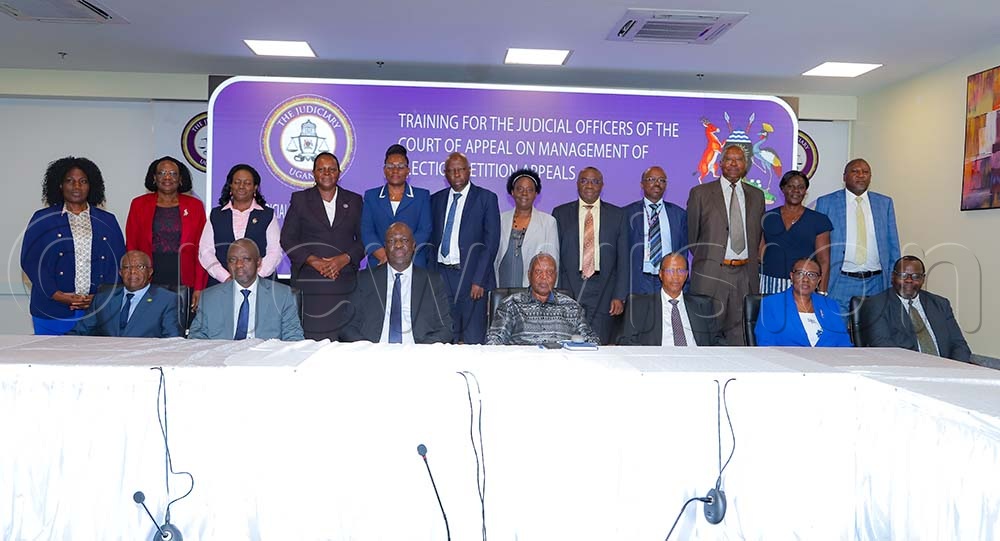
Deputy Chief Justice Moses Kazibwe Kawumi with justices of the Court of Appeal and guest speakers at the closing of the training on management of election appeals on Friday June 5, 2026. (Credit: Farooq Kasule)
“I support a vote recount even when the ballot boxes have been tampered with because I am interested in knowing what is inside the boxes, but the magistrate in Masaka made a mistake. You cannot refuse to do a vote recount in one case over tampered ballot boxes, but you allow the vote recount in another case. This kind of inconsistency affects public trust in the judicial system and should be avoided,” Mwagutsa said.
Over the years, the judiciary has been ridiculed over inconsistent decisions on similar matters, hence affecting the public trust in the judicial system.
According to High Court Judge Prof. Andrew Khaukha, the executive director of the Judicial Training Institute, 107 parliamentary election petitions have so far been filed in court following the gazettement of the winners.
From the 2021 general elections, 257 both parliamentary and local government election petitions were filed in the High Court, of which 140 went up to the Court of Appeal for determination.
Under the law, the Court of Appeal serves as the final appellate court for parliamentary election petitions.
With the concept and content for the training, Justice Khaukha said they analysed a total of 131 election appeals.
“I thank Justice Geoffrey Kiryabwire, the administrator of the Court of Appeal for working closely with us in putting together this training,” Justice Khaukha said.
During the training, the justices of the Court of Appeal, including Oscar Kihika, Eva Luswata, Hellen Obura, Dr Asa Mugenyi, Geoffrey Kiryabwire and Jesse Byaruhanga, blamed the Electoral Commission (EC) over lack of punctuality in the management of the elections, which they said unreasonably discredits the country’s electoral process.
On the issue of declaration forms, Justice Ssekaana advised the EC to adopt the carbonated format whereby the EC retains the original, as opposed to the current practice where each agent is given an original copy.
Ssekaana noted that some of the agents acquire blank declaration forms and fill in their own results, leading to a mismatch of the results.
EC was represented by Jennifer Angeyo and Ahmed Abdallah Ochoma, who promised to amplify the justices’ concerns to the top management for consideration.
Meanwhile, James Jumire Ereemye Mawanda, the judiciary spokesperson, said they are waiting for funds to kick-start the hearing of the petitions, which, by law, takes precedence over other matters.
“As the judiciary, we are ready to hear and determine the petitions, but we have not yet been availed the funds. Once the funds have been availed to us, we shall commence the hearing and determination of the petitions as soon as possible,” Mawanda said.