
Civil society calls for strict monitoring of labour export companies
Atim said inadequate monitoring of labour recruitment agencies can leave workers vulnerable to abuses, including violations of employment terms and other forms of exploitation.
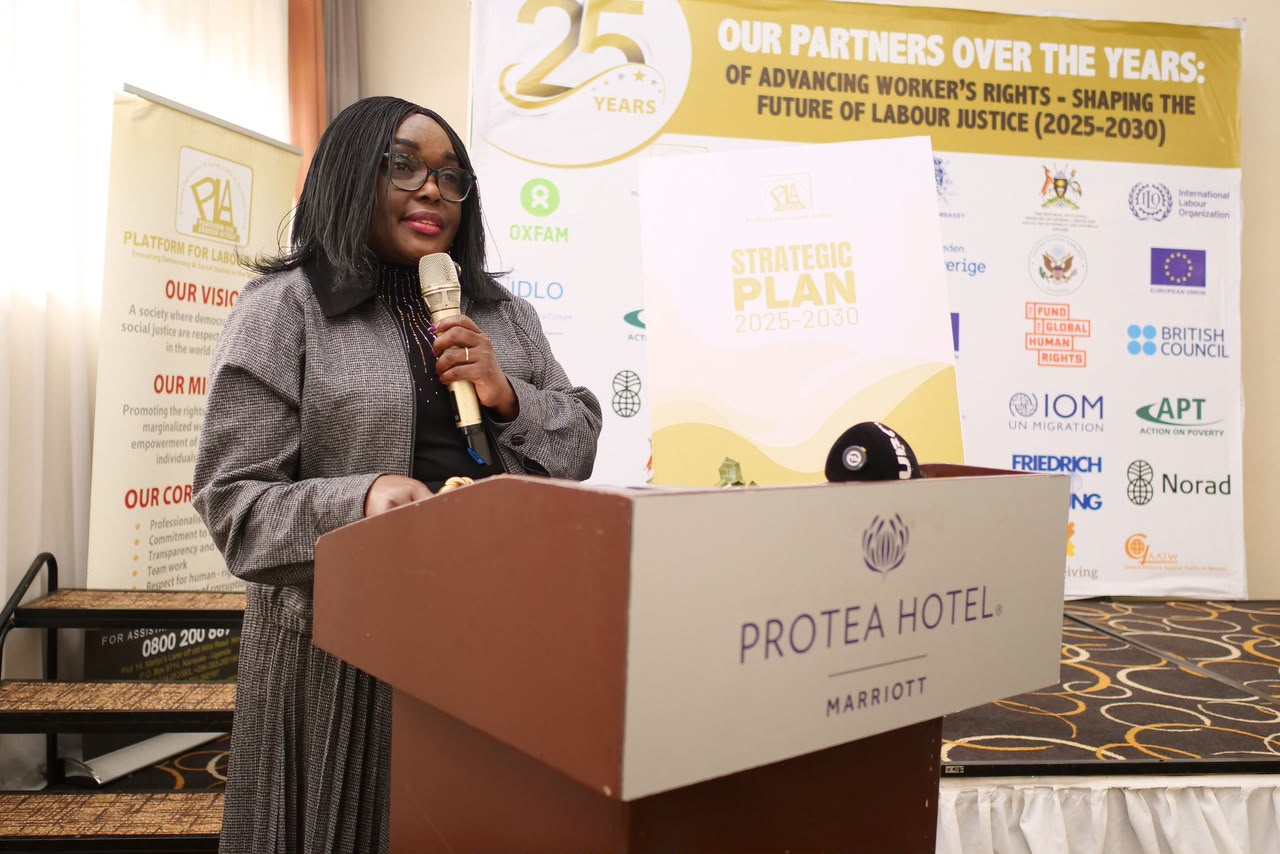
Lady Justice Bamugemereire at the Public Law and Advocacy (PLA) 25th anniversary celebration. (Credit: Rhyman Agaba)
_________________
Civil Society Organisations (CSOs) have called for stricter monitoring of companies recruiting Ugandans for employment abroad, warning that weak oversight exposes migrant workers to abuse and leaves them without adequate protection.
According to the Platform for Labour Action (PLA) board of directors chairperson, Dr Patricia Atim, the Government should strengthen regulation of labour export companies and ensure that recruitment agencies comply with licensing requirements before sending Ugandans to work in foreign countries.
She said stronger monitoring was necessary to protect migrant workers from exploitation and ensure that recruitment companies meet their obligations to workers before, during and after deployment.
Atim made the remarks on Wednesday (September 23) at Protea Hotel in Kampala during an event organised by PLA to mark its 25th anniversary and launch its five-year strategic plan for 2025-2030.
Atim said the protection of workers should extend beyond Uganda's borders, particularly as increasing numbers of Ugandans seek employment opportunities abroad.
She said inadequate monitoring of labour recruitment agencies can leave workers vulnerable to abuses, including violations of employment terms and other forms of exploitation.
She, therefore, called for stronger coordination among government agencies responsible for labour, immigration and migrant workers to ensure that Ugandans travelling abroad for employment are adequately protected.
The call came amid wider concerns raised by various civil society members over weak enforcement of Uganda's labour laws, particularly among workers in vulnerable and informal employment arrangements.
Atim said Uganda has progressive laws intended to protect workers and employers, but limited enforcement continues to contribute to labour injustices.
She said the challenge is more pronounced in the informal sector, where many workers operate without formal contracts and may not know their rights or where to seek redress when those rights are violated.
Atim said many employers in the informal sector also mistakenly regard labour laws as applying mainly to formal corporate workplaces, leaving a large section of the workforce inadequately protected.
She urged government and civil society organisations to intensify public sensitisation on labour rights and responsibilities, saying workers need to understand both their rights and the procedures for reporting violations.
“We have to continue sensitising our masses, our populace, around legal rights, duties of employers, rights of employers, duties of employees, and rights of employees to enhance awareness,” she said.
Atim also called for increased capacity-building for labour officers and community development officers at district level, saying they are often the first point of contact for workers facing employment disputes.
Supreme Court Justice Catherine Bamugemereire. (Courtesy)
Her concerns were echoed by Supreme Court Justice Catherine Bamugemereire, who called for strengthening the country's labour justice system to ensure workers can effectively enforce their rights.
Bamugemereire called for the recruitment of more judges for the labour and industrial courts, saying the shortage of judicial officers contributes to the backlog of labour cases.
“Right now, we have only two judges, and they sit on the same court, so we don't have more than one court sitting at the same time,” she said.
Bamugemereire also called for the strengthening of statutory and institutional frameworks governing labour and urged the Government to review laws to address gaps that leave some categories of workers inadequately protected.
She said labour protection should also take into account emerging and non-traditional forms of employment, including digital platform workers, domestic workers, artisanal workers and Ugandans working abroad.
“I also said we need to commit here and now to building a Uganda that works for every worker. Whether an artisanal worker in a quarry, or a household worker in the home, or a stay-at-home mum, or a digital platform worker, or somebody who works abroad but without any sort of protection from the Government,” she said.
Bamugemereire said the Government, employers, the Judiciary and civil society must work together to ensure that labour rights guaranteed in law are reflected in workers' daily experiences.
“Civil society must remain vigilant and steadfast in bridging the gap between vulnerable communities and the law,” she said.
She urged employers to respect workers' dignity and ensure timely payment and fair wages, saying decent working conditions benefit workers, families and communities.

Supreme Court Justice Catherine Bamugemereire poses for a group photo with participants at the event. (Courtesy)
The event brought together professionals from government, academia and the legal fraternity. It also featured testimonies from beneficiaries and speeches from PLA's board of directors, including the founding member, Lillian Keene Mugerwa.
Mugerwa founded PLA 25 years ago in Katwe before the organisation expanded its work to Lira district, where it also supported children orphaned by the war in northern Uganda.
PLA was also commended for its contribution to reforms in Uganda's social security sector, including mid-term access to benefits for eligible National Social Security Fund members and the establishment of the Uganda Retirement Benefits Regulatory Authority.