
Govt gives farmers 150 tractors to boost mechanisation
The machines are expected to help farmers open up land and carry out other farm operations as the Government steps up efforts to mechanise agriculture and move farmers from subsistence to commercial production.
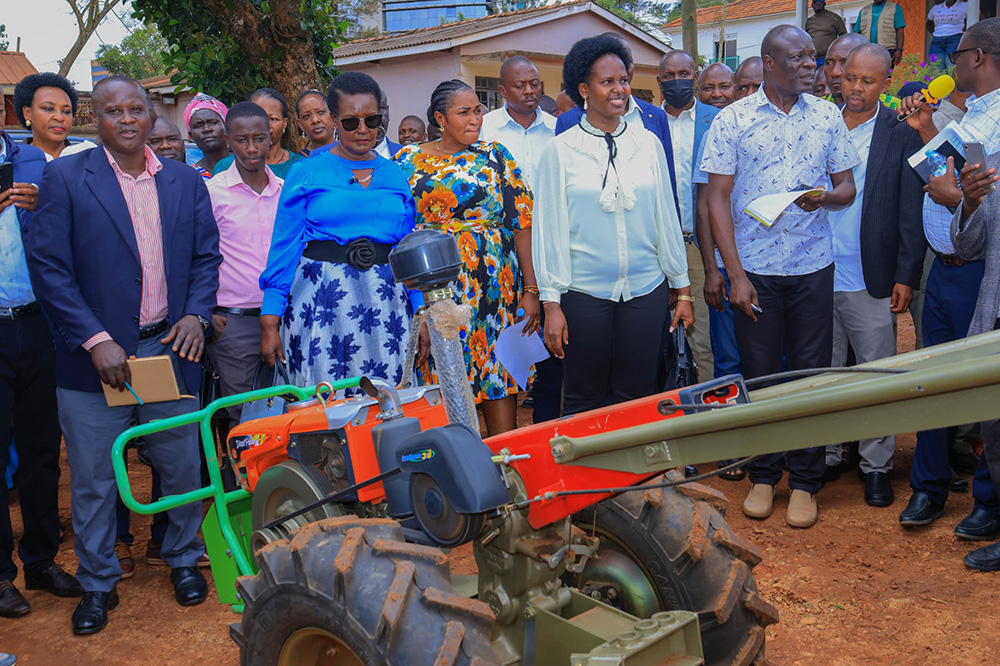
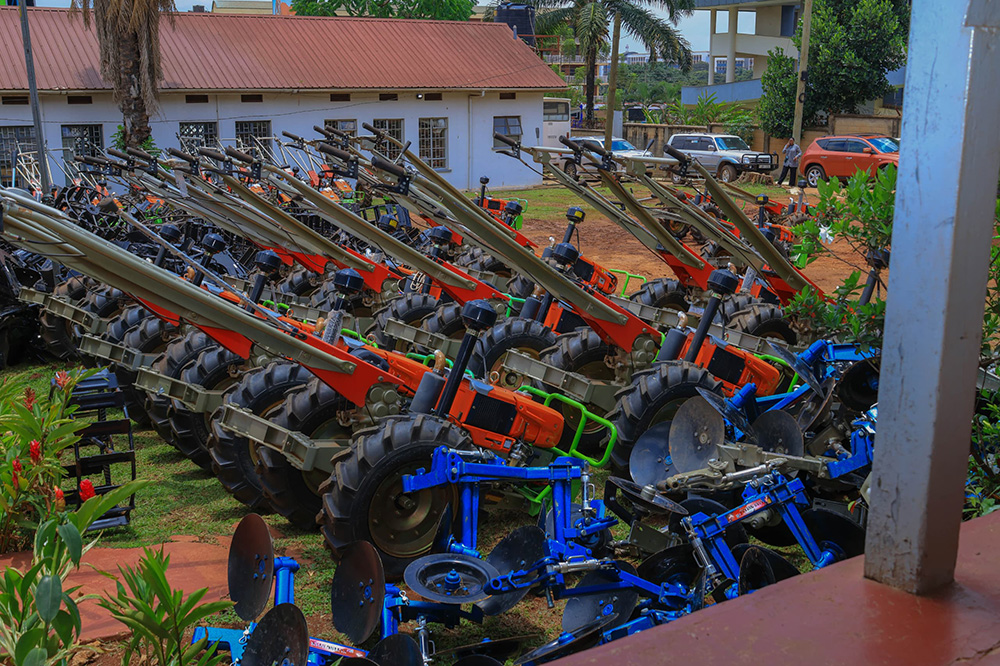
The government has handed over 150 tractors to farmers as part of efforts to reduce subsistence farming and accelerate the commercialisation and mechanisation of agriculture. (Courtesy photo)
_________________
The government has handed over 150 tractors to farmers as part of efforts to reduce subsistence farming and accelerate the commercialisation and mechanisation of agriculture.
The 14-horsepower, single-axle tractors, commonly known as walking tractors, were handed over on Saturday to representatives of farmer groups from across the country.
The machines are expected to help farmers open up land and carry out other farm operations as the Government steps up efforts to mechanise agriculture and move farmers from subsistence to commercial production.
At least 38% of Uganda's 6.9 million hectares of agricultural land is mechanisable, but only about 4% is currently mechanised.
The tractors were handed over by the Minister of State for Agriculture, Desire Muhooza, at the Uganda Climate-Smart Agricultural Transformation Project (UCSATP) offices on Buganda Road in Kampala.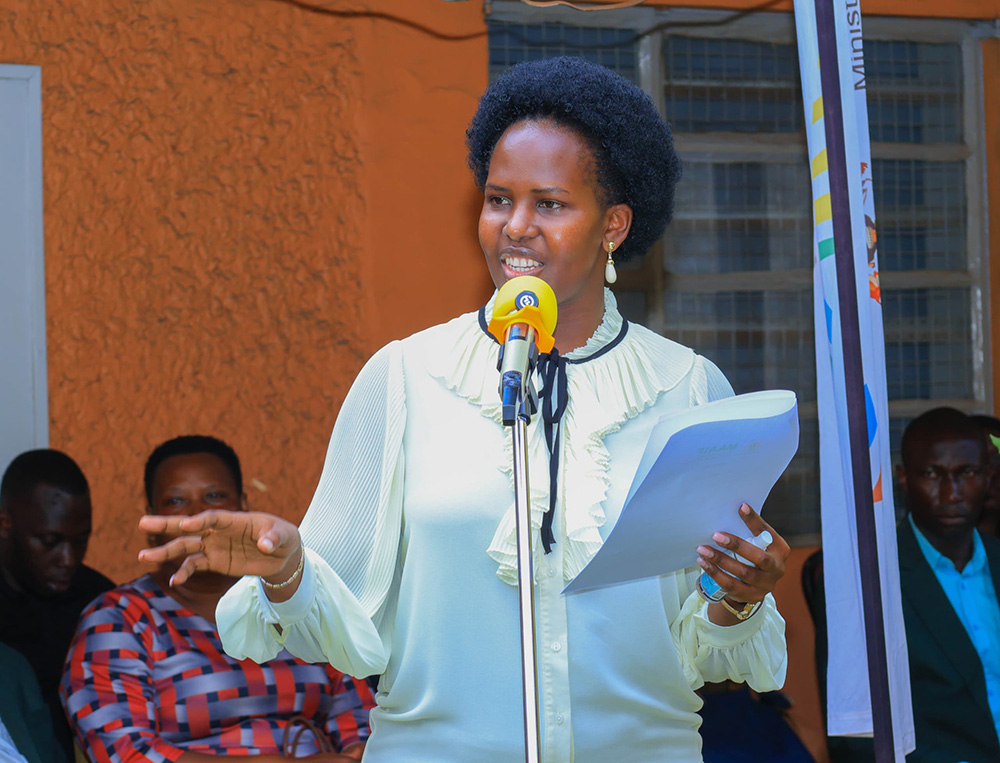
Minister of State for Agriculture, Desire Muhooza. (Courtesy photo)
UCSATP is a six-year World Bank-funded project implemented by the Ministry of Agriculture, Animal Industry and Fisheries (MAAIF), together with its agencies, including the National Agricultural Research Organisation (NARO), National Animal Genetic Resources Centre and Data Bank (NAGRC&DB), and Uganda National Meteorological Authority (UNMA).
According to the ministry, the diesel-powered tractors can cultivate up to four acres on one litre of diesel.
Boniface Okanya, the Commissioner for Agricultural Infrastructure, Mechanisation and Water for Agricultural Production at MAAIF, said the machines would significantly reduce the labour required to prepare land.
"What a man can do in one acre, you need 10 men to finish. These can do five acres a day," Okanya said.
Okanya, who represented the MAAIF permanent secretary, Gen. (Rtd) David Kasura-Kyomukama, said the ministry had strengthened its mechanisation centres to provide technical support to farmers.
"The ministry will empower mechanisation centres so that our technical staff can come and support you. We have many farmers, but we have chosen you to represent others," he said.
Okanya said operators would be trained in the sub-counties where the equipment is deployed and warned farmers against mishandling the machines.
"We shall come and train the operators in the sub-counties where the equipment is located. They chase away the operator and the equipment breaks down in a week. If you maintain them, the minimum is 20 years. Report any fault that is identified," he said.
He said the tractors could be used for more than land opening, including slashing, transportation when fitted with a trailer, grinding food and spraying.
"It is a matter of attaching the relevant equipment. The machine is robust," Okanya said.
He added that the Government has a contract with the supplier to service the machines and urged farmers not to undertake repairs themselves.
"The operator will be retooled repeatedly. If they operate well, they can be taken on to operate big tractors," he said.
Okanya also cautioned beneficiaries against conflicts that could undermine the programme.
"One person, I think in Agago, burned the tractor we gave out to farmers after they disagreed. We went and had him arrested. If you misuse it, it will be recalled and given to another district," he said.
'We are tired of the hoe'
Amelia Kyambadde, the chairperson of the parliamentary committee on agriculture, welcomed the initiative, saying the walking tractors were suitable for Uganda's fragmented landholdings.
Kyambadde said although Uganda has many farmers, the Government had opted to work through farmer groups so the machines could benefit more people.
She urged the beneficiary groups to share the equipment with other farmers in their communities as Government works to provide more machines.
She said the parliamentary committee on agriculture would support efforts to secure more funding for the programme so other farmer groups could also benefit.
"Your success will determine how far this programme goes," Kyambadde said.
Muhooza said the Government was using the latest distribution as a trial to assess the effectiveness of the machines before expanding the programme.
"We want to do a trial test. Elsewhere across the developed world, small-scale farmers no longer use hoes, so we shouldn't be the exception. We want the farmer to use less energy but harvest a lot," she said.
She said the initiative was aimed at supporting the Government's plan to transform agriculture from subsistence to commercial production.
Muhooza said Government had previously distributed 650 tractors but acknowledged that there had been challenges with the model used to distribute them.
She said the latest approach of working through farmer groups was intended to improve access, management and accountability.
"If you disagree, please don't burn the tractor. Instead, take it to the chief administrative officer who can take good custody," Muhooza said.
She urged the beneficiaries to act as ambassadors for the programme and provide feedback on the performance of the machines.
"Be ambassadors. We are going to rely on you for information on the effectiveness of these tractors. We are going to train farmers from the groups so that if one person is away, the other can maintain [the machine]," she said.