
Chief Justice Zeija urges clerics to promote ADR at first Judiciary iftar
“We are defined by our adversarial roles or our impartial mandates. But tonight, we gather as a community reminded by the spirit of the holy month of Ramadhan that our shared humanity and our shared commitments to the truth precedes orders, the principle of this foreign month to which patience, self-discipline and deep reflection are remarkably similar to the virtues of our role that requires us to set aside personal bias in favour of common good,” Zeija said.
Judiciary Permanent Secretary Dr Pius Bigirimana greeting Dr Yahaya Ssemuddu and Ex-EC chairperson Badru Kiggundu. (Credit: Farooq Kasule)
KAMPALA - The Judiciary, in a historic move on February 28, 2026, hosted the Muslim community to its first ever iftar dinner at its headquarters in Kampala, marking a significant moment of unity and spiritual reflection during the holy month of Ramadhan.
The inaugural iftar dinner was spearheaded by the Judiciary Muslim Association, which brings together all Muslim staff, both judicial and non-judicial, within the institution.
Several high-profile Muslims in the country, including the First Deputy Mufti of Uganda, Sheikh Muhammad Ali Waiswa, were among the guests treated to a sumptuous iftar dinner.
Presiding over the spiritual event, Chief Justice Dr Flavian Zeija underscored the importance of the gathering, noting that it reaffirmed the values that bind judicial officers in the courtroom.
“We are defined by our adversarial roles or our impartial mandates. But tonight, we gather as a community reminded by the spirit of the holy month of Ramadhan that our shared humanity and our shared commitments to the truth precedes orders, the principle of this foreign month to which patience, self-discipline and deep reflection are remarkably similar to the virtues of our role that requires us to set aside personal bias in favour of common good,” Zeija said.
Zeija said the iftar dinner reaffirmed the Judiciary’s shared values of justice, dignity, accountability and unity in service to the people.
He noted that there has been an increase in the number of Muslims in the Judiciary, with at least one Muslim represented at every level of the courts, from the lower benches to the top.
“May this holy month of Ramadhan be a firm reminder to us all that this creed refines character,” Zeija said.
He observed that justice must be anchored not only in law but also in conscience, as commanded by the Noble Qur’an.
“Our nation remains both unified, therefore national cohesion must commend religious leaders for playing an indispensable role in promoting social harmony, moral guidance and peaceful resolution,” Zeija noted.
He urged Muslim clerics to champion Alternative Dispute Resolution mechanisms such as mediation and reconciliation to complement the formal justice system, noting that they foster restorative outcomes.
Using the example of when a district Kadhi in Masaka helped him resolve an inheritance case under Islamic law by guiding him on the shares for each beneficiary in an estate, Zeija underscored the importance of the clergy in dispute resolution.
“It was an amazing moment for me because I was schooled by the district kadhi on the matter. So, muslim clerics actually play a very big role in resolving disputes through Alternative Dispute Resolution (ADR) mechanisms, and that is why we are training them to ensure that they help us,” Zeija said.
He observed that interfaith harmony remains essential for communities of different faiths and promotes mutual respect.
“I wish to commend the judiciary muslim association for this innovation of the judiciary muslim iftar dinner. I acknowledge that the association has fostered unity, reflection and ethical consciousness. Their work strengthens the moral foundations of public service and contributes meaning for the institution of trust,” Zeija said.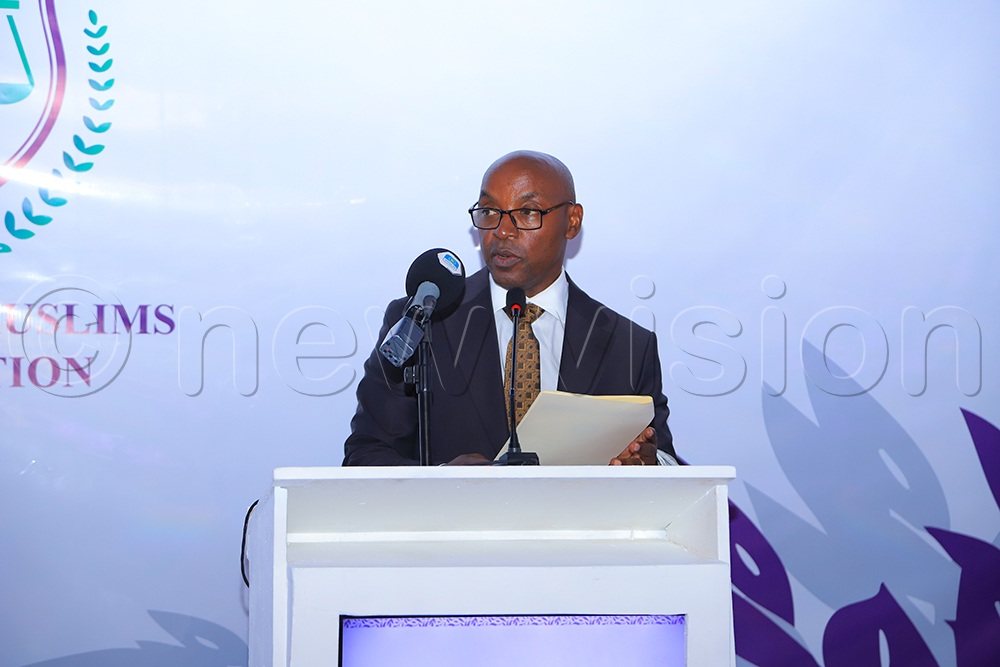
Chief Justice Dr Flavian Zeija speaking during the Iftar dinner. (Credit: Farooq Kasule)
Zeija further noted that Ramadhan teaches empathy. “May this evening renew our energy to serve with integrity, transparency and open hearts,” Zeija said.
The Principal Judge, Jane Frances Abodo, said the iftar dinner marked more than a gathering for Muslims to break the fast, describing it as a celebration of innovation, inclusivity and unity within the Judiciary.
“It is a reflection of our commitment to embracing diversity, strengthening collegiality and fostering an environment where all judicial officers, regardless of their faith, feel recognised and respected,” Abodo said.
Abodo remarked that the holy month of Ramadhan serves as a reminder that justice is rooted not only in law but also in moral responsibility, empathy and fairness.
“The lessons of patience and accountability cultivated during fasting are directly applicable to our work in the courts, where decisions impact lives and shape society. I, therefore, extend my heartfelt gratitude to the judiciary muslim officers association for pioneering this initiative by creating a platform that celebrates faith, fellowship and reflection,” Abodo said.
Dr Pius Bigirimana, the Judiciary Permanent Secretary, encouraged Muslim judicial officers to mentor younger colleagues.
“I think it is important as muslims to come together to support each other, mentor the young ones specially to make them understand that they are judicial officers who must have morals to serve with integrity,” Bigirimana said.
Bigirimana said he approved the event because the Christian fraternity has also been given space to pray.
Acting chief registrar Pamela Lamunu Ocaya remarked that Ramadhan provides a framework for professional excellence as it strengthens resilience. “I wish you a happy Ramadhan,” Ocaya said.
Court of Appeal Judge Musa Ssekaana, who is also the patron of the Judiciary Muslim Association, said the association brings together not only Muslim judicial officers but all Muslim Judiciary staff and friends.
Ssekaana commended the Judiciary's top management for accepting to host the dinner and urged them to formalise it on the Judiciary calendar, just like the Executive and Parliament, the two other arms of Government.
He said formalising the event would affirm the Judiciary’s commitment to religious harmony, boost morale and self-engagement, and align with the country’s national values of equality and freedom of worship.
The Judiciary Muslim Association Savings and Credit Cooperative Organisation has also been launched.
Justice Ssekaana said it will provide accessible financial services, including interest-free loans in line with Islamic principles, structured savings plans and opportunities for Sharia-compliant investments.
Underscoring the importance of fasting, Justice Ssekaana noted that fasting does not only teaches Muslims patience and self-control, which are essential qualities for judicial officers to deliberate with clarity and impartiality, but also promotes detoxification, mindfulness, nutrition and stamina, enhancing focus in courtrooms.
“Let us carry the essence of Ramadhan in our judicial duties so that our decisions we make in court are guided by wisdom,” Ssekaana remarked.
Zulaika Nantezza, a deputy registrar at the Court of Appeal, revealed that the idea of establishing the Judiciary Muslim Association was conceived during an iftar dinner hosted by Justice Ssekaana in 2021.
Fasting during the holy month of Ramadhan is one of the five pillars of Islam. It is mandatory for all adult Muslims worldwide and lasts between 29 and 30 days.