
Anti-corruption caravan heads to oil-rich Bunyoro region
The Inspector General of Government (IGG) has previously estimated that Uganda loses more than sh9 trillion annually to corruption, representing nearly a quarter of the national budget.
IGG Lady Justice Aisha Luzze Batala (right) flags off the 2026 Anti-Corruption Caravan in Kampala on Friday, championing the fight against corruption and promoting accountability. (Photo by Nelson Kiva)
____________________
The latest state and non-state efforts against corruption and their impact so far informed discussions at the launch of the 2026 Anti-Corruption Caravan, which will focus on the Bunyoro sub-region from Sunday, June 21, to Friday, June 26, 2026.
At the launch, which took place at ActionAid International Uganda's offices located in Kansanga, Kampala, on Friday, June 19, 2026, government officials, civil society organisations and development partners renewed calls for a united front against corruption.
The initiative comes against the backdrop of troubling statistics. According to Transparency International (TI), Uganda’s score on the Corruption Perceptions Index (CPI) declined from 28 in 2019 to 25 in 2025, placing the country below the global average score of 42 and the Sub-Saharan Africa average of 32.
The decline, according to TI, suggested that perceptions of corruption within Uganda's public sector remain deeply entrenched.
The Inspector General of Government (IGG) has previously estimated that Uganda loses more than sh9 trillion annually to corruption, representing nearly a quarter of the national budget.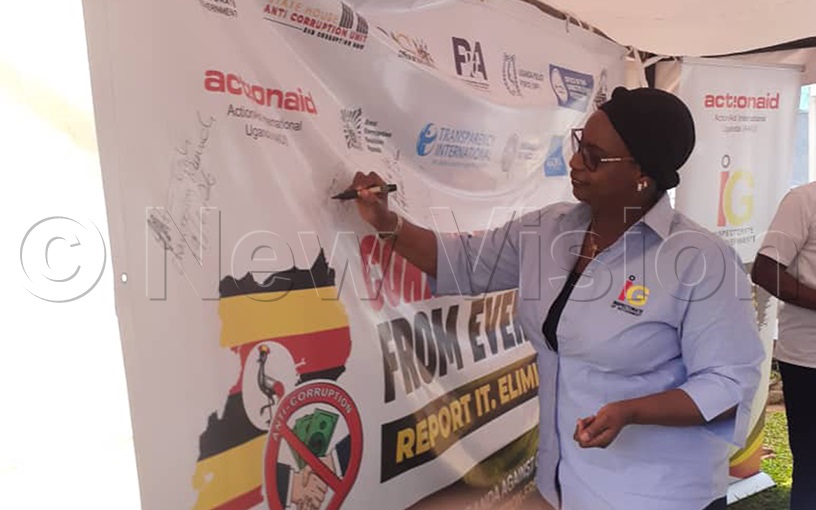
IGG Lady Justice Aisha Luzze Batala officially launches the 2026 Anti-Corruption Caravan in Kampala on Friday, reaffirming the commitment to transparency, integrity and accountability in public service. (Photo by John Matrix Tiboruganda)
Such losses, according to anti-corruption crusaders, translate into missed opportunities in healthcare, education, infrastructure and job creation.
The IGG, Justice Aisha Batala Naluzze, described corruption as one of the greatest obstacles to Uganda's social and economic transformation.
"Every shilling that is lost in corruption is a classroom that is not built, it is medicine that is not delivered to the hospitals, and it is a road that is not maintained and a livelihood opportunity that is denied," she said.
She argued that corruption undermines trust between citizens and the state and called for greater citizen involvement in accountability processes.
The 2026 Anti-Corruption Caravan brings together the Inspectorate of Government, Transparency International Uganda, ActionAid International Uganda, development partners, media organisations, local governments and community leaders.
The caravan seeks to strengthen citizens' role in demanding accountability and safeguarding public resources.
Organisers say it will directly engage more than 5,000 citizens while reaching millions more through radio, television and social media platforms.
The campaign will traverse the Bunyoro sub-region, covering the districts of Kiryandongo, Masindi, Buliisa, Kagadi, Kikuube, Hoima District and Hoima City.
Activities will include community dialogues, public awareness campaigns, media engagements, barazas, citizen accountability forums and joint monitoring exercises aimed at identifying corruption vulnerabilities in service delivery.
According to Naluzze, the caravan is intended to take accountability conversations directly to communities and create spaces where citizens can report corruption and maladministration.
Samuel Ntale, the country director of ActionAid International Uganda, said the region has demonstrated positive momentum in anti-corruption efforts and is becoming increasingly important to Uganda's economic future due to oil and gas developments.
"We are seeing more opportunities coming in from Bunyoro sub-region, especially with the oil production set to come in," Ntale said.
Ntale said the caravan seeks to ensure that communities directly influence discussions about governance and service delivery.
"We would like to take the accountability discussions down to the communities so that we hear the citizens' voice directly," he said.
Lillian Zawedde Senteza from Transparency International Uganda said that despite investments in anti-corruption frameworks, corruption remains a major obstacle to development.
She cited findings from the National Integrity Survey, which indicate that 76% of Ugandans believe corruption is increasing within the public sector, while 59.5% identify greed as the leading driver of corruption.
The Uganda Bribery Index also reveals widespread experiences of corruption in service delivery. According to the survey, the Uganda Police Force recorded the highest likelihood of bribery at 71%.
"The fight against corruption cannot be won by government institutions alone," Zawedde emphasised.
She called for stronger implementation of the Right to Information Act, greater coordination among anti-corruption actors, stronger protection for whistle-blowers and enhanced accountability regardless of an individual's status.
Gerald Gwaira, the director of research, innovation and advocacy at the Inspectorate of Government, revealed that numerous investigations involving senior public officials and government institutions are underway.
"There are very many investigations ongoing against several public officials, senior public officials," he said.
He said the investigations involve the Inspectorate of Government, the Criminal Investigations Directorate (CID) and the State House Anti-Corruption Unit, among others.
Gwaira said investigators are deliberately taking time to build watertight cases.
"Investigations, especially involving corruption, take a bit of time because we have to collect evidence so that when we take these people to court, we have evidence to present," he explained.
He said that among cases already concluded are investigations involving officials at the Electoral Commission (EC) and the agriculture ministry, where implicated officers were ordered to refund billions of shillings.
"We arrested some officials from the Office of the Prime Minister who are in charge of refugee registration, and investigations are ongoing to get to the bottom of the allegations," he said.