
WHO chief hails Uganda’s dedicated Ebola treatment facilities
Dr Tedros, who is in the country on an official visit, said Uganda’s response system stood out for its combination of a large general health facility and a specialised Ebola treatment centre, noting that the arrangement strengthens the country’s capacity to isolate and manage highly infectious cases effectively.
The Commissioner for Clinical Services in the Ministry of Health, Rony Bahatungire (left) looks on as the Director-General of the World Health Organization (WHO), Dr. Tedros Adhanom Ghebreyesus (right) speaks after they visited Mulago Referral Hospital Isolation Unit on June 8 2026. Center is the WHO representative and Head of mission, Dr. Kasonde Mwinga. (Photo by Ronnie Kijjambu)
________________
The World Health Organisation (WHO) director general, Dr Tedros Adhanom Ghebreyesus, has praised Uganda’s dedicated Ebola treatment infrastructure, describing it as a strong example of preparedness and partnership in managing infectious disease outbreaks in Africa.
Dr Tedros, who is in the country on an official visit, said Uganda’s response system stood out for its combination of a large general health facility and a specialised Ebola treatment centre, noting that the arrangement strengthens the country’s capacity to isolate and manage highly infectious cases effectively.
“What makes this arrangement special is that while you have the big hospital with more than 1,500 beds, there is also a separate treatment centre that can handle Ebola patients,” he said during a meeting with senior Ministry of Health officials.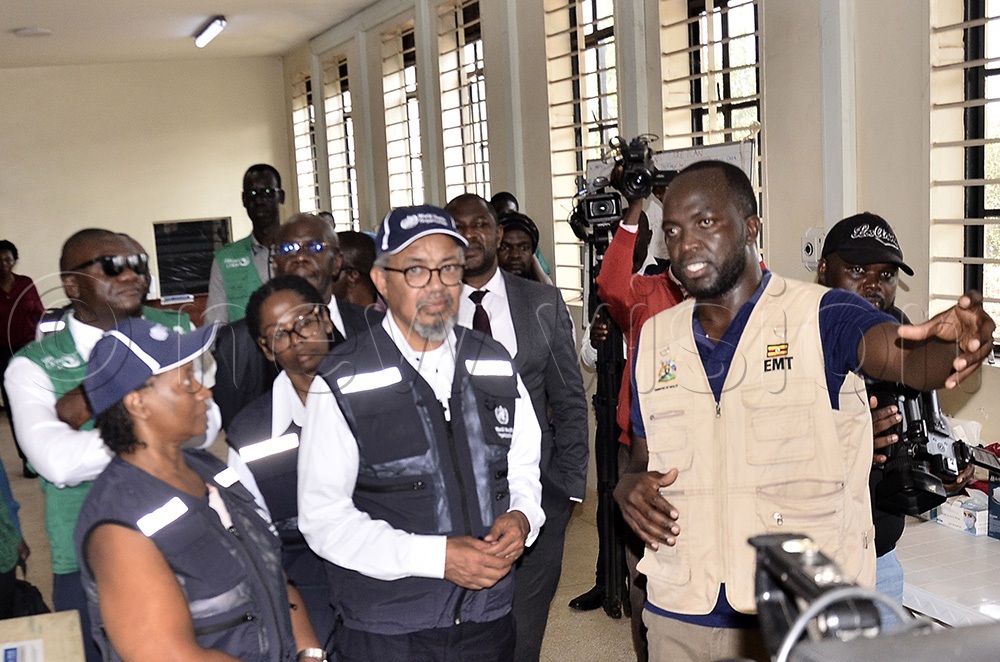
The WHO representative and Head of mission, Dr. Kasonde Mwinga, (left) looks on as the staff of Mulago Hospital, Dr. Christopher Wagobole (right) explains to the Director-General of the World Health Organization (WHO), Dr. Tedros Adhanom Ghebreyesus (centre) as he visited Mulago Referral Hospital Isolation Unit Mulago Kampala on June 8 2026. (Photo by Ronnie Kijjambu)
He commended the dedication of Uganda’s health workers and the effectiveness of emergency medical teams trained through WHO-supported programmes in collaboration with the European Union. According to Dr Tedros, the trained teams demonstrate the value of sustained investment in emergency preparedness and frontline capacity building.
Dr Ghebreyesus also highlighted Uganda’s early detection of imported Ebola cases from the Democratic Republic of Congo (DRC) and the swift declaration of the outbreak on May 15, describing the response as very swift and effective in limiting wider transmission.
He further praised the government’s decision to postpone the Uganda Martyrs Day celebrations, which annually attract between two and three million pilgrims, saying the move likely prevented a much larger outbreak.
“If that event had not been delayed, we would probably now be counting cases in three digits or more,” he said.
The Ministry of Health has announced plans to establish a 50-bed Ebola treatment unit in DRC in support of response efforts in eastern DRC.
Permanent secretary Dr Diana Atwine said the new treatment units will form part of Uganda’s broader regional response strategy aimed at stopping the outbreak at its source while strengthening domestic preparedness.
“Uganda is supporting the outbreak response in DRC by deploying health workers and setting up 50-bed treatment units this week,” Atwine said, adding that the country has already established two mobile laboratories in Bwera and Arua to enhance Ebola testing and diagnostics.
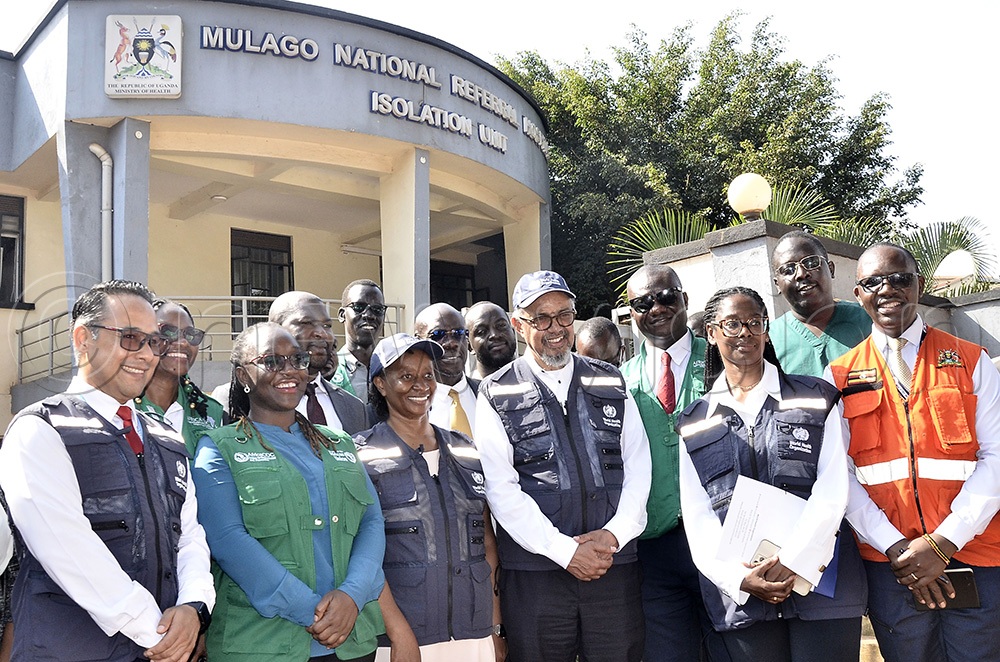
The Director-General of the World Health Organization (WHO), Dr. Tedros Adhanom Ghebreyesus (third right) poses for group photograph with staff of WHO, Africa CDC, Ministry of Health and Mulago Referral Hospital after the visited Mulago Referral Hospital Isolation Unit Mulago on June 8 2026. (Photo by Ronnie Kijjambu)
Dr Ghebreyesus, who is in Uganda to assess preparedness and support coordination efforts, said the country’s Ebola response reflects strong collaboration between government institutions, WHO, Africa CDC and other partners.
He emphasised that Uganda and DRC must continue working closely to strengthen cross-border surveillance and coordination, warning that infectious diseases do not respect national boundaries.
The WHO chief reiterated the agency's continued support to Uganda, praising the commitment of health workers and describing Uganda’s overall response as a model of effective outbreak management in the region.
“I am really glad by what I see. World Health Organisation support will always be there. Uganda has the experience and can do it,” he said.