
Arua mobilises communities to safeguard against Ebola threat
Drani said hand hygiene remains one of the key preventive measures being promoted across the district.
A health worker interacting with Gloria Alesi, a businesswoman at the Vurra border post about Ebola. The government has intensified surveillance and screening at Uganda's border points with the Democratic Republic of Congo (DRC) as part of efforts to prevent the spread of the Ebola Bundibugyo virus. This was on June 6, 2026. (Photos by Lawrence Mulondo)
________________
Authorities in Arua district have intensified community engagement and risk communication efforts to prevent the spread of the Ebola Bundibugyo virus, with officials emphasising that public participation is critical in defeating the disease.
Speaking to New Vision on June 5, 2026, Arua district health educator and member of the district Ebola task force, Gasper Drani, said the district has rolled out an extensive risk communication and community engagement strategy aimed at protecting residents from the virus.
“We realised that Ebola attacks and kills people, which is why communities themselves must take charge of the fight against the disease,” Drani said. “Our goal is to ensure that people understand the prevention measures and put them into practice consistently.”
According to the Ministry of Health, Uganda had registered 19 confirmed Ebola cases by Friday, including 14 imported cases and five local infections. Thirteen patients remained admitted, four had been discharged, and two deaths had been recorded.
As one of Uganda’s high-risk districts bordering the Democratic Republic of Congo, Arua remains vulnerable because of the numerous porous border crossings frequently used by travellers.
Community awareness at the centre
Drani said hand hygiene remains one of the key preventive measures being promoted across the district.
“We continue to encourage regular handwashing with soap and water and advise people to avoid direct contact with bodily fluids, especially from suspected Ebola patients,” he said.
To reach more people, the district is conducting community meetings, radio talk shows and distributing Information, Education and Communication (IEC) materials such as posters, flyers and fact sheets. The materials contain illustrations and simple messages that can be easily understood by different audiences.
“The information on the posters helps people visualise the threat and understand what they must do to protect themselves,” he said.
However, Drani noted that shortages of information materials remain a major challenge. The district plans to engage community leaders and equip them with fact sheets to strengthen information dissemination.
“Leaders have previously attended our engagements but often left without educational materials. We need posters in schools, markets, churches and other public places so that the message reaches everyone,” he added.
A track driver crossing from Congo to Uganda at the Vurra border post in Arua district being screened with a temperature gun by a medical officer at the Vurra Point of Entry. The government has intensified surveillance and screening at Uganda's border points with the Democratic Republic of Congo (DRC) as part of efforts to prevent the spread of the Ebola Bundibugyo virus. This was on June 6, 2026. 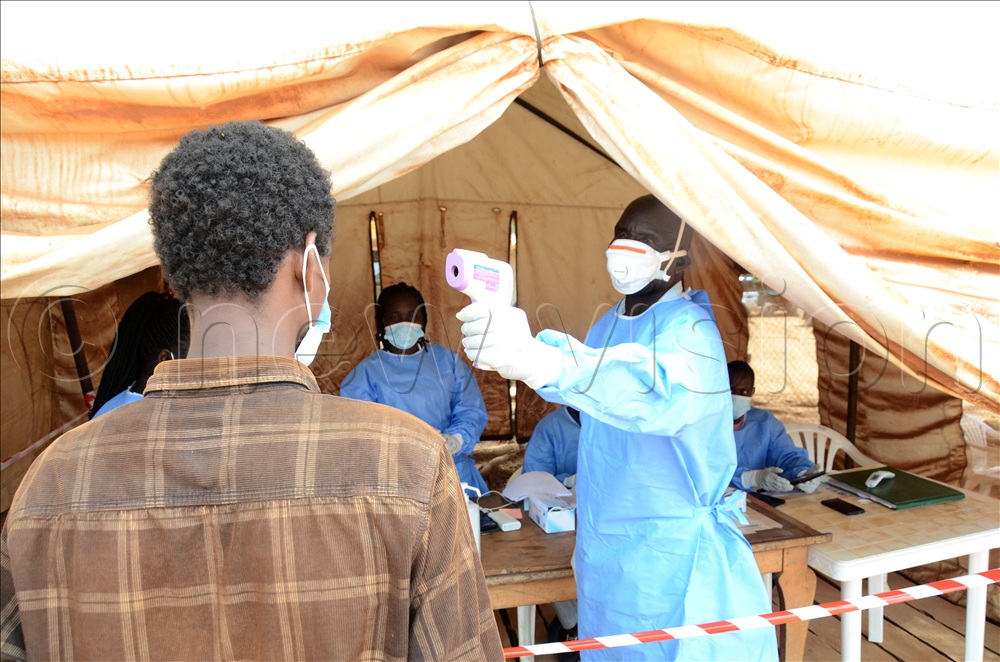
Surveillance and resource gaps
Drani said the district surveillance team, supported by the Rapid Response Team, continues to investigate alerts from communities.
“We have received more than 40 alerts so far, and all have been managed according to Ministry of Health guidelines,” he said.
Despite the heightened response, funding remains a challenge. Drani said the district requires about sh220m for effective risk communication activities, but has yet to receive the funds.
Following the Ministry of Health’s declaration of the Ebola outbreak on May 15, Arua shifted from preparedness to full response mode.
“Most of the primary cases reported in the country have passed through Arua because of the porous border,” he said. “Last week, six new cases were announced, and four of them had travelled through this region.”
Although Arua has not yet recorded a confirmed Ebola case, health authorities remain on high alert.
Screening at border points
At Vurra border post, health workers dressed in protective gear conduct temperature screening for all authorised entrants into Uganda. Emmanuel Andama, the point-of-entry in-charge, said four district health workers and two International Organization for Migration (IOM) staff members are deployed at the facility.
Travellers are required to wash their hands before undergoing temperature checks. Those with elevated temperatures undergo secondary screening and are questioned about symptoms, travel history and possible exposure to Ebola.
“If someone presents signs that raise concern, we place them in a holding area and notify the district for further management,” Andama said.
Health workers also collect traveller information through locator forms to facilitate contact tracing if symptoms develop later.
“This information helps health authorities track and monitor individuals even after they have crossed the border,” he explained.
Andama said samples from suspected cases are tested at the Uganda Virus Research Institute laboratory in Arua, with results available within hours.
However, he noted that inadequate handwashing facilities, limited supplies of masks and sanitiser, and the presence of numerous unofficial crossing routes continue to undermine border surveillance efforts.
Challenges at Odramacaku
At the Odramacaku border point, the situation is more complicated because few visible barriers are separating Uganda and the Democratic Republic of Congo. Residents and traders cross freely, making surveillance difficult.
Charles Caicocabo, the medical laboratory technician in charge of the point of entry, said communities on both sides of the border are increasingly vigilant and quick to report suspected cases.
“There is a high level of awareness, and people understand that Ebola is real and dangerous,” he said.
Nonetheless, health workers continue to operate from an ageing tent originally procured during the COVID-19 pandemic. They also lack adequate isolation facilities, gloves, masks and sanitiser.
“Controlling movement is difficult because pedestrians and boda boda riders can easily bypass the main screening point,” Caicocabo said.
He called for greater sensitisation of boda boda operators, hotel owners and bar managers, who frequently interact with travellers crossing the border.
Partners join the response
To strengthen preparedness efforts, Amref Health Africa Uganda has committed sh100 million towards Ebola prevention and response activities in Arua district, Koboko district and Arua city.
Emmanuel Ebitu, Amref’s project manager based in Arua, said the support focuses on coordination, surveillance, risk communication and infection prevention.
“We are working closely with district health teams to strengthen supervision, community engagement and monitoring of the Ebola response,” he said.
Amref has also printed Ministry of Health-approved educational materials in several local and regional languages and distributed them at border points, trading centres and other public gathering places.
The organisation is working with Village Health Teams (VHTs) to spread awareness in communities and support surveillance activities.
Ebitu said Amref plans to secure additional funding to expand awareness campaigns in schools, particularly those near border areas where learners cross daily between Uganda and the Democratic Republic of Congo.
“Knowledge is one of the strongest tools against Ebola,” he said. “By ensuring that children, teachers and communities understand how the disease spreads and how to prevent it, we can reduce the risk of transmission and protect lives.”