
US brings sh4.35b AI-powered portable X-ray technology to Uganda
“This is trade over aid in practice. An innovative American company is bringing proven AI-enabled technology to Uganda's clinics. Every American taxpayer dollar here delivers results we can measure and verify,” Healey said.
Jessica Healey, the Acting Deputy Chief of Mission at the US Embassy, speaking during the official handover of the machine at Joint Medical Stores offices on October 30, 2026. (Photos by Mary Kansiime)
________________
The United States has committed about sh4.35b to expand access to diagnostic services in Uganda, with 10 artificial intelligence-powered portable X-ray machines deployed to selected private health facilities.
The programme, funded by the US Department of State, is being implemented by Joint Medical Store (JMS) in partnership with American manufacturer MinXray Inc. and AI health technology provider Qure.ai.
The machines are expected to strengthen tuberculosis (TB) screening and diagnostic imaging in private not-for-profit and private-for-profit health facilities.
The initiative was launched on October 30 at JMS headquarters in Nsambya, Kampala. It introduces a revolving financing model in which revenue generated from patient services will be used to purchase additional equipment, reducing reliance on future foreign assistance.
Speaking at the launch, Jessica Healey, the US Embassy's acting deputy chief of mission, said the programme demonstrated how American commercial partnerships could support Uganda's healthcare needs while promoting self-reliance.
“This is trade over aid in practice. An innovative American company is bringing proven AI-enabled technology to Uganda's clinics. Every American taxpayer dollar here delivers results we can measure and verify,” Healey said.
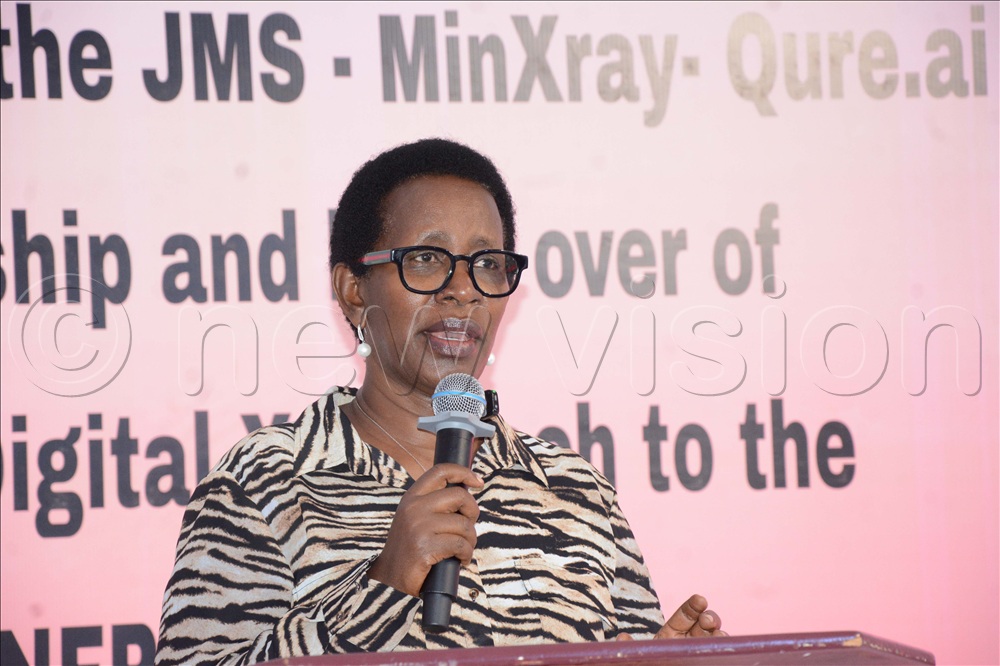
Diana Atwine, the Permanent Secretary at Ministry of Health speaking during the handover ceremony
She said revenue collected from diagnostic services would be channelled into a revolving fund to purchase additional X-ray units, allowing the initiative to expand without further US assistance.
Under the arrangement, participating facilities will retain 50% of revenue from diagnostic services to meet operational costs, while 10% will go towards equipment insurance. The remaining 40% will be deposited into a JMS-managed fund to finance additional machines.
JMS projects that the fund could finance the purchase of 10 to 11 additional systems over seven years. The machines will be bought directly from MinXray at cost, without a JMS markup or administrative fee.
JMS executive director Dr Bildard Baguma said the arrangement would provide a sustainable financing model for expanding access to modern diagnostic equipment.
“Our ambition is to transform the initial ten systems into a sustainable financing mechanism that progressively expands access to modern diagnostic technology across Uganda's private health sector,” Baguma said.
MinXray manufactures the portable digital X-ray systems, while Qure.ai provides the artificial intelligence technology that supports image analysis. JMS serves as their local representative, while health workers at participating facilities have been trained to operate and maintain the equipment. The agreement also provides for warranty and maintenance support.
Baguma said the machines would primarily be used for chest X-rays to screen for TB, although their broader imaging capabilities could also help identify other chest conditions and guide further clinical assessment.
Building on earlier gains
Between October 2025 and April 2026, the machines screened more than 14,000 people and identified 237 TB cases. Of those diagnosed, 83% had started treatment.
The equipment also detected heart and lung conditions unrelated to TB, demonstrating its potential to support diagnosis beyond tuberculosis screening.
Dr Diana Atwine, the Ministry of Health permanent secretary, welcomed the financing arrangement, saying the government would assess its affordability and long-term sustainability.
“The Ministry of Health welcomes this innovative financing approach and will be interested in studying its implementation, affordability, and sustainability,” Atwine said.
Faith-based facilities among beneficiaries
The Ministry of Health, JMS and the country's four medical bureaus selected the 10 beneficiary facilities based on need, expected utilisation, readiness and ability to pay.
Three facilities affiliated with the Uganda Catholic Medical Bureau and three under the Uganda Protestant Medical Bureau will receive the equipment. Two facilities affiliated with the Uganda Muslim Medical Bureau, one under the Uganda Orthodox Medical Bureau and one private-for-profit facility complete the distribution.
According to the Ministry of Health, private not-for-profit facilities, most of which are faith-based, account for about 33% of healthcare delivery in Uganda.
The deployment is expected to expand access to diagnostic services through these facilities while creating a financing model that could support the gradual expansion of the technology to other parts of the country.