
Uganda's non-communicable diseases burden doubles — medics
Representing Dr Charles Ayume, the state minister for primary health care, Mugahi said available health data showed that the number of people living with NCDs had doubled in five years, with cancer, mental health conditions and other lifestyle-related illnesses increasingly adding to Uganda’s disease burden.
Members of Parliament exercising during the orientation meeting on selfcare, Sexual Reproductive Health at Mestil Hotel in Nsambya on 18th August 2026. (Credit: Juliet Kasirye)
KAMPALA - The Ministry of Health has warned that Uganda’s burden of non-communicable diseases (NCDs) has doubled over the past five years.
Dr Richard Mugahi, the Commissioner for Reproductive and Child Health at the Ministry of Health, says that the sharp rise in the number of people living with NCDs puts fresh pressure on the country’s already constrained health system.
On Tuesday, he challenged the new Parliament to prioritise sustainable financing for prevention and early treatment.
Mugahi made the remarks on August 18, at an orientation meeting for members of the 12th Parliament on self-care, sexual and reproductive health and other health rights issues at Mestil Hotel in Kampala.
Mugahi said the government’s NCD prevention strategy should also recognise that risk factors vary across the country. He cited Karamoja, where lifestyles, livelihoods, physical activity and dietary patterns may differ substantially from those in urban areas.
“We need to consider regional differences and tailor our interventions accordingly,” he said at the meeting, which was organised by the Centre for Health, Human Rights and Development (CEHURD).
Mugahi said reducing Uganda’s NCD burden would ultimately require a shift from a largely curative health system towards one that puts greater emphasis on prevention, self-care and early detection.
Representing Dr Charles Ayume, the state minister for primary health care, Mugahi said available health data showed that the number of people living with NCDs had doubled in five years, with cancer, mental health conditions and other lifestyle-related illnesses increasingly adding to Uganda’s disease burden.
“The number of people living with NCDs has doubled. Uganda’s next health crises are sickle cell, mental health, diabetes and cancers; all these are NCDs. It's not HIV/AIDS but generally NCDs,” Mugahi told legislators, warning that the trend was placing additional pressure on the health system.
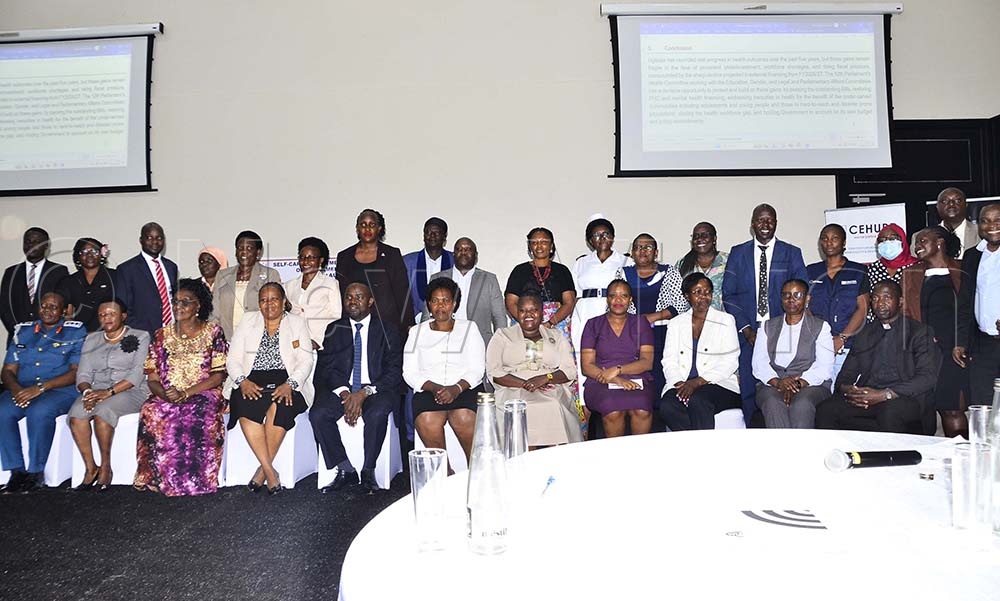
Dr Richard Mugahi (second left) Health ministry Commissioner Reproductive and Child Health poses for a photo with members of parliament and other health experts during the orientation meeting on selfcare, Sexual Reproductive Health at Mestil Hotel in Nsambya on 18th August 2026. (Credit: Juliet Kasirye)
Currently, Uganda's NCD burden is contributing to 35% of all deaths in the country.
Non-communicable diseases (NCDs) account for roughly 33% to 35% of all deaths in Uganda, with a 22% risk of premature death between ages 30 and 70.
The Ministry of Health reports that conditions like cardiovascular disease, diabetes, cancer, and hypertension are rising rapidly due to lifestyle and dietary shifts.
The burden is huge in urban centres like Kampala and Mbarara district, where lifestyle behaviours are poor, including eating junk food, less exercise, and exposure to toxic environments like polluted air. Annually, Uganda gives birth to more than 20,000 babies with sickle cell.
The Ministry of Health noted that more than 10 million people are stressed or mentally disturbed, while Uganda records more than 38000 cancer cases every year, with about 7,000 new cases registered yearly.
Mugahi urged MPs to promote prevention, including physical activity, healthier diets, routine screening and early treatment in their constituencies.
“Self-care is the most effective way to reduce the incidence of illness. It may not eliminate health problems, but it can significantly improve outcomes,” Mugahi said.
However, health advocates said individual responsibility alone would not be enough to reverse the NCD trend without stronger government investment in healthcare.
CEHURD Executive Director Fatia Kiyange said the 12th Parliament should use its five-year term to address longstanding gaps in health financing and access to care.
One of the major outstanding issues, according to CEHURD, is the establishment of a National Health Insurance Scheme.
Kiyange said Uganda still lacks a functional national health insurance scheme, while health insurance coverage remains low and households continue to shoulder a significant share of healthcare costs through out-of-pocket payments.
She said Parliament should therefore prioritise sustainable domestic financing for health rather than leaving households to bear the increasing cost of healthcare. CEHURD also urged the 12th Parliament to move Uganda towards the Abuja target of allocating 15% of the national budget to health.
The organisation called for greater investment in primary healthcare, mental health, sexual and reproductive health, medicines, medical equipment and human resources. For NCDs, the financing question is increasingly important as diseases such as hypertension, diabetes, cancer and other chronic conditions require long-term prevention, screening, treatment and follow-up.
Josephine Bilibona, the Chairperson of the Parliamentary Maternal Health Committee, said legislators should also lead by example by adopting healthier lifestyles before taking the message of self-care to their constituents.
“As Members of Parliament, we must take the message of self-care back home and share it widely. It starts with us,” Bilibona said.
She encouraged MPs to use physical activity opportunities, including the parliamentary gym and sports programs, noting that legislators often spend long hours seated in vehicles, offices and parliamentary sessions.
She also urged MPs to strengthen oversight of health services and ensure that health workers and district authorities educate communities about disease prevention, screening and early treatment.
Bilibona called for greater awareness of cancer and other NCDs in rural communities, where access to reliable health information can be limited.
She also cautioned communities against relying on unverified claims that local herbs and other remedies can cure diseases such as diabetes, hypertension and cancer.