
Uganda hosts Africa's Ebola emergency command centre
The launch was officiated by Dr Chris Baryomunsi, Uganda's newly appointed Minister of Health.
Minister of Health Dr Chris Baryomunsi (third right) interacting with officials from international agencies and embassies during the launch of the Continental Incident Management Support Team (IMST) command centre focusing on the Bundibugyo Ebola virus at the Infectious Diseases Institute (IDI) at Makerere University. (Photos by John Odyek)
________________
A continental emergency command centre aimed at strengthening the response to the ongoing Bundibugyo Ebola virus outbreak has been launched at Makerere University in Kampala.
The Continental Incident Management Support Team (IMST) was officially launched on June 27, 2026, at the Infectious Diseases Institute (IDI) at Makerere University.
The initiative, established by the Africa Centres for Disease Control and Prevention (Africa CDC) in close collaboration with the World Health Organisation Regional Office for Africa (WHO AFRO), is intended to support country-led efforts to contain high-threat public health emergencies across the continent.
In line with their mandate to prevent, detect and control disease outbreaks, Africa CDC and WHO have activated formal emergency response mechanisms to coordinate and strengthen regional preparedness and response efforts.
The IMST will serve as the central platform for strategic leadership and decision-making, operational planning, resource coordination, information management, partner engagement and oversight of outbreak response interventions.
The continental team will operate under the principles of "One Plan, One Team, One Budget and One Monitoring and Evaluation Framework" to ensure all partners work through a unified coordination structure.
The approach is expected to minimise duplication, enhance accountability and accelerate the implementation of outbreak control measures in affected and at-risk countries.
The operationalisation of the regional logistics hub in Entebbe will provide a critical mechanism for staging, securing and rapidly deploying essential medical supplies, personal protective equipment (PPE) and technical expertise to affected areas and other member states at risk.
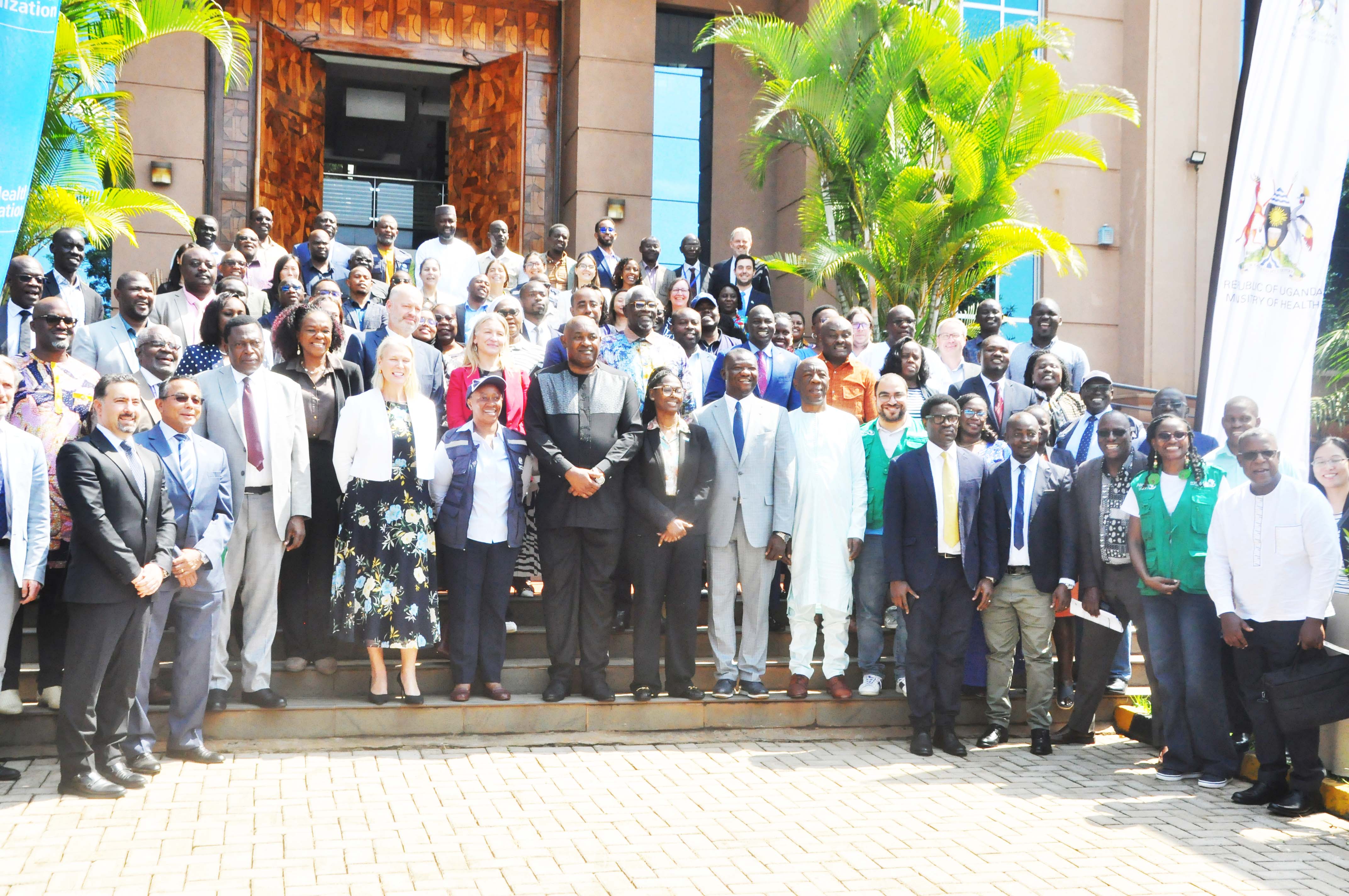
Officials from Government, Makerere University and international agencies during the launch of the Continental Incident Management Support Team (IMST) command centre focusing on the Bundibugyo Ebola virus at the Infectious Diseases Institute (IDI) at Makerere University.
The launch was officiated by Dr Chris Baryomunsi, Uganda's newly appointed Minister of Health. He was joined by officials from Africa CDC, WHO, United Nations agencies, development partners and senior health experts from across the continent.
“Uganda is proud to host this important continental platform. It reflects our shared commitment to protecting the health and security of our people and demonstrates that when Africa stands together, we are stronger than any outbreak,” Dr Baryomunsi said.
The minister commended President Yoweri Museveni for his commitment to health security and for accepting Uganda's request to host the Continental Incident Management Support Team (IMST).
“His leadership has enabled Uganda to provide not only a home for this important coordination mechanism, but an environment where experts from Africa CDC, WHO and partner organisations can work together in support of Member States across Africa,” Baryomunsi said.
He noted that the ongoing Ebola outbreak had demonstrated that global health security depends on collective action.
“The Ebola outbreak reminds us that no country is safe until every country is prepared. It also reminds us that solidarity is not simply a principle; it is an operational necessity,” he said.
Baryomunsi criticised travel restrictions imposed on Uganda by more than 20 countries in response to the Ebola outbreak, describing the measures as being driven by fear rather than science.
He warned that unnecessary restrictions could harm economies by disrupting trade, tourism and investment.
The minister expressed concern over the manner in which some international agencies and sections of the media have communicated about the outbreak, arguing that reports often combine Uganda's Ebola cases with those recorded in the Democratic Republic of Congo, creating a misleading picture of the situation in Uganda.
Baryomunsi revealed that the government would soon convene a meeting with ambassadors and representatives of development partners to provide accurate information on Uganda's Ebola situation and discourage unnecessary travel restrictions.
He emphasised that Uganda has extensive experience in managing Ebola outbreaks and urged international partners to ensure that risk communication reflects the epidemiological realities in each affected country.
“We do not want a situation where people in the United States, Canada and Europe think Uganda has hundreds of Ebola cases when many of those cases are actually in DRC,” Baryomunsi said.
Dr Munirat Ogunlayi, Senior Health Specialist at the World Bank, said the institution is pursuing a two-tier approach to support the Ebola emergency response.
She explained that one component involves working with regional organisations to implement priority cross-border interventions in line with Africa's health security master plan. The second component focuses on working directly with national governments to support the implementation of country-led response plans.
Dr Tolbert G. Nyenswah, director of pandemic prevention, preparedness and response (PPPR) at Africa CDC, paid tribute to frontline health workers, surveillance officers, burial teams, logisticians and affected communities for their role in combating the outbreak.
"Your courage, sacrifice and commitment remain the foundation of this response," Nyenswah said.
Dr Marie-Roseline Darnycka Belizaire, regional emergency director at the WHO Regional Office for Africa, warned that the ongoing Bundibugyo Ebola outbreak demonstrates how rapidly infectious diseases can spread when response systems are not fully aligned.
"The virus can move faster than systems that are not aligned. It can move faster than an alert that is not investigated, a delayed laboratory sample, a contact that is not followed up, or a border team that is not prepared," Belizaire said.
She noted that Ebola can spread quickly through markets, mining sites, transport corridors, health facilities, households and border communities.
"It moves even faster through silence, fear, delays, misinformation and mistrust. That is why the response must move with speed, trust, discipline, unity and science, reaching communities through coordinated action," Belizaire said.