
Uganda backs pandemic treaty at WHO Assembly
The 79th World Health Assembly, taking place in Geneva from May 18 to May 22, has brought together ministers of health, diplomats, scientists and global health agencies from across the world to discuss international health priorities, pandemic preparedness and reforms within the WHO system.
Delegates are expected to deliberate on pandemic preparedness mechanisms, sustainable health financing, universal health coverage, antimicrobial resistance, climate-linked health risks and reforms aimed at strengthening global emergency response systems.
Uganda has backed the adoption of the global pandemic agreement at the ongoing 79th World Health Assembly in Geneva, Switzerland, in a bid to secure equitable access to vaccines, stronger international cooperation and expanded local manufacturing capacity to better prepare the world for future health emergencies.
Delivering Uganda’s national statement before delegates attending the annual World Health Organisation assembly on May 19, 2026, Dr Henry Mwebesa said the COVID-19 pandemic exposed deep global inequalities and systemic weaknesses that require collective international action.
“Uganda therefore supports a fair and legally binding Pandemic Agreement with equity as its cornerstone, including timely technology transfer, local manufacturing capacity, and equitable access to vaccines and therapeutics,” Dr Mwebesa said.
He also urged member states to finalise negotiations on the Pathogen Access and Benefit-Sharing (PABS) annex, a key component of the proposed pandemic accord intended to ensure fair sharing of scientific data, medical technologies and outbreak-related benefits.
Global health leaders meet in Geneva
The 79th World Health Assembly, taking place in Geneva from May 18 to May 22, has brought together ministers of health, diplomats, scientists and global health agencies from across the world to discuss international health priorities, pandemic preparedness and reforms within the WHO system.
This year’s assembly comes at a critical moment as countries continue recovering from the effects of the COVID-19 pandemic while simultaneously responding to emerging global health threats, including the ongoing Ebola outbreak in Uganda and the Democratic Republic of Congo.
Delegates are expected to deliberate on pandemic preparedness mechanisms, sustainable health financing, universal health coverage, antimicrobial resistance, climate-linked health risks and reforms aimed at strengthening global emergency response systems.
The assembly is also discussing how countries can improve cooperation during future pandemics following criticism over vaccine inequity, supply chain disruptions and delayed access to treatments during COVID-19.
Uganda highlights Ebola response
In his address, Dr Mwebesa said Uganda’s current response to the Ebola outbreak demonstrates the importance of resilient national health systems and international cooperation.
“Uganda is currently responding to an Ebola outbreak. We have over time built a strong, resilient system to deal with public health emergencies. With strong national leadership and collaboration with WHO and other partners, we shall effectively respond to this outbreak as previously demonstrated,” he said.
Uganda recently confirmed two imported Ebola Bundibugyo cases linked to neighbouring eastern Democratic Republic of Congo, where health authorities are battling a worsening outbreak involving hundreds of suspected infections and deaths.
The Ebola situation has already prompted intensified border surveillance, contact tracing and emergency response measures across Uganda, while the World Health Organisation recently declared the outbreak a Public Health Emergency of International Concern.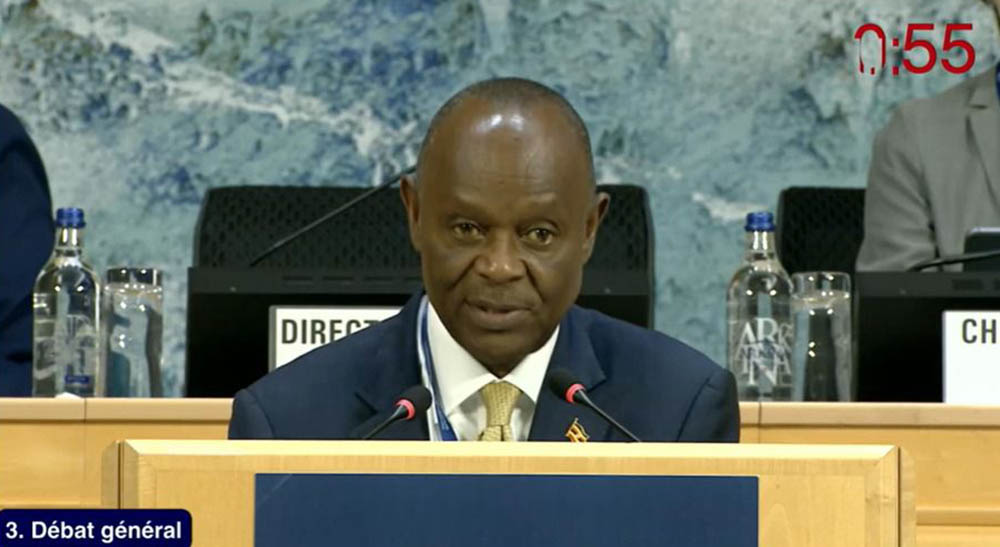
Uganda supports WHO reforms
Uganda also used the Geneva assembly to support ongoing reforms within the WHO and the wider United Nations system, but cautioned that reforms should not weaken the organisation’s operational capacity in member states.
“Reform must strike a delicate balance: addressing challenges while preserving WHO’s fundamental capacity to strengthen country-level operations and respond to Member States’ needs,” Dr Mwebesa said.
He commended WHO Director-General Tedros Adhanom Ghebreyesus for his leadership and said the assembly’s focus on primary health care, universal health coverage, sustainable financing, health workforce strengthening and surveillance aligns closely with Uganda’s national health priorities.
Refugee burden and financing concerns
Uganda further raised concern over growing pressure on its health system as the country continues hosting more than two million refugees, the largest refugee population in Africa.
Dr Mwebesa called on WHO and international partners to provide increased support for refugee health services and national health systems managing humanitarian pressures.
“We are concerned by the dwindling responsibility and burden sharing. We call for enhanced support by WHO and partners to our national health systems for refugee response,” he said.
He called for renewed global solidarity, predictable financing and stronger international cooperation to build resilient health systems capable of responding to future pandemics and public health emergencies.
WHO raises global alarm
The escalating outbreak has now drawn global attention, with the Director-General of the World Health Organization, Tedros Adhanom Ghebreyesus, declaring the Ebola outbreak in Uganda and the DRC a Public Health Emergency of International Concern.
Speaking at the 79th World Health Assembly in Geneva on May 19, Tedros said the decision was taken because of the scale and speed of the epidemic.
“This is the first time a director-general has declared a PHEIC before convening an emergency committee. I did not do this lightly,” Tedros said.
According to the WHO, at least 30 Ebola cases have already been confirmed in the DRC's northeastern province of Ituri, while Uganda has confirmed two cases in Kampala, including one death.
However, the WHO warned that the real scale of the outbreak could be significantly larger.
“Beyond the confirmed cases, there are more than 513 suspected Ebola cases and 131 suspected deaths. We will convene the Emergency Committee today to advise us on temporary recommendations,” Tedros said.
The WHO chief said field operations are currently being expanded, including surveillance, laboratory testing and contact tracing.