
Uganda steps up Ebola measures with ban on handshakes, hugs
Atwine said rapid response and surveillance teams have since been deployed to trace contacts and monitor all possible exposure points linked to the infected individuals. The ministry has also intensified screening at border points, hospitals and public spaces as part of broader containment efforts.
According to permanent secretary Dr Diana Atwine, the temporary suspension of physical greetings is aimed at minimising direct contact, one of the key ways Ebola spreads between individuals.
KAMPALA - The Ministry of Health has temporarily banned handshakes and other forms of physical greetings as health authorities intensify efforts to contain the spread of Ebola following the confirmation of two imported cases linked to the Democratic Republic of Congo (DRC), where deaths have now risen to 131.
The Ministry of Health announced the new preventive measures amid growing concern over the rapid spread of Ebola Bundibugyo, a rare strain, across eastern DRC and fears of wider regional transmission.
According to permanent secretary Dr Diana Atwine, the temporary suspension of physical greetings is aimed at minimising direct contact, one of the key ways Ebola spreads between individuals.
“The country has experience from previous outbreaks, which we have always managed to contain and address in the shortest time possible. This time as well, we are confident that we shall overcome it,” Dr Atwine said during an appearance on the national broadcaster, UBC, on May 18, 2026.
Uganda has already confirmed two imported Ebola cases involving Congolese nationals who travelled into the country seeking medical treatment in Kampala. One of the patients later died at Kibuli Muslim Hospital, while another is currently receiving treatment at an isolation facility at Mulago National Referral Hospital.
Atwine said rapid response and surveillance teams have since been deployed to trace contacts and monitor all possible exposure points linked to the infected individuals. The ministry has also intensified screening at border points, hospitals and public spaces as part of broader containment efforts.
Dr Atwine urged the public to remain calm but vigilant, warning that the outbreak in eastern Congo appears to be spreading rapidly.
“It appears to be a widespread problem. We need to work together; we cannot continue doing things the usual way. That is why we have also been forced to postpone a very major event that attracts many people,” she said.
The government recently postponed this year’s Martyrs’ Day celebrations at Namugongo over fears that the annual pilgrimage could accelerate transmission of the virus.
Atwine reminded Ugandans that symptoms may include fever, vomiting, diarrhoea, unexplained bleeding and severe body weakness.
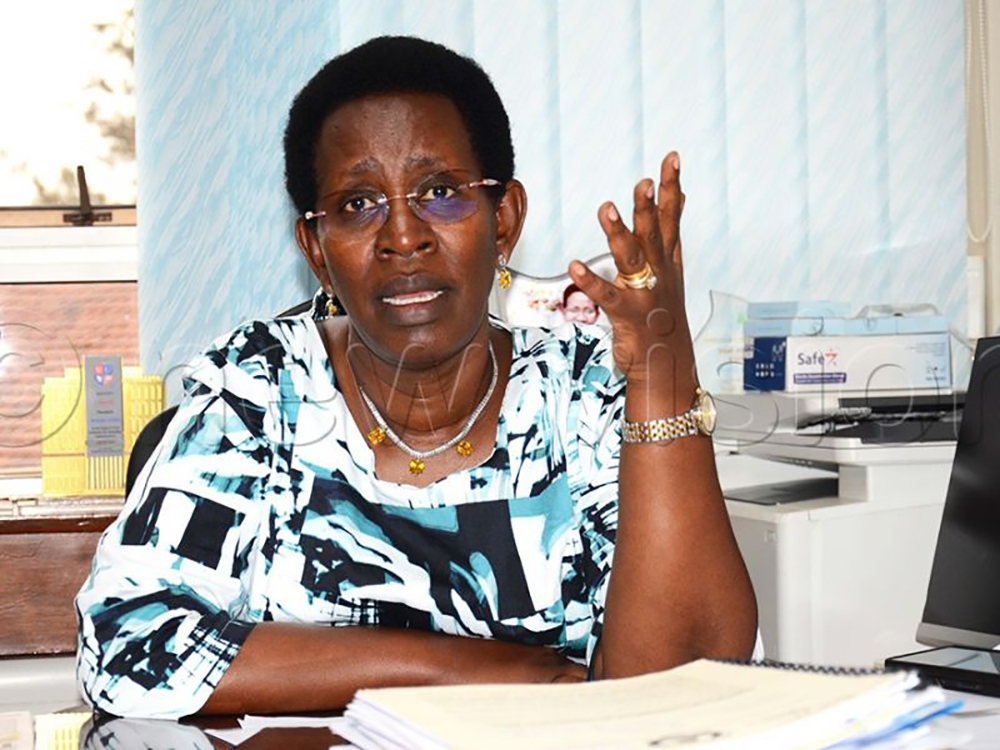
Dr Diana Atwine
Border districts on high alert
Prof. Charles Olaro said risk assessments conducted by the ministry had identified Uganda’s western border districts as highly vulnerable because of intense movement between Uganda and eastern Congo.
“We have conducted a risk assessment and established that the western border from Arua to Kisoro is highly risky. We have deployed surveillance teams across all districts along that stretch, as well as a laboratory in Kasese,” Prof. Olaro said.
Dr Atwine also revealed that Uganda first learnt of the outbreak in Congo on May 14, when about 65 suspected deaths had already been reported.
WHO raises global alarm
The escalating outbreak has now drawn global attention, with the Director-General of the World Health Organisation, Tedros Adhanom Ghebreyesus, declaring the Ebola outbreak in Uganda and DRC a Public Health Emergency of International Concern.
Speaking at the 79th World Health Assembly in Geneva on May 19, Tedros said the decision was taken because of the scale and speed of the epidemic.
According to the WHO, at least 30 Ebola cases have already been confirmed in the DRC's northeastern province of Ituri, while Uganda has confirmed two cases in Kampala, including one death.
However, the WHO warned that the real scale of the outbreak could be significantly larger.
“Beyond the confirmed cases, there are more than 513 suspected Ebola cases and 131 suspected deaths. We will convene the Emergency Committee today to advise us on temporary recommendations,” Tedros said.
The WHO chief said field operations are currently being expanded, including surveillance, laboratory testing and contact tracing.
U.S. imposes travel restrictions
The United States government has announced a comprehensive emergency response to the outbreak, including travel restrictions and emergency funding.
The U.S. Department of State said it had established an interagency Ebola coordination cell involving embassies in Uganda, the DRC, Rwanda and South Sudan.
Washington has also imposed travel restrictions under a Title 42 order prohibiting entry into the United States for foreign nationals who have visited Uganda, the DRC or South Sudan within the last 21 days.
The U.S. has additionally mobilised an initial $13 million (Sh48.5 billion) for outbreak response activities, including laboratory support, surveillance, risk communication, safe burials and emergency case management.