
Steering committee launched to oversee US–Uganda sh8.8 trillion health pact
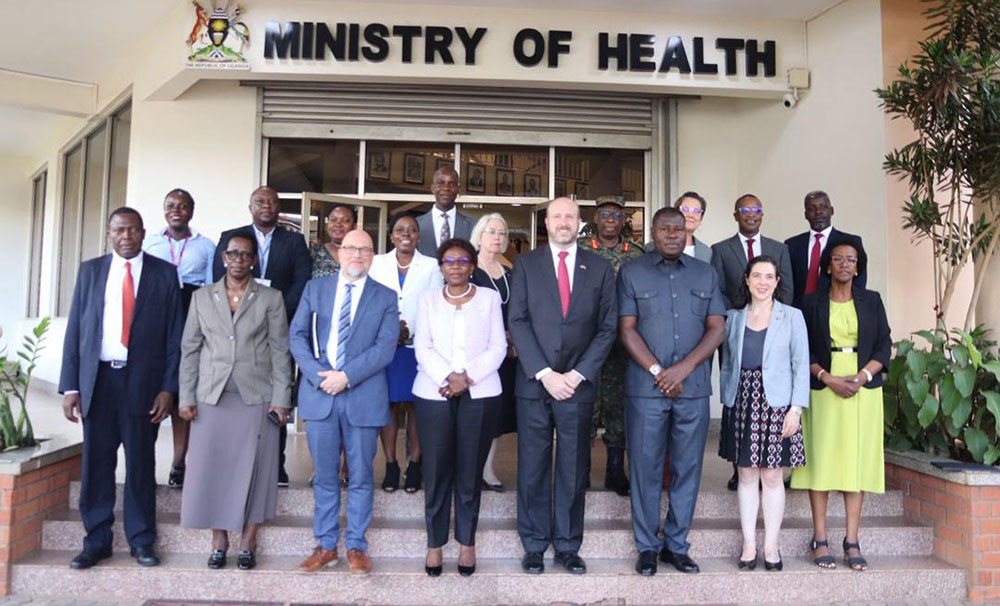
Co-chaired by the U.S. Ambassador to Uganda, William W. Popp and the Minister of Health, Dr. Jane Ruth Aceng Ocero, the Joint Health Steering Committee is designed to ensure that every dollar of the partnership is tracked, aligned, and delivered according to national priorities and agreed performance targets.
Minister of Health Dr. Jane Ruth Aceng Ocero emphasised that the agreement is anchored in national development priorities and long-term system strengthening. (Courtesy Photo)
KAMPALA - The Ministry of Health and the United States have formally launched a new Joint Health Steering Committee (JHSC) to oversee the implementation of a five-year health financing agreement worth $2.3 billion (about sh8.8 trillion), for the two countries to manage large-scale health cooperation operations.
The committee, which held its inaugural meeting at the Ministry of Health headquarters, Wandegeya, will act as the central decision-making and oversight body for the landmark Health Memorandum of Understanding signed in December 2025.
This will bring together senior leadership from both governments to guide, monitor, and coordinate one of the largest bilateral health investments Uganda has ever received.
Co-chaired by the U.S. Ambassador to Uganda, William W. Popp and the Minister of Health, Dr. Jane Ruth Aceng Ocero, the Joint Health Steering Committee is designed to ensure that every dollar of the partnership is tracked, aligned, and delivered according to national priorities and agreed performance targets.
In December 2025, Uganda signed a five-year sh8.8 trillion with the United States Mission in Uganda, aiming to target TB, malaria, global health security, and maternal-newborn care.
The partnership also focuses on improving maternal and child health services, strengthening Uganda’s health systems, and building long-term institutional and workforce capacity to reduce dependency on external support.
According to the Ministry of Health, the Joint Health Steering Committee is not just administrative, but strategic. It will set policy direction, monitor results, manage risks, and strengthen accountability across all programmes funded under the agreement.
Other key responsibilities of the committee include financial oversight, tracking performance indicators, and ensuring that health investments translate into measurable improvements in service delivery and outcomes.
The partnership reflects shared commitment to global health security and resilience, with a focus on addressing diseases at their source while strengthening Uganda’s capacity to respond to future outbreaks.
Speaking during the launch, U.S. Ambassador William W. Popp said the committee is central to the broader strategic direction of the partnership.
“The Joint Health Steering Committee underscores the strategic importance of this partnership. It advances the Trump Administration’s America First Global Health Strategy by addressing disease threats at their source, strengthening bilateral cooperation, promoting American innovation, and building sustainable local health systems that can graduate to self-sufficiency,” said U.S. Ambassador Popp.
According to the Ministry of Health, the Joint Health Steering Committee is not just administrative, but strategic. It will set policy direction, monitor results, manage risks, and strengthen accountability across all programmes funded under the agreement.
The newly established committee will oversee the rollout of an implementation plan that includes $410 million in U.S. health assistance in the first year alone.
That funding will be gradually expanded under a government-to-government framework intended to promote long-term sustainability and local ownership of health systems.
Minister of Health Dr. Jane Ruth Aceng Ocero emphasised that the agreement is anchored in national development priorities and long-term system strengthening.
The committee’s technical focus will include ensuring that funding reaches frontline health workers, improving access to essential medicines and supplies, and strengthening data systems for tracking disease trends, service delivery, and supply chains.
It will also oversee a gradual transition of technical assistance from donor-led clinical site support to government-led health system functions, a shift intended to deepen national ownership of health services.
A strong emphasis has also been placed on co-investment, with Uganda committing over sh2.17 trillion ($577 million) over five years to demonstrate shared responsibility in the health sector.
According to the US government, this marks a significant step toward reducing dependency on external funding while strengthening domestic financing for health.
Another major feature of the agreement is a performance-based approach, which links continued support to measurable results and agreed health indicators. Both governments said this is intended to improve efficiency, accountability, and impact across all programmes.
The JHSC will also play a key role in enhancing preparedness and response to emerging health threats, including outbreaks and cross-border disease risks, reinforcing Uganda’s position in regional and global health security frameworks.
Officials from both sides said the success of the partnership will not be measured only by reductions in disease burden, but also by long-term improvements in systems, institutions, and the overall quality of healthcare delivery.
Ultimately, the Joint Health Steering Committee is expected to serve as the engine room of the entire $2.3 billion cooperation framework, ensuring that commitments made on paper translate into measurable improvements in hospitals, communities, and health systems across Uganda.