
HIV fight is not over — Uganda AIDS Commission boss
Dr. Musoba warned that the country will not win the HIV war if we think the HIV fight is a preserve for the government, Uganda AIDS Commission, Parliament, or Ministry of Health, but it is a community fight.
Stakeholders after the national HIV meeting at Protea Hotel in Kampala. (Credit: David Lukiiza)
Stakeholders in the HIV/AIDs fight have called for enhanced community participation. “The fight against HIV/AIDS is not over, so we would like everyone to join the response,” the Uganda AIDS Commission (UAC) boss, Dr Nelson Musoba, has said.
Dr. Musoba warned that the country will not win the HIV war if we think the HIV fight is a preserve for the government, Uganda AIDS Commission, Parliament, or Ministry of Health, but it is a community fight.
He was speaking during the HIV National Stakeholders Meeting with a focus on the HIV national perspective and strengthening partnerships for a unified HIV/AIDS response at the Protea Hotel in Kampala on Tuesday, April 21, 2026.
In attendance was Otuke East Constituency MP Julius Acon, who delivered the keynote address, emphasising the urgent need for humanitarian action.
“HIV prevention requires everyone to get involved; we need to sensitise our community about the scourge," said Acon, who is a retired athlete and a humanitarian.
Acon further noted that he was inspired to join the HIV fight initiative so as to sensitise his fellow sportsmen.
Other stakeholders in the fight against HIV/AIDS included Ministry of Health officials, health workers, civil society organisations, the business community, university students, and Village Journey Africa, among others.
In his remarks, Dr. Musoba noted that the Uganda AIDS Commission sought the partnership with Village Journeys Africa and has added the Uganda AIDS marathon as one of the avenues to reach the community and to allow it to take charge.
About Uganda AIDS Marathon
For the last 40 years, the Uganda AIDS Commission has been coordinating the HIV response. In this regard, the agency has constantly searched for ways to continue raising awareness about HIV and how to sustain the conversation. Gradually, UAC realised that sports are an attractive way of getting the message out because people love it.
“We are using these strategies to reach out to communities using non-conventional, traditional methods. In addition, we are also in touch with artists, musicians, and comedians,” he noted.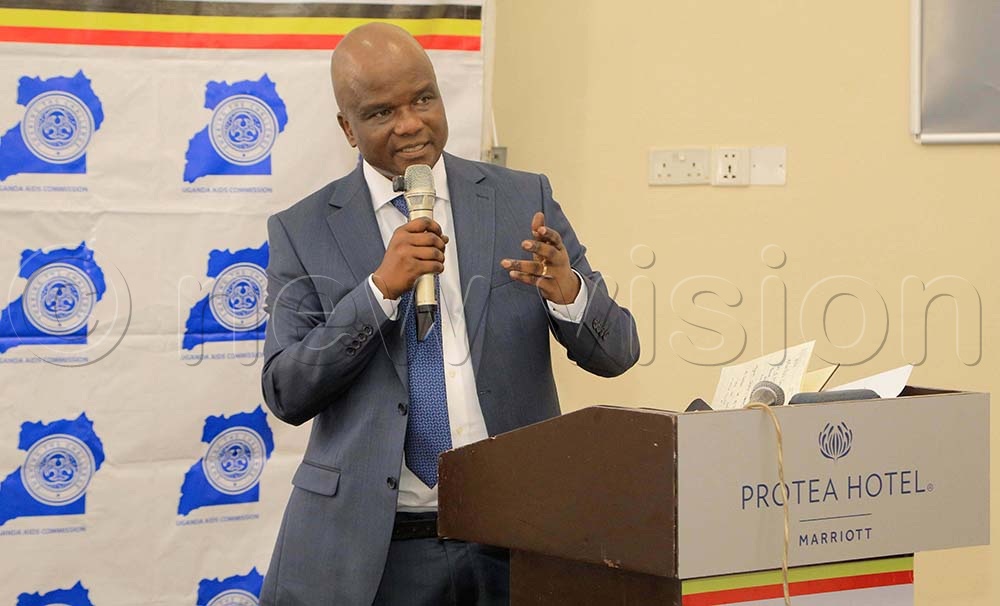
In his remarks, Dr. Musoba noted that the Uganda AIDS Commission sought the partnership with Village Journeys Africa and has added the Uganda AIDS marathon as one of the avenues to reach the community and to allow it to take charge. (Credit: David Lukiiza)
It is upon this background that the Uganda AIDS Commission, in partnership with Village Journey Africa, has organised the Uganda AIDS marathon as one of the build-up activities of World AIDS Day.
The marathon will be launched and activated in 10 cities, given that their HIV prevalence is higher than the rest of the country, said Village Journeys Africa Chief Executive Director Maery Mungati.
According to the 2025 National HIV Estimates Report, Fort Portal city leads with a prevalence of 14.3%, Soroti city at 11.6%, Mbarara city at 9.9%, Gulu city at 9.6%, Masaka city at 9.6%, Lira city stands at 9.1%, Hoima city with 7.7% (down), Jinja City at 6.5%, Mbale city at 4.9% and Arua City at 4.0%.
The climax of the marathon will be in Kampala on the 29th, marking it as a national event. She urged upcountry stakeholders to join the city marathons in the different regions of the country.
HIV burden
In 2024 alone, 37,000 new infections were recorded nationwide, with nearly 70% of the infections happening among adolescent girls and young women (15–24).
By contrast, only 17% of new infections were among boys and uncircumcised men engaging in unsafe sexual practices. HIV prevalence has slightly declined from 5.1% in 2023 to 4.9% last year.
Annual AIDS-related deaths have also dropped significantly, from 54,000 in 2010 to 20,000 in 2024.
Approximately 1.5 million Ugandans are living with HIV, with about 1.3 million currently on antiretroviral therapy.