
Avoid unprotected sex 48 hours after Lenacapavir jab, scientist advises
Dr Flavia Matovu Kiweewa, who has been at the forefront of Lenacapavir trials, said the two-day waiting period is critical, especially for those eager to resume sexual activity immediately after receiving the jab.
Health Minister, Dr Jane Ruth Aceng officiating the launch of Lenacapavir on April 17 in Lira City. (Credit: Agnes Kyotalengerire)
________________
Ugandans receiving the newly introduced long-acting HIV prevention injection, Lenacapavir, have been advised to wait at least 48 hours before having unprotected sex to allow the drug to build up to protective levels in the body.
In an extensive interview with the leading Ugandan scientist, Dr Flavia Matovu Kiweewa, who has been at the forefront of Lenacapavir trials, said the two-day waiting period is critical, especially for those eager to resume sexual activity immediately after receiving the jab.
“The injection does not work instantly. If you want to be protected early, you must take the four oral pills provided and wait 48 hours before having sex. Do not rush into sex immediately after the injection. Wait 48 hours, take the pills, and give the drug time to work,” Dr Kiweewa explained in an interview
Why the 48-hour wait matters
Lenacapavir is designed as a long-acting HIV prevention drug, administered once every six months. But unlike a vaccine that may trigger an immediate immune response, the drug needs time to reach what scientists call a protective threshold in the body.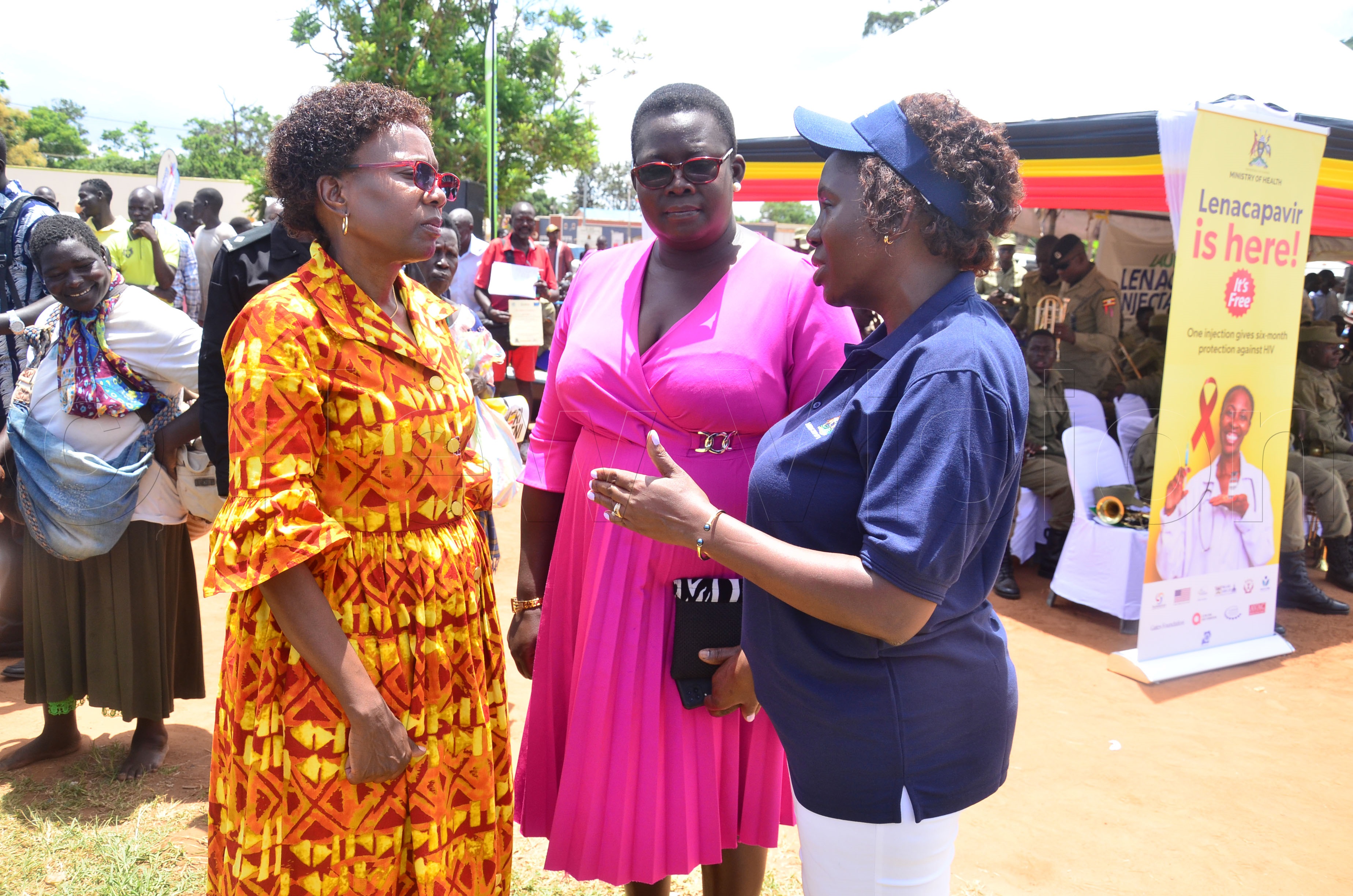
Dr Flavia Kiweewa Matovu talking to the Health Minister after the launch of Lenacapavir in Lira City. (Credit: Agnes Kyotalengerire)
Dr Kiweewa said that without the accompanying starter pills, it can take up to 28 days for the drug levels from the injection alone to become fully protective.
“To bridge that gap, we give two pills immediately after the injection and two more the following day. By the end of those two days (48 hours), you have enough drug in your system to safely begin sexual activity,” she said.
She cautioned that skipping the pills or ignoring the waiting period could leave individuals exposed to HIV infection despite receiving the jab.
How the injection works in the body
During the rollout of Lenacapavir in Lira, New Vision witnessed jabs being given to the stomach or thighs, where the recipients would be asked to choose one of their preference. We asked Dr Kiweewa about the science behind this.
She highlighted that the Lenacapavir jab is administered under the skin (subcutaneous tissue), where it forms a small depot, a temporary swelling or nodule that slowly releases the drug into the bloodstream over six months.
“The medicine dissolves gradually and spreads to all parts of the body, including the genital tissues where protection is needed,” Dr Kiweewa explained. “That’s how it blocks HIV if exposure occurs.”
This slow-release mechanism is what allows Lenacapavir to be taken just twice a year, a major shift from daily oral PrEP pills.
Why injection sites vary
While the drug was initially administered in the abdomen and thighs, ongoing studies in Uganda are now offering more flexibility. Dr Kiweewa revealed that participants can receive the injection in four areas of the body: the upper arm, abdomen, thigh, and buttocks, giving users flexibility and comfort in choosing what works best for them.
Interestingly, many Ugandan women are now opting for the upper arm, which she said is seen as more convenient and less intrusive compared to other sites that may require more privacy.
“The upper arm is more convenient and less intrusive. You don’t need privacy like with the abdomen or thighs, and people are already used to injections in the arm,” she said.
She emphasised that the effectiveness of the drug does not depend on where it is injected.
“Whether it’s the arm, abdomen, thigh, or buttocks, the drug works the same,” she said.
Returning for the next dose
To maintain protection, Dr Kiweewa noted that users must return for their next injection every six months, with a small flexibility window.
“You should come back on time, within plus or minus 14 days of your due date. If you took the jab on the 1st, you must go back for the second jab two weeks before or after the 1st of next month. Missing the scheduled dose could reduce protection levels, increasing the risk of HIV infection,” Dr Kiweewa advised.
A game-changer—but not a silver bullet
While officiating the launch of Lenacapavir on April 17 in Lira, Health Minister Jane Ruth Aceng described the drug as a game-changer, noting that it offers a convenient alternative to daily pills and could significantly reduce new infections.

Health Minister, Dr Jane Ruth Aceng officiating the launch of Lenacapavir on April 17 in Lira City. (Credit: Agnes Kyotalengerire)
Uganda has already reduced new HIV infections from 96,000 in 2010 to about 37,000 in 2025, but about 100 people still acquire HIV every day, with many of them young women. Despite the excitement around Lenacapavir, Dr Kiweewa and health officials stress that it should be used correctly and alongside other prevention strategies.
“The rollout of Lenacapavir will be phased, prioritising people at risk in high-burden districts. The Ministry of Health has completed training at 103 health facilities across the country, which will begin phase 1 implementation this April. By December 2026, a total of 300 health facilities shall be expected to provide lenacapavir for PrEP, Dr Aceng said.
The rollout of Lenacapavir in Uganda is being driven by a broad coalition of international partners, technical agencies, and donors, including the Global Fund, the United States Government, and the World Health Organisation, alongside civil society groups, community networks, and implementing partners.
These collaborations are aimed at ensuring that scientific breakthroughs translate into equitable access for populations most at risk of HIV, while strengthening national prevention efforts.
Speaking on behalf of development partners, United States Deputy Chief of Mission Mikael Cleverley described the rollout as a major milestone in global HIV prevention efforts.
“We’re here today to celebrate the historic next step in the United States’ partnership with the Global Fund and Gilead Sciences to provide Lenacapavir to high-burden HIV countries, including Uganda. Lenacapavir is a groundbreaking innovation from an American company, and it demonstrates American excellence in science and leadership in HIV prevention,” he said.
He added that the United States and the Global Fund have set an ambitious target to reach three million people in high-burden countries with Lenacapavir by 2028.