
Experts call for stronger partnerships to improve Uganda’s cancer response
Ugandan cancer epidemiologist Dr Annet Nakaganda, who specialises in the causes of cancer and clinical trials, said civil society organisations should complement existing Government structures rather than create parallel systems that consume time and resources.
Uganda’s cancer epidemiologist Dr Annet Nakaganda posing for a group photo with other panellists after the session at the 28th World Cancer Congress in Hong Kong. (Photo by John Musenze)
_________________
Uganda needs stronger coordination between government, civil society and other stakeholders to improve cancer control, with experts calling for better use of existing systems, evidence-based planning and greater domestic funding.
Ugandan cancer epidemiologist Dr Annet Nakaganda, who specialises in the causes of cancer and clinical trials, said civil society organisations should complement existing Government structures rather than create parallel systems that consume time and resources.
"What civil society organisations have to do is to make sure that they help the existing systems and structures connect and work better, other than maybe establishing a parallel system altogether," Nakaganda said.
Nakaganda was speaking after presenting on the role of civil society in national cancer control planning and implementation at the 28th World Cancer Congress in Hong Kong, organised by the Union for International Cancer Control (UICC).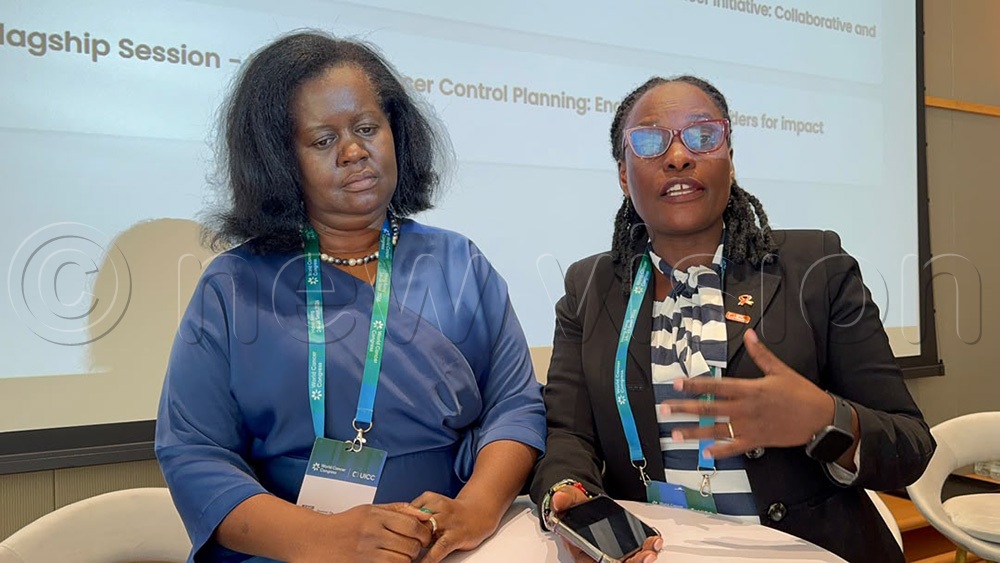
Uganda’s cancer epidemiologist Dr Annet Nakaganda on the left with Dr Sharon Kapambwe, who works with the WHO European Region. (Photo by John Musenze)
Uganda was represented by about 20 delegates drawn from civil society, the cancer institute, advocacy groups and cancer survivors.
Nakaganda, who has worked in both government and civil society systems in Uganda, said civil society organisations have an advantage because of their speed and flexibility in connecting stakeholders and responding to gaps.
“The good thing with the civil society is the ability to move and to connect stakeholders quickly. And when I say quickly, I mean quickly, as in time. Time is one of the precious resources we have,” she said.
She said civil society should first identify gaps in existing systems, test solutions that address those gaps, and then work with Government to implement and scale up interventions that have proved effective.
"In that way, we shall have a cancer control system in Uganda that is really very, very functional," she said.
The call comes amid a growing cancer burden in Uganda, with approximately 39,000 new cases and around 24,600 cancer-related deaths reported annually, according to 2026 data from the Uganda Cancer Institute.
The data also showed that about 80% of Ugandans have never been tested for cancer and therefore do not know their status.
Nakaganda said Uganda's rising cancer burden is linked to both demographic changes and lifestyle and environmental factors.
“One is that as the population increases, of course we are going to see more cancer cases, but also due to increasing age. The higher the life expectancy, the more chances of getting cancer,” she said.
“We have what we call the lifestyle or the behaviours we choose to adopt that also predispose us to cancer-causing agents like smoking, tobacco, alcohol consumption, physical inactivity, overweight, and unhealthy dieting,” she added.
She also cited environmental exposures, including fuel fumes, air pollution and roofing materials such as asbestos, which individuals have little control over and must rely on Government action to address.
Nakaganda welcomed recent moves to ban charcoal use, saying prolonged exposure to charcoal smoke predisposes Ugandans to cancer. She also linked charcoal production to environmental degradation, which she said undermines the environment's role in protecting against disease.
The need for stronger planning and domestic ownership was also emphasised by Dr Sharon Kapambwe, who works with the WHO European Region and has spent more than 15 years helping countries, particularly African countries, develop national cancer control plans.
Kapambwe said countries should begin by developing cancer control plans based on detailed assessments of their cancer burden and the interventions that can have the greatest impact.
“One of the first things is to make sure that a country has a cancer control plan. Prioritize. You need to do a situation analysis which is detailed and true of the picture in your country,” Kapambwe said.
She said such an analysis should examine which cancers are killing people, which of the top five or 10 cancers have the most effective interventions, and where inequalities exist, including between women and children, rural and urban areas, and men and women.
"At the end of the day, the government will put money where they're going to get the most out of that at a certain cost," she said.
Kapambwe warned that cancer control plans risk remaining unimplemented without domestic funding.
"Above all, we should make sure that our cancer control plans are getting domestic funding. Yes, we get partners to help. But the change will come when there is domestic funding from within the countries to support these plans. Otherwise, they end up being plans that are merely sitting on shelves gathering dust," she said.
She added that cancer control requires involvement beyond the Ministry of Health, including finance and commerce stakeholders because some cancer risk factors extend beyond the health sector.
“For civil societies like Annet's who are working, it also means that we need to ensure that the stakeholders at the table include the finance team, the Ministry of Finance, not just the finance team in the Ministry of Health, the Ministry of Commerce and Industries, because some of the risk factors for cancer go beyond the health sector.”