
Exclusion of key populations undermining health gains, EOC report says
Isabirye noted that findings from districts such as Kasese and Bushenyi show that stigma, particularly from some health workers, has eroded trust in the health system, discouraged disclosure, and weakened adherence to treatment.
Petua Isabirye (L), EOC's Principal Education Officer, who unveiled the report, Julius Kamya (C), a Commissioner in charge of education at EOC and Dr Charles Olaro, who was the chief guest at the event. (Credit: Rhyman Agaba)
The exclusion of vulnerable and key populations from essential health services is undermining Uganda’s progress in tackling HIV, tuberculosis (TB), and malaria, a new report by the Equal Opportunities Commission (EOC) has revealed.
Presenting the findings on March 31, 2026, at Imperial Royale Hotel in Kampala, EOC Principal Education Officer, Petua Babirye Isabirye, said persistent inequalities, stigma, and systemic barriers continue to lock out those most at risk from accessing care.
“The study highlights critical realities affecting vulnerable populations and the urgent need to address exclusion if we are to end these diseases,” Isabirye said while unveiling the 98-page report.
She explained that the report focuses on key populations most affected by these barriers, including truck drivers, sex workers, people with disabilities (PWDs), and the elderly, among others, who often face overlapping vulnerabilities that limit their access to healthcare services.
Titled “Documentation of Human Rights and Equity Violations: An Assessment of Access to HIV/AIDS, TB and Malaria Services by Vulnerable Populations in Uganda,” the report documents widespread discrimination, service gaps, and structural challenges across the country.
Isabirye noted that findings from districts such as Kasese and Bushenyi show that stigma, particularly from some health workers, has eroded trust in the health system, discouraged disclosure, and weakened adherence to treatment.
“These judgmental attitudes have serious consequences. Patients lose confidence in health facilities, which ultimately affects health outcomes,” she said.
To address this, the Commission recommends mandatory anti-stigma training for health workers, linked directly to licensing and performance assessments. It also proposes stronger oversight by regulatory bodies to ensure professionalism across the health sector.
The report further highlights that exclusion is most severe in high-burden and hard-to-reach areas.
The study covered 40 districts across Uganda’s central, western, eastern, and northern regions, including border communities, islands, and post-conflict areas.
“We deliberately targeted districts and communities that experience a disproportionate burden of HIV, TB, and malaria to ensure no region is left behind,” Isabirye emphasised.
Island districts such as Kalangala and Buvuma were highlighted for their unique challenges, including limited access to health facilities due to reliance on water transport.
Similarly, post-conflict districts such as Amuru, Kitgum, and Gulu continue to face weak infrastructure and long distances to healthcare services.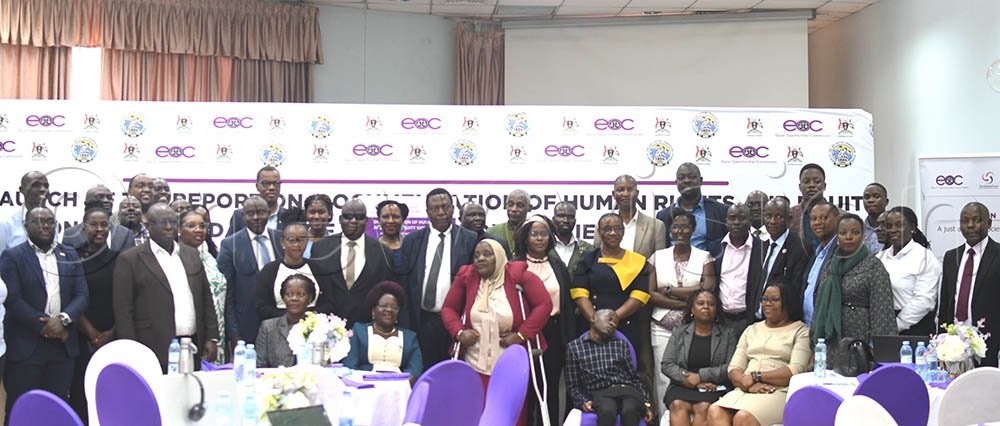
Participants who attended the launch of the report at Imperial Royale Hotel on Tuesday, organised by EOC with support from Global Fund and TASO, these included government officials, civil society personnel and EOC staff. (Credit: Rhyman Agaba)
The report also points to high-burden districts such as Busia, Kasese, Kisoro, and Namayingo, where prevalence rates remain elevated and access to integrated services is still inadequate.
Beyond geographical barriers, the report identifies misinformation, myths, and social stigma as key drivers of exclusion.
Brenda Facy Azizuyo, a programmes officer at the International Community of Women Living with HIV Eastern Africa, said many people living with HIV and TB continue to face discrimination due to limited public understanding of the diseases.
“The key issue that came out strongly is stigma and discrimination. Many people still do not understand HIV, and this is driven by myths and misinformation,” Azizuyo said.
She called for stronger collaboration between the government, civil society, and communities to address these knowledge gaps and promote inclusive health services.
“We need to work together to tackle stigma and understand its root causes if we are to improve access to care,” she added.
Responding to the report, the Director General of Health Services at the Ministry of Health, Charles Olaro, acknowledged the challenges highlighted and welcomed the recommendations.
He noted that while compassion is already part of medical training, there is a need to strengthen its application in practice.
“Training of health workers includes compassion. However, we will work with training institutions to further emphasise patient-centred care and professional conduct,” Olaro said.
He added that the Ministry will review the report and work with its technical teams to integrate feasible recommendations into policy and programming.
“This is not just an academic exercise. It is critical in strengthening accountability, improving our healthcare system, and ensuring that every Ugandan accesses care with dignity and respect,” he said.
The study, conducted in December 2025 with support from the Global Fund and The AIDS Support Organisation (TASO), also calls for strengthening human resource capacity and scaling up community sensitisation efforts.
EOC Secretary to the Commission, Shaft Nasser Mukwaya, commended the report’s contributors and emphasised the importance of incorporating the lived experiences of affected populations in shaping policy responses.
“We recognise the support from our partners and the voices of key populations whose experiences have shaped this report,” Mukwaya said.
Other stakeholders present included Fatia Kiyange, executive director of the Centre for Health, Human Rights and Development (CEHURD).
The report concludes that unless deliberate efforts are made to eliminate stigma, strengthen systems, and prioritise inclusion, Uganda risks reversing gains made in the fight against HIV, TB, and malaria.