
Excessive bleeding after childbirth a silent killer of mothers
Dr Kisegerwa said that, given the risk of excessive bleeding, the Mulago community was encouraged during the walk to donate blood and ensure blood is readily available for mothers.
The walk, held on October 3, 2026, under the theme "Prevent, Recognise, Respond to Save Lives,” was part of a gear-up activity for World Post-Partum Haemorrhage Day, an annual event that falls on October 5. (Credit: Agnes Kyotalengerire)
Excessive bleeding after childbirth, medically known as postpartum haemorrhage (PPH), remains the leading cause of maternal deaths in Uganda, accounting for 46% of reported maternal deaths, according to the National Annual Maternal, Newborn, and Child Health (MNCH) and Maternal and Perinatal Death Surveillance and Response (MPDSR) report for 2024/2025.
A team of health workers from the Ministry of Health and Mulago Specialised Women and Neonatal Hospital, led by the acting deputy executive director, Dr Enock Kisengerwa, and the chairperson of the Postpartum Haemorrhage Subcommittee at the Ministry of Health, Dr Joy Beyeza, trekked up Mulago Hill and traversed the Wandegeya community to raise awareness about excessive bleeding after delivery.
The walk, held on October 3, 2026, under the theme "Prevent, Recognise, Respond to Save Lives,” was part of a gear-up activity for World Post-Partum Haemorrhage Day, an annual event that falls on October 5.
Dr Kisegerwa, who was the chief walker, said excessive bleeding after delivery, also known as obstetric haemorrhage, remains the leading cause of maternal deaths in Uganda.
He said the excessive bleeding can be difficult to control, resulting in the loss of mothers' lives.
“It is unfortunate for a mother to lose a life while giving a life,” he said and added that no effort must be spared to see that the mothers don't suffer that fate.
Excessive bleeding cases
According to the National Annual Maternal, Newborn, and Child Health (MNCH) and Maternal and Perinatal Death Surveillance and Response (MPDSR) report for 2024/2025, excessive bleeding after delivery, or postpartum haemorrhage, was the leading cause of maternal deaths, accounting for 46% of all reported maternal deaths.
By age, women aged 25 years and above accounted for the highest proportion of deaths due to excessive bleeding after childbirth in the same period, at 76%. They were followed by women aged between 20 and 24 years, who accounted for 15%, while those aged 19 years and below accounted for 9%.
The chairperson of the Postpartum Haemorrhage Subcommittee at the Ministry of Health, Dr Joy Beyeza, described excessive bleeding after delivery as a monster.
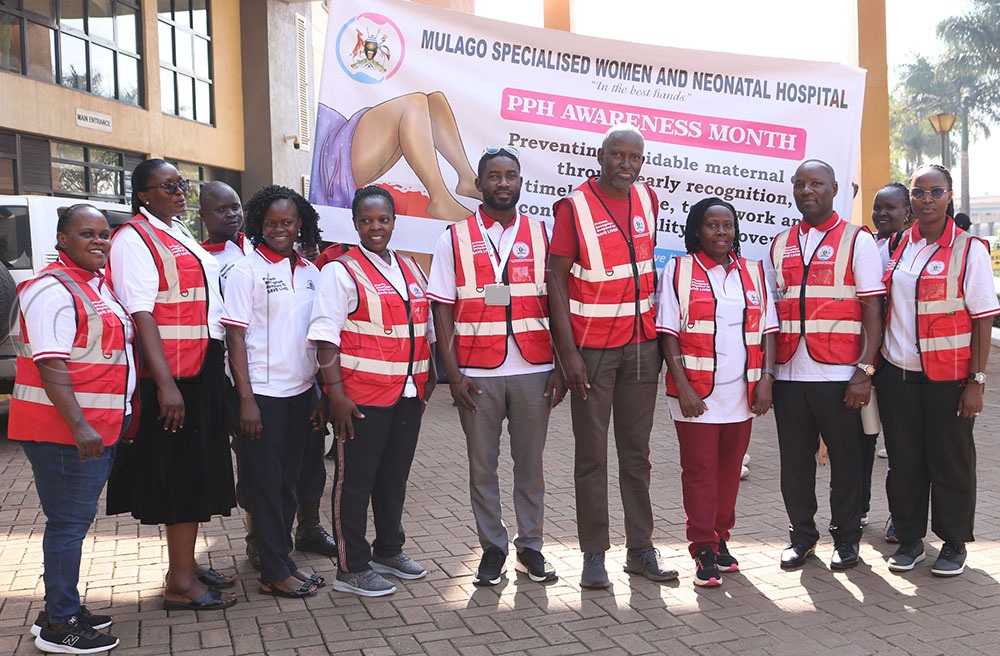
A team of health workers from Ministry of Health and Mulago Specialised Women and Neonatal hospital after the walk. (Credit: Agnes Kyotalengerire)
She further noted that Mulago Specialised Women and Neonatal Hospital decided to conduct the awareness campaign because health workers cannot control what happens beyond the hospital's gate.
“If a mother comes very late, they will not be able to save her, and it will hurt them. So, the more reason they are reaching out to the community around them,” Dr Beyeza said.
The senior obstetrician and gynaecologist at Mulago Specialised Women and Neonatal Hospital, Dr Stephen Baguma, said it is important to raise awareness about postpartum haemorrhage so that mothers can take steps to prevent it.
According to Dr Baguma, preventing excessive bleeding does not begin in the hospital or when a mother goes to deliver. It begins well before conception, as an individual plans for delivery, and continues during antenatal care, where mothers receive the necessary information to help prevent the condition.
Causes of excessive bleeding after delivery
Dr Baguma noted that excessive bleeding after childbirth is mainly caused by tears in the birth canal and uterus, which is termed "ruptured uterus", after which bleeding starts. Another cause is failure of the uterus to contract.
Naturally, the uterus has mechanisms for closing off the blood vessels that supplied the baby through the placenta, causing the bleeding to stop. However, bleeding continues when the uterus fails to contract.