
African states push for self-reliant health systems at sovereignty conference
In her opening remarks, the permanent secretary in the Ministry of Health, Dr Diana Atwine, said the meeting had been deliberately planned to respond to current challenges facing health systems across the continent.
The permanent secretary in the Ministry of Health, Dr Diana Atwine addressing officials from ministries of health and finance at Kampala Serena Hotel. (Courtesy photos)
________________
African countries have convened in Kampala for a three-day meeting to discuss how to build stronger, self-reliant health systems amid shifting global funding dynamics.
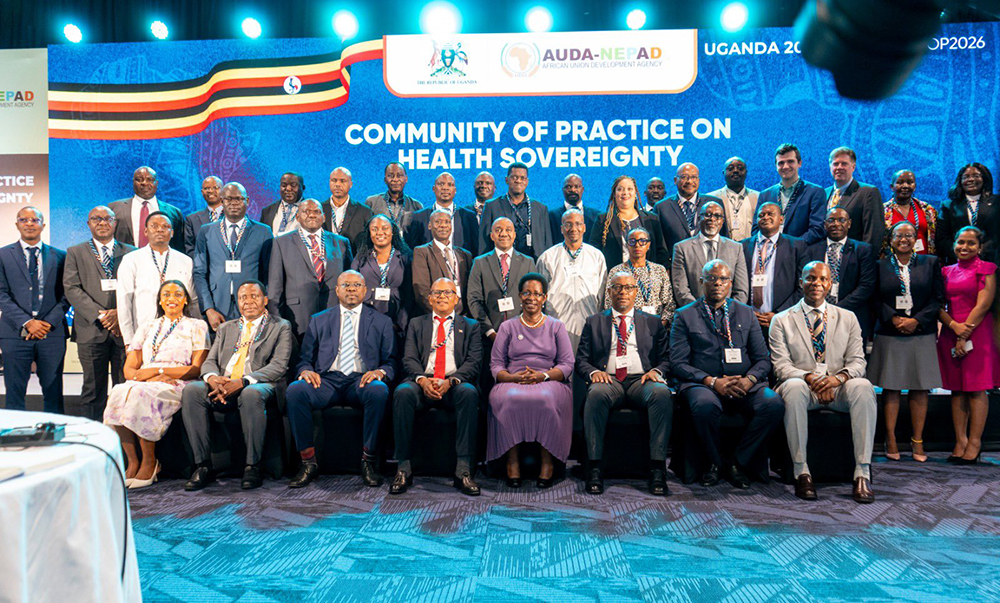
The inaugural Community of Practice on Health Sovereignty, running from March 23 to March 25, 2026, at Kampala Serena Hotel, has brought together officials from ministries of health and finance in eight countries, including Senegal, Kenya, Eswatini, Mozambique, Zambia, Tanzania, Botswana, and South Africa.
The meeting, co-hosted by Uganda alongside the African Union Development Agency (AUDA-NEPAD) with support from Georgetown University, is focused on creating a platform for countries to share experiences and develop practical, country-led solutions to health system challenges.
In her opening remarks, the permanent secretary in the Ministry of Health, Dr Diana Atwine, said the meeting had been deliberately planned to respond to current challenges facing health systems across the continent.
“We are not here by chance; we are here by design,” she said, emphasising that health should be seen not just as a service but as a key driver of socio-economic transformation.
She noted that while some countries have managed to sustain essential services despite changes in global funding, the situation highlights the need to increase domestic financing and better align health priorities with national development agendas.
Participants are expected to focus on how governments can reduce dependence on external funding and instead invest more of their own resources in health systems. This includes improving efficiency, achieving better value for money, and moving away from fragmented approaches.
Linton Mchunu, advisor to the CEO of AUDA-NEPAD, said the meeting will provide an opportunity for countries to build a common understanding of the challenges they face and design practical solutions driven by local realities.
“The cost of inaction is always higher than action,” he said.
Discussions are also expected to explore ways African countries can work together more closely, including through pooled procurement of medical supplies and strengthening local manufacturing capacity.
Dr Atwine encouraged countries to collaborate more, suggesting approaches where nations can trade health commodities among themselves to reduce costs and improve access.
“Uganda emphasises that this convening is by design, not chance, calling for a shift in the conversation to prioritise health, maximise value for money, and move away from fragmented approaches. Central to this is building self-reliant systems that can withstand changes in external financing. As African countries, we must pursue cost-saving measures such as pooled procurements, strengthening local manufacturing capacity, and deepening collaboration. You buy my test kits, I buy your medicine. Let’s collectively do more with less for sustainability,” Atwine noted.
Deus Bazira, director of the Georgetown University Global Health Institute, urged participants to ensure that reforms are well thought out and sustainable.
“We should not compromise competence just to get something done,” he said.
The meeting comes at a time when many African countries are rethinking how to finance and manage their health systems in the face of declining donor support. By bringing together both health and finance ministries, the organisers aim to ensure that decisions go beyond policy discussions and translate into practical, sustainable action.