
US aid cuts force NGOs out of Kiryandongo, 146 health workers laid off
The funding cuts have disrupted health services, reduced food and cash support to vulnerable families, and weakened efforts to fight malnutrition, especially among refugees and host communities.
US aid cuts force NGOs out of Kiryandongo, 146 health workers laid off
KIRYANDONGO - Kiryandongo district is facing a growing health crisis after several non-governmental organisations scaled down or closed operations following cuts in US funding, leaving at least 146 health workers out of jobs.
The funding cuts have disrupted health services, reduced food and cash support to vulnerable families, and weakened efforts to fight malnutrition, especially among refugees and host communities.
In Kiryandongo, one of Uganda’s largest refugee-hosting districts, the impact is already big and unbearable, with at least five non-governmental organisations having scaled down or closed operations, triggering the loss of 146 health workers and leaving critical gaps in service delivery.
“The partners who have left have left us with a very big staffing gap. In the health sector, 146 staff have been laid off. In education, 173 teachers have also lost their jobs. It is a very big problem,” said Chief Administrative Officer Anslem Kyaligonza for Kiryandongo during the launch of the mass malnutrition screening launch on March 19 at Kiryandongo district headquarters.
The exodus is linked to cuts in international funding, particularly from the United States, which has long been a major backer of humanitarian programs in Uganda’s refugee settlements.
As funding declines, the consequences are cascading through health systems, food supply chains, and household incomes. For a district where refugees make up nearly half the population, the timing could not be worse.
Kiryandongo hosts about 165,000 refugees within a total population of 365,000, according to Acting District Health Officer Dr. Irene Nabitaka. The district’s population is overwhelmingly young, with more than half aged below 18, a demographic particularly vulnerable to malnutrition and disease.
“Our staffing level is only at 38 percent, and nutrition staffing is even worse at 30 percent. We do not even have a district nutritionist. Yet the burden we are dealing with is enormous.” Nabitaka said.
The district’s health system, already under strain, has been further weakened by the departure of implementing partners who previously supported staffing, food distribution, and emergency services.
“Most of these partners were providing human resources to health facilities. When they withdrew, over 146 staff were lost. That has affected service delivery significantly,” Nabitaka explained.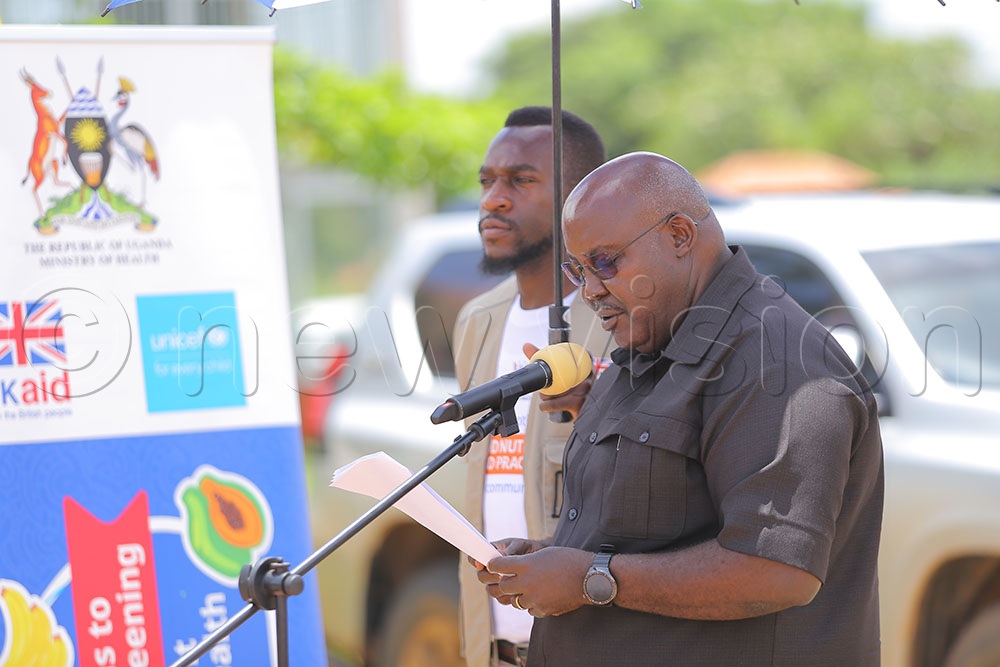
Chief Administrative Officer Anslem Kyaligonza for Kiryandongo during the launch of the mass malnutrition screening launch on March 19 at Kiryandongo district headquarters. (Credit: John Musenze)
According to the CAO, the cuts extend beyond staffing because food assistance and cash support to refugee households have also been reduced, undermining already fragile livelihoods. Kyaligonza said that some partners previously provided substantial financial assistance to families.
“There was support of up to $1,00 (sh3.7 million) per household, though it was a one-off; this is now totally off. Now, even the regular support has reduced. UNHCR has scaled down cash support, and the World Food Programme has also reduced food supplies. Other NGOs helped us with human resources, items and cash, but these have closed down,” he said.
Nabitaka highlighted that today, some households receive as little as Shs10,000 per month, an amount local officials said is insufficient to meet basic nutritional needs. She noted that the result is a slow but steady deterioration in food security, particularly among children.
“We are seeing the effects directly. Malnutrition is increasing, and at the same time, our capacity to respond is going down.” Nabitaka said.
Data from the district shows that the Global Acute Malnutrition rate currently stands at 8 percent an alert level. Moderate acute malnutrition is at 5.8 percent, while severe acute malnutrition stands at 1.2 percent.
Although these figures represent an improvement from previous years, district officials warned that the gains are fragile and could be reversed by the current funding crisis.
Nationally, the situation mirrors the local reality. Uganda continues to grapple with high levels of malnutrition, with more than 2.4 million children under five stunted, a sign of chronic, irreversible damage. About 29 percent of children are affected, while anaemia remains widespread among both children and women.
In refugee-hosting districts, over 114,000 children and 13,000 pregnant and breastfeeding women are estimated to be acutely malnourished.
Kyaligonza, however, said the district has secured some new collaborations, including programmes that will provide small cash transfers and livelihood support to selected households.
“One organisation will support 3,500 households with about Shs16,000 per month in host communities and Shs18,000 in the settlement,” he said. “Another will train youth and women and give them start-up capital of about Shs500,000 to begin businesses.”
The Director General of Health Services, Dr. Charles Olaro, who represented Health Minister Jane Ruth Aceng at the launch, acknowledged the funding challenges but reaffirmed government's commitment to addressing the crisis.
“We are in the process of recruiting health workers, and currently, the first phase is for those who were affected by the US funding cuts. We believe that in this exercise, we will deploy more professionals,” Olaro noted.