
Easter fever grips Kampala suburb as Orthodox faithful end 54-day fast
Globally, this tradition is observed across countries with strong Orthodox heritage, including Ethiopia, Eritrea, Russia, Greece, Serbia and Ukraine. In Africa, Ethiopia, in particular, is known for its deeply rooted Orthodox traditions under the Ethiopian Orthodox Tewahedo Church.
The Lead Priest Siyuman Binian (left) at Soya Medhananialem Ethiopian Orthodox church in Bbunga Makindye Division with believers during the Easter Celebrations on Saturday. (Credit: Benjamin Semwanga)
_______________
The air in Bunga-Soya suburbs, Kampala, is rich with the aroma of freshly brewed coffee and the unmistakable spice of doro wat, signalling not just a feast, but the end of a profound spiritual journey.
The festive mood spreads to neighbouring Kabalagala and Ggaba as Orthodox Christians on Saturday emerged from a demanding 54-day fast, stepping into Easter with a blend of reverence, relief and radiant joy.
These celebrations follow the ancient Julian Calendar, still used by many Orthodox churches to determine the dates of religious feasts. This is why Orthodox Easter often falls later than that observed by Western churches using the Gregorian calendar.
Globally, this tradition is observed across countries with strong Orthodox heritage, including Ethiopia, Eritrea, Russia, Greece, Serbia and Ukraine. In Africa, Ethiopia, in particular, is known for its deeply rooted Orthodox traditions under the Ethiopian Orthodox Tewahedo Church.
At Medhanialem Orthodox Church - one of the most prominent Orthodox worship centres serving Kampala’s diverse faithful, the celebration beats are stronger.
The Mbunga-Soya complex is closely associated with the Ethiopian Orthodox Tewahedo Church, which represents one of the largest and most visible Orthodox communities in Uganda.
From the early hours, streams of worshippers dressed in flowing white garments on Saturday (April 11) gathered. Their movements - bowing and kneeling in prayer - create a solemn rhythm that reflects both devotion and discipline.
Inside the church, the atmosphere is deeply contemplative.
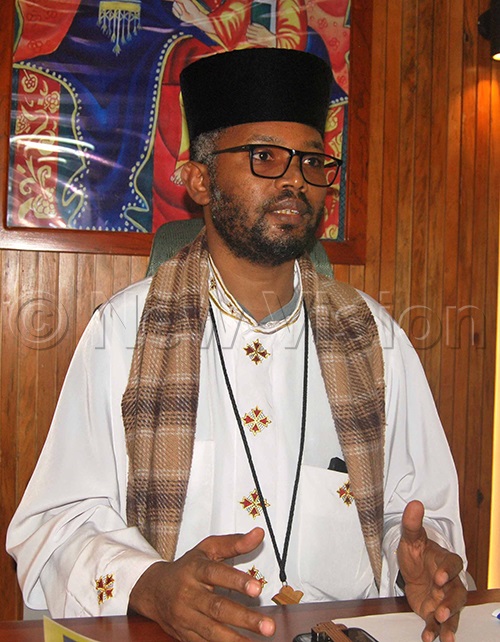
Priest Siyuman Binian. (Credit: Benjamin Semwanga)
The service builds to a moment of stillness as Father Siyuman Binian delivers a message that resonates far beyond the church walls. His words challenge the congregation to embody the teachings they have spent weeks reflecting upon.
“There is too much in this world for anyone to sleep hungry, to wear rags, or to have no shelter,” he tells the attentive congregation, his voice steady but firm.
His message underscores a central theme of Easter: faith is not merely ritual, but a lifetime’s responsibility. It is a call to action - one that extends into homes, communities and the wider world.
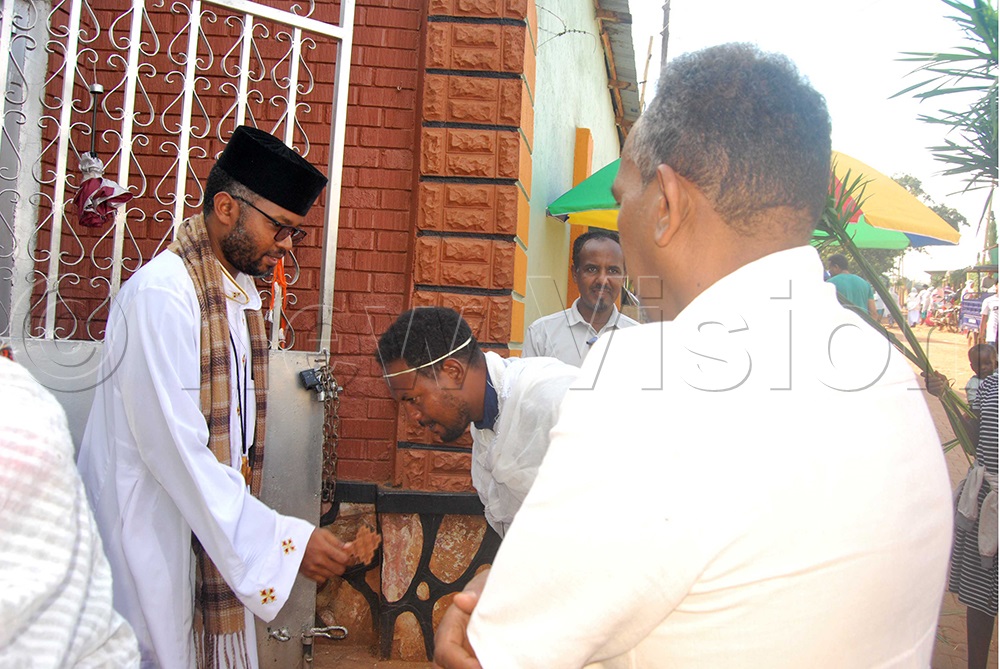
The Lead Priest Siyuman Binian (left) at Soya Medhananialem Ethiopian Orthodox church in Bbunga Makindye Division with believers during the Easter Celebrations on Saturday. (Credit: Benjamin Semwanga)
Soon after, the quiet reflection gives way to a deeply personal ritual. One by one, worshippers approach the altar. Heads bowed, they receive a blessing as Father Binian gently presses a cross to their foreheads. Some whisper silent prayers; others bend to kiss his hand, a gesture of humility and reverence that has endured across generations.
Beyond the church compound, the scene transforms into a vibrant theatre of everyday life.
Vendors line the entrance, their stalls brimming with palm fronds, incense, apples, bread, perfumes and brightly coloured garments. The air buzzes with conversation and commerce, blending the sacred with the social in a way that defines many Ugandan celebrations.
Among the worshippers is Hail Getachu, who reflects thoughtfully on the meaning of Easter in a world often marked by conflict. For him, the message of Christ carries urgent relevance.
“If everyone followed the example of Jesus Christ, there would be no war in places like Israel, the Horn of Africa or Ukraine,” he says, his voice calm but resolute.
Not far away, Hana Selam speaks of a quieter, more personal emotion: homesickness. Yet even in her longing, there is gratitude.
“I miss home,” she admits softly, “but I am grateful that Uganda has given me another place where I can still celebrate my faith.”
Her experience reflects the broader story of the Orthodox community in Kampala City - a melting pot of cultures and backgrounds, united by shared belief and tradition.
The Easter celebrations follow the deeply reflective period of Holy Week, when the faithful commemorate the suffering, crucifixion and resurrection of Jesus Christ. The 54-day fast that precedes it - especially prominent in Ethiopian tradition - is both physical and spiritual, requiring discipline, sacrifice and introspection.
Now that fast has come to an end.
In homes of the Orthodox faithful in the Ggaba neighbourhood and beyond, families are gathering around tables laden with traditional dishes.
"Laughter is returning to spaces that have been marked by restraint. The act of eating together is becoming symbolic - both a physical nourishment and a spiritual reward", says one of the elders at the Mbunga-Soya church.
Requesting anonymity, he added, "Amid the joy and festivity, one message is resonating.
Easter is not simply a day on the calendar. It's a way of life.