
Why Amuru district special needs pupils prefer learning with newspapers
The school, located in Pabbo Town Council, Amuru district in Northern Uganda, has a special unit that handles children with hearing impairments.
Primary Seven pupils receive PASS PLE revision pullouts to support their exam preparation. (Photo by Ritah Mukasa)
________________
Pabbo Primary School has an enrolment of 2,119 learners, of whom 247 have special needs, including hearing and visual impairments, as well as intellectual and physical disabilities.
The school, located in Pabbo Town Council, Amuru district in Northern Uganda, has a special unit that handles children with hearing impairments.
Alex Ocen, a special needs teacher for lower primary schools, says children with hearing impairments are among the best performers in their classes thanks to the special attention they are given at the unit.
Interestingly, he says that 11 children are deaf and communicate only through sign language, but they always win the reading competitions at the school. Ocen attributes this to the newspapers they receive at the unit every week under the Newspapers in Education (NiE) programme implemented by Save the Children, an organisation that saves and cares for children around the world.
“Weekend Vision and Toto Magazine have good pictures, cartoons, stories and graphics,” he says, adding that it’s difficult for learners with hearing impairments to understand concepts without illustrations. They also need to practice more with stories and pictures. This is why they enjoy engaging with Toto Magazine because it gives them the opportunity to read, fill in puzzles, and search for words. They also draw, match and count. Those who cannot read at least draw or see pictures and relate them to what they learn or see at home and in the school environment.
“We also have learners with intellectual disabilities such as dyslexia, dysgraphia and memory loss,” Ocen says. And because they cannot learn at the same pace as their classmates, “Some get demoralised and hate school.”
However, newspapers and other learning aids motivate them to learn at their pace. And this, with time, boosts their confidence, knowing that they too can make it.
Daniel Oceng, the Deputy Head Teacher, adds that newspapers also help to relieve teachers of the heavy workload, especially in schools with a big teacher-to-pupil ratio like Pabo Primary School where 27 teachers have to attend to 2,119 pupils in addition to other responsibilities.
“We are always constrained. Newspapers help to keep the children busy as the teacher attends to other duties or classes,” he says.
In addition, Sister Betty Laker, who uses newspapers to teach Religious Education in Primary Five says; “These are the most relevant instructional materials I have used.” Whatever she teaches can be found in the newspaper. Moreover, learners easily relate to the stories and pictures they see. When, say, she is teaching about God’s creation. She asks learners to cite examples from the newspapers and point out things like trees, people and animals. They also go ahead to explain how they can conserve God’s creation. In the same way, when she is teaching about leadership, she uses examples from the Bible relating them to the current leaders whose pictures are in the newspapers.
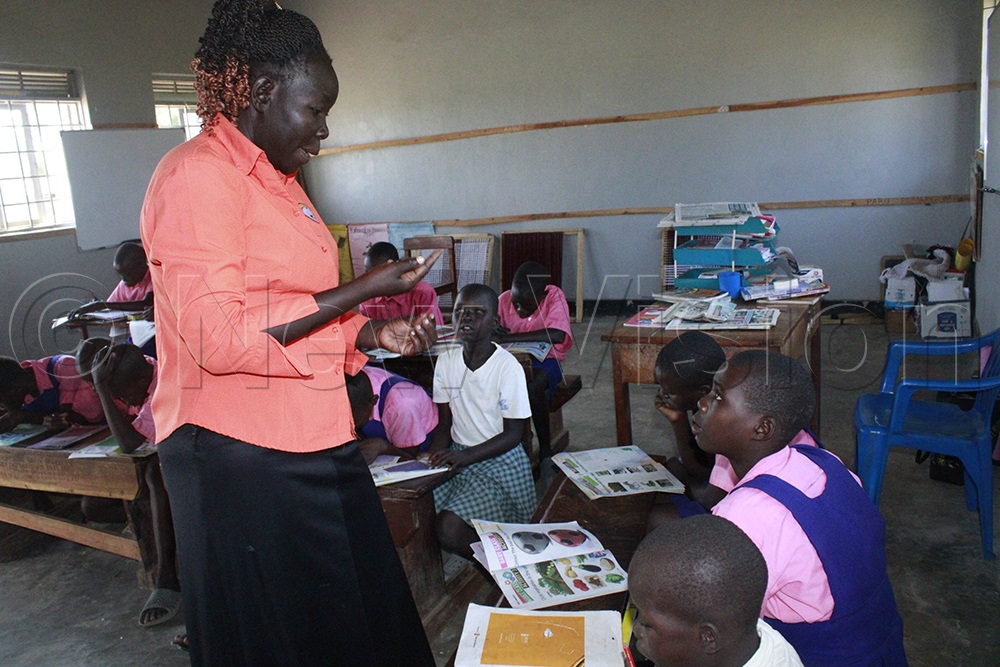
A special needs teacher uses sign language to support learners with hearing impairments during a lesson. (Photo by Ritah Mukasa)
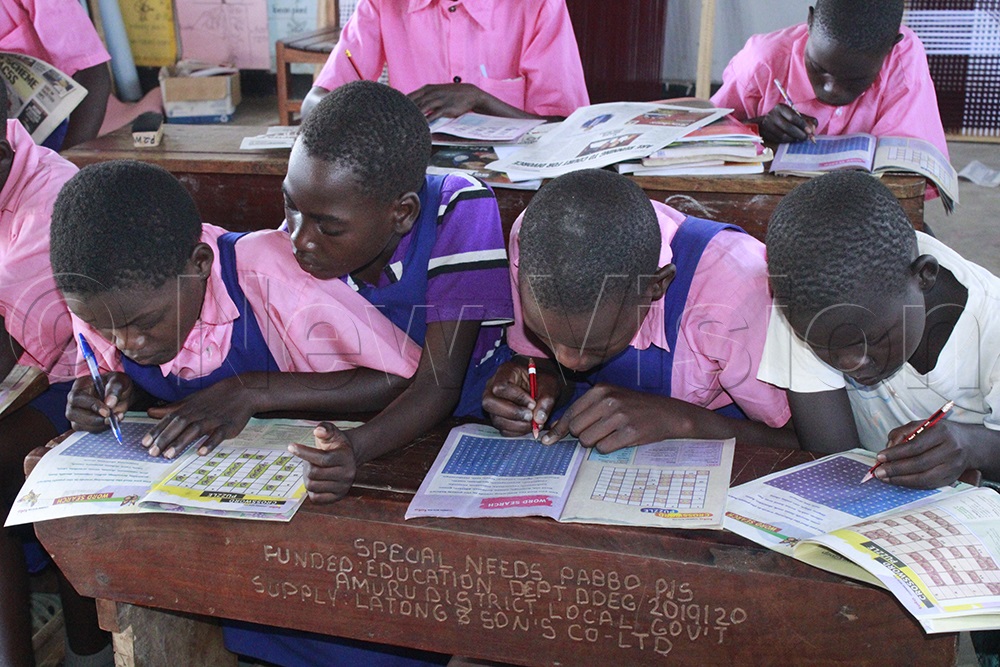
Pupils with hearing impairments complete puzzles in Toto Magazine as part of their learning activities. (Photo by Ritah Mukasa)
Meanwhile, Ocen and Oceng call for more copies of Weekend Vision and Toto Magazine and support for special needs children. They need classes and boarding facilities to save them from walking long distances to school. They also need the Uganda Sign Language dictionaries and other learning aids.
About the NiE Programme
Every week, Pabo Primary School receives 25 copies of Weekend Vision and Toto Magazine under the Newspapers in Education (NiE) programme which is being funded by the Norwegian Agency for Development Cooperation (NORAD) through Save the Children, an organization that saves and cares for children around the world. NORAD is implementing a five-year programme from 2024 to 2028 called “Transforming the Future-For and with Children” in Acholi and Karamoja regions. The program aims to ensure that all children enjoy their rights to survival, protection, development and participation in a safe, inclusive, accountable and resilient environment.