
Sexuality education: Govt adopts tight framework
Under the National Framework for Education on Health and Life Skills, the Government has restricted the sexual and health-related content that can be taught to children and young adults, depending on their age.
(L-R) Patience Namanya, sexual and reproductive health and rights coordinator at the Ministry of Gender; Dennis Mugimba, Ministry of Education spokesperson; Cleophus Mugenyi, chief education officer in charge of education administration and training; Rev. Daniel Token Wejuli, programme specialist for spirituality at the Inter-Religious Council of Uganda; Beat Bisangwa, from the Office of the First Lady; Irene Mwenyango, assistant commissioner for adolescent and school health at the Ministry of Health; and Charles Serwanja, public health team leader, pose for a group photo after a press conference at the Uganda Media Centre on October 26, 2026. (Photo by Nancy Nanyonga).
_________________
The Government has adopted a stricter, values-based framework for teaching health and life skills to children and young people, following the rejection of Comprehensive Sexuality Education.
Under the National Framework for Education on Health and Life Skills, the Government has restricted the sexual and health-related content that can be taught to children and young adults, depending on their age.
The framework introduces five age groups, with specific content permitted or prohibited for each group.
For instance, children below the age of nine will not be taught about puberty, mental health and hygiene, teenage pregnancy and human reproduction.
Children below the age of 12 will not be taught about marriage, while those below five will not receive lessons on alcohol and substance abuse.
In addition, children below five years will not be taught about HIV and AIDS, sexually transmitted infections and diseases, non-communicable diseases, first aid and safety procedures.
WHAT HAS BEEN ALLOWED
All children will be taught about self-awareness, personal hygiene, categories of relationships, healthy and unhealthy friendships, family and family formation.
Under the framework, school-going children will also be taught abstinence from sex, violence and abuse against children, seeking care and support, life skills, and the use of media and digital technology.
They will also learn about community and national identity, culture, values, citizens’ rights, history and responsibilities, as well as leadership, civic awareness and environmental stewardship.
The National Framework for Education on Health and Life Skills is Uganda’s localised approach to sexuality education, following the rejection of Comprehensive Sexuality Education, which was developed by the World Health Organisation.
Under the new framework, the Government will not allow the introduction of contraceptives to children.
The framework was developed by the Ministry of Education and Sports, in conjunction with the Office of the First Lady, the ministries of health, gender and local government, the Uganda AIDS Commission, the Directorate of Ethics and Integrity, and the Inter-Religious Council of Uganda.
The Government presented the framework to journalists yesterday during a function held at the Uganda Media Centre (UMC) in Kampala.
WHY THE FRAMEWORK
Dr Cleophus Mugenyi, the chief education officer in charge of education administration and training at the education ministry, said the framework was not just an educational intervention, but also an economic and social safety necessity for children.
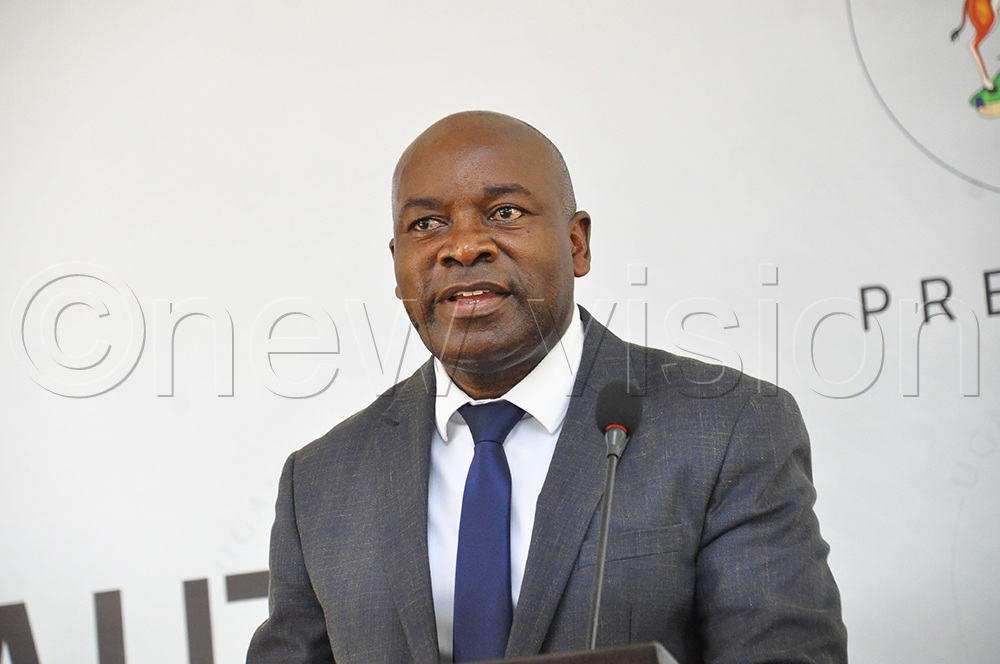
Chief Education Officer for Education Administration and Training at the Ministry of Education, Cleophus Mugenyi, addresses journalists during a press conference at the Uganda Media Centre on October 26, 2026. (Photo by Nancy Nanyonga)
Addressing young people and parents, Mugenyi said the framework was designed to equip young people with the knowledge to protect their health, the confidence to make informed decisions and the skills to secure their livelihoods.
He explained that the framework covers five key modules, including growth and human development; relationships, life skills and keeping safe; health and well-being; and responsible citizenship. The modules are intended to equip children with the knowledge and skills they need as they grow.
Mugenyi said health and well-being, as well as responsible citizenship modules are designed to protect children against abuse while ensuring that they learn age-appropriate content.
“These have been broken into units, learning outcomes, life skills and values to be acquired across different age groups: three to five years; six to nine years; 10 to 12 years; 13 to 16 years; and 17-plus-year-olds,” he said.
“The philosophy in this framework is that we are using a risk-avoidance approach for prevention and risk-reduction as a mitigation strategy for those already at risk to promote responsible living by our young people.”
According to the education ministry, Uganda’s growing young population presents both a major opportunity and an urgent challenge.
With more than 50% of the population below the age of 18, Mugenyi said the country’s youth population could drive the socio-economic transformation outlined in Vision 2040.
However, he said, for this to happen, young people needed not only academic knowledge, but also health literacy, resilience and life skills to navigate a complex world of risks, temptations and opportunities.
“By life skills, we mean the practical abilities that help a young person to manage everyday challenges, become resilient and transition into responsible adulthood,” he said.
IMPLEMENTATION PLAN
During the media briefing, Dr Dennis Mugimba, the education ministry’s spokesperson, said implementation of the framework would begin immediately. He added that it would be officially launched this Wednesday at the Office of the Prime Minister.
Mugimba defended the Government’s decision to develop a localised framework, saying it was intended to guide how young people are nurtured as they transition from childhood to adulthood.
He said the framework would help the country address rising cases of teenage pregnancies, substance abuse and moral decay.
Beat Bisangwa, the executive director of the Uganda Chapter of the Organisation of African First Ladies for Development, said the adoption of a risk-prevention approach would protect children against abuse and promote their overall health.
“With this framework, we will prepare the children well, and we will keep them safe,” she said.
Dr Richard Mugahi, the commissioner for maternal and child health at the Ministry of Health, said the framework would enable the Government to speak with one voice on the issues affecting young people.
“As a country, we have been struggling with teenage pregnancies. Now we struggle with substance abuse among young people. This is when this framework is needed most,” he said.