
New study flags teacher crisis in West Nile and Karamoja
Education leaders called for better staffing, fairer remuneration, stronger professional development and improved working conditions.
Some of the education leaders who attended the event in a group photo. (Courtesy photos)
________________
From overcrowded classrooms to inadequate teaching resources, teachers in West Nile and Karamoja are facing conditions that threaten their ability to deliver quality education, according to a new assessment that has prompted calls for urgent policy action.
The 2025 Teacher Situation Assessment, conducted across 204 refugee-hosting and non-refugee schools, surveyed 1,716 teachers and included 116 classroom observations, exposing a gap between teachers’ commitment to their work and the structural support available to them.
The findings were discussed on Friday (October 23) at a national stakeholders’ engagement organised by Education Advocacy Network (EAN) at Fairway Hotel in Kampala, where education leaders called for better staffing, fairer remuneration, stronger professional development and improved working conditions.
The assessment also identified heavy workloads, gaps in professional support and unequal pay among barriers to effective teaching, prompting education stakeholders to urge government to turn research into action.
Filbert Bates Baguma, the general secretary of the Uganda National Teachers’ Union (UNATU), said teacher welfare is inseparable from the quality of education learners receive.
He warned that poor remuneration, overcrowded classrooms and inadequate support create challenges that individual teachers cannot resolve on their own.
The study was conducted by Luigi Giussani Foundation and Oxfam Uganda, with funding from Denmark’s Ministry of Foreign Affairs.
It examined teacher support systems, professional development, classroom practices, curriculum implementation, child protection and language support.
Its findings point to a teaching workforce that remains committed and collegial but is constrained by heavy workloads, inconsistent lesson planning, fragmented professional development, weak record-keeping practices and concerns about teachers’ rights and pay disparities.
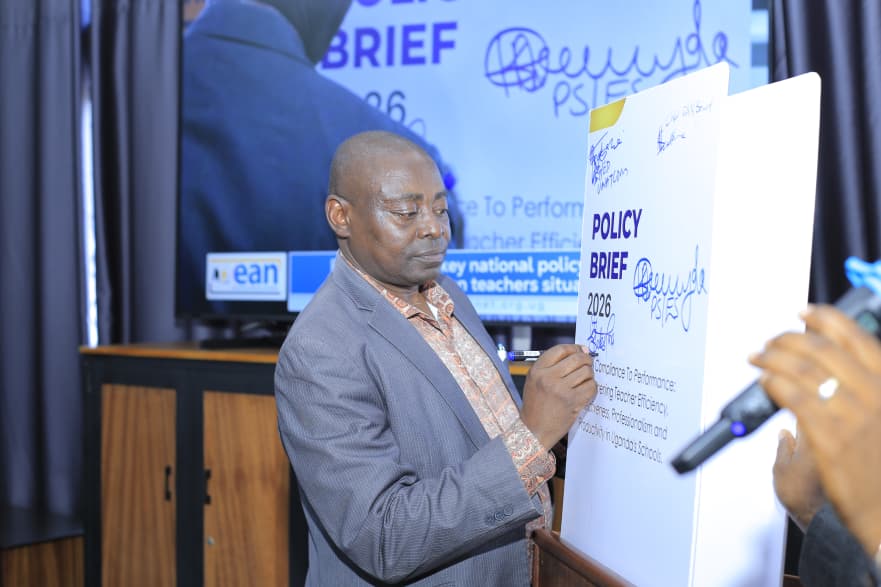
The engagement brought together representatives from the Ministry of Education and Sports, Uganda National Examinations Board, the Directorate of Education Standards, Uganda National Commission for UNESCO, Makerere University Business School and civil society organisations.
Practical policy decisions
The engagement was intended to ensure the findings inform practical policy decisions rather than remain another report on the education sector's challenges.
Priorities included improving teacher motivation and professionalism, strengthening lesson preparation, reviewing schemes of work and encouraging collaboration among teachers, school leaders and communities.
Evidence-based decisions
Dr Kedrace Rwankore Turyagyenda, the permanent secretary of the Ministry of Education and Sports, said credible research is essential to sound policymaking.
“Policymaking, decision-making should be driven by, authentic and unbiased data,” she said.
Turyagyenda welcomed research from Karamoja, saying it contributes to the evidence policymakers draw on when developing policies and guidelines.
She acknowledged the difficult circumstances facing some teachers, including overcrowded classrooms and inadequate facilities, and urged continued support for teachers as the sector implements reforms such as the competence-based curriculum.
The PS also called for education advocacy to extend beyond government to communities, emphasising the shared responsibility for ensuring children receive meaningful education.
“Our products are human,” she said, highlighting the lasting impact teachers have on the lives of the children they educate.
Overcrowding undermine teaching
Baguma illustrated the staffing challenge by citing a secondary school in Kyenjojo district with approximately 1,800 students but only nine teachers on the government payroll.
He also described lower-primary classrooms where teachers handle as many as 300 learners, some sitting on the floor in crowded spaces with limited room for classroom activities.
“How do you expect this teacher to be mentally healthy?”
The UNATU boss argued that teachers should not be judged solely on classroom performance without considering the conditions under which they work.
“At the end of the day, we are misjudged as teachers because you use what you have in the environment where you are and then you produce what you are capable of producing,” he said.
The findings are significant for a country whose education workforce serves millions of learners.
According to the Uganda Bureau of Statistics’ 2025 Baseline Education Census, Uganda’s teaching and non-teaching education workforce serves more than 13.5 million learners.
Yet shortages, uneven teacher deployment and inadequate classroom facilities continue to raise questions about whether learners in underserved communities receive the attention and support they need.
Recommendations
Luigi Giussani Foundation recommended recruiting adequate numbers of teachers, addressing remuneration disparities sustainably and reviewing district local government staffing structures to strengthen education inspection and school supervision.
The foundation also called for stronger district local language boards to support multilingual and bilingual teaching, alongside improved access to electricity, internet connectivity and information and communication technology (ICT) in schools.
It further recommended training teachers to use affordable ICT tools effectively in teaching and learning.
Angela Nalwanga, chairperson of the EAN board of directors, said teachers needed adequate support and resources to deliver quality education.
“There can be no quality education without teachers who are motivated, supported, and well-equipped,” she said, urging policymakers to reflect teacher support in budgetary commitments.
Teddy Mutoni, programme coordinator and partner relations representative at Luigi Giussani Foundation, said the research and stakeholder dialogue were important steps towards addressing the challenges identified.
Mary Nyiramugisha, programmes officer at the Institute for Human Capital Incubation Transformation and Development (IHCITD), called for increased investment, improved working conditions and continuous professional development.
“If we want better learning outcomes for the children in West Nile, in Karamoja, and across Uganda, we must invest in the people who teach them,” she said.
Pay disparities
Baguma criticised disparities in teacher remuneration, particularly following the 2022 salary enhancement for science teachers.
He said science teachers received a 300 per cent pay increase while arts and humanities teachers did not receive a comparable enhancement at the time, despite teaching the same learners.
“These are doing the same work,” he said, warning that disparities could undermine morale and cooperation within schools.
He also questioned the sustainability of policies encouraging teachers to acquire higher qualifications without corresponding improvements in remuneration.
Baguma cited figures presented by the union leaders suggesting that about 84 per cent of primary school teachers were willing to leave the profession, with 50 per cent attributing this to low pay.
He further called for better access to healthcare and improved support for teachers working in hard-to-reach areas, arguing that poor living and working conditions affect teachers’ well-being and their ability to deliver lessons consistently.