
West Nile TVET schools get laptops to improve EMIS data management
The intervention follows revelations that the institutions had not updated records of their learners and teachers since 2024, leaving outdated information on the system and creating challenges in data management and reporting.
John Muhangi, senior manager of programmes design and development at Luigi Giussani, trains TVET officials in the West Nile region. (Photo by Robert Ariaka)
________________ TVET officials attend EMIS training at White Castle Hotel in Arua to enhance their data entry skills. (Photo by Robert Ariaka)
Three technical and vocational education and training (TVET) institutions in the West Nile region have received laptops and training to address gaps in the management of learner and teacher data on the Government’s Education Management Information System (EMIS).
The intervention follows revelations that the institutions had not updated records of their learners and teachers since 2024, leaving outdated information on the system and creating challenges in data management and reporting.
The support was provided during a two-day training organised by the Luigi Giussani Foundation under the DANIDA SP2 project, implemented with support from Oxfam and funded by the Danish Ministry of Foreign Affairs. The training on October 1, 2026, brought together management teams and teachers from the three institutions and focused on registering learners and updating institutional data using EMIS.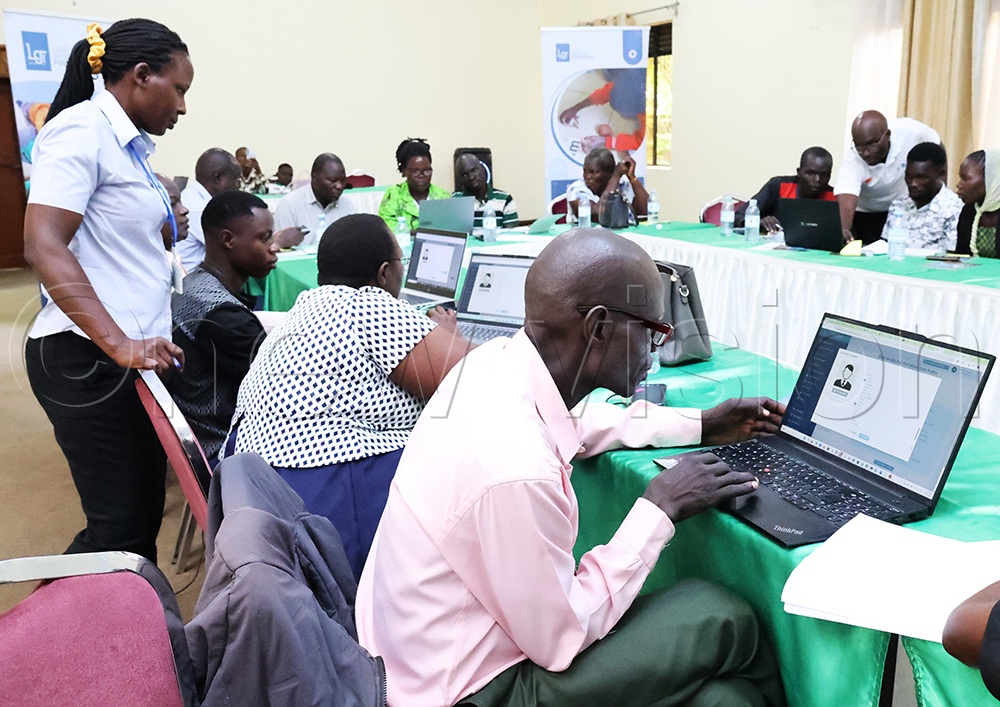
Officials said the training was also intended to address a growing reliance on external service providers, whom some institutions had been paying to access the system and update records on their behalf.
Patrick Ejom, the head trainer at Omugo Skills Development Centre in Terego district, said the laptop and training would strengthen the institution’s ability to manage and update information on learners and teachers.
“The laptop will help improve our institutional system of updating learners and teachers’ details, which will make it easier for the ministry to access information from our institution through the system,” Ejom said.
He noted that many TVET institutions still face capacity gaps in technology and EMIS management at district level.
“In our various districts, we were not well catered for, leaving capacity gaps. Our ICT technicians and the designated focal point persons for EMIS were getting challenges which were not answered,” he explained.
“This will provide space for us to embark on trainee registration on the system and enter other information needed on the school by the government, including staff and infrastructure details,” he added.
At Inde Skills Development Centre in Madi Okollo district, deputy head trainer Monicah Alimah Draleru said the institution discovered that records on the system still contained details of former students and teachers because the information had not been updated for nearly two years.
“We are very delighted that we have got this opportunity to come for this training. It was just yesterday when we actually started entering the students’ names into the EMIS system,” Draleru said.
She explained that the institution previously depended on outsiders to access the system, a practice that increased operational costs.
“We used to hire somebody from outside to come and help our secretary access this information. You know how costly that is. Little did we know that there was gold lying behind all this,” she said.
According to Draleru, four teachers from the institution participated in the training and can now independently manage the system.
“I think the responsible person was either reluctant or whatever happened, we do not know. We learnt about it when we carried out the students’ headcount,” she added.

Officials from the Luigi Giussani Foundation and Oxfam hand over a laptop to Monicah Alimah Draleru, deputy head trainer at Inde Skills Development Centre in Madi Okollo, and staff. (Photo by Robert Ariaka)
Rosemary Abikoko, the secretary of Lodonga Polytechnic School, said internet access and the cost of data had hindered the institution’s ability to manage learner registrations online.
“Buying data each and every day has been a major problem at our school, making registration of learners a challenge. After this training, we now have confidence to register learners and teachers in the system,” Abikoko said.
She added that the laptop donated by the Luigi Giussani Foundation would ease the storage and management of institutional data.
Need for training
John Muhangi, the senior manager for programme design and development at the Luigi Giussani Foundation, said requests from teachers highlighted the need for training in ICT, financial literacy and data management.
“One issue that emerged strongly was the need for data management using the EMIS system. The training we have conducted will address the desire to update and manage the system,” Muhangi said.
He noted that the foundation partnered with the Ministry of Education and Sports to identify an expert who trained the participants on EMIS management.
Muhangi said the broader goal was to ensure that education institutions provide accurate and timely data that government can use for planning and decision-making.
“The bigger picture is to ensure that the government and education institutions are capable of inputting correct data that the government can use to inform decisions,” he said.
He emphasised that strengthening digital data management in schools and training institutions would improve the quality of information available to government, enabling better planning, resource allocation and policy formulation across the education sector.