
Makerere's Prof. Magara unveils solutions to Academic Writing hurdles
The book seeks to help academic writers produce work that not only meets scholarly standards but also contributes to the development of practical products and services.
Prof. Magara (Left) handing over a copy of his book to Prof. Nawangwe (Right) during its launch at Senate Building, Makerere University. (Photo by John Odyek)
_________________
Prof. Elisam Magara, a lecturer at the East African School of Library and Information Sciences at Makerere University, has released a 267-page book aimed at guiding students, lecturers, researchers and postgraduate scholars on productive academic writing.
The book seeks to help academic writers produce work that not only meets scholarly standards but also contributes to the development of practical products and services.
Titled ‘From Records to Publication: A Guide to Academic Authorship’, it was launched at the Senate Building, Makerere University on Thursday, February 12.
Demystifying Academic Writing
Scholars testify that Academic authorship is often perceived as ritualised, complex, and difficult to navigate. The new publication attempts to demystify the process by offering a clear, structured guide that helps scholars overcome common challenges and thrive in the demanding “publish or perish” environment.
At the launch, Magara said the guide supports scholars from the moment they conceive an idea to the stage where their work is published and accessible to readers.
Rigorous Editorial Process
Magara described a rigorous editorial process that began in 2022, including international calls for contributions, peer review of abstracts, write shops for feedback, and multiple rounds of chapter reviews to ensure quality and relevance.
“This publication is meant not just for Makerere but for scholars across the region and beyond,” he added.
Makerere’s growing research Output
Prof. Barnabas Nawangwe, the Vice-Chancellor of Makerere University, presided over the launch and highlighted the institution’s growing research output.
He said the university’s annual peer-reviewed publications have risen from about 500 a decade ago to roughly 700, and now exceed 2,000, which shows evidence of a strengthening research culture.
Nawangwe called for the revival of college-based academic journals to expand publication opportunities and attract global scholars.
“Our level of development depends on the knowledge we produce. Countries like China invested heavily in education, research, and publication, and today they are global industrial leaders because of that,” he said.
Challenges for Young Scholars
The Vice-Chancellor stressed that Makerere must intensify research, publishing, and innovation to sustain knowledge creation. He noted that many young scholars face difficulties navigating foreign journal submission processes, limiting publication success.
He estimated that fewer than half of manuscripts produced by Makerere authors reach reputable international journals, underscoring the need for stronger mentorship and institutional support.
Nawangwe commended Prof. Magara and his editorial team for producing the authorship guide, describing it as an essential resource for master’s and PhD students, early-career researchers, and institutions seeking to strengthen research capacity.
“This is central to the mission of a university. When we invest in research and publication, we secure our future,” he added.
Mentorship and Academic Communication
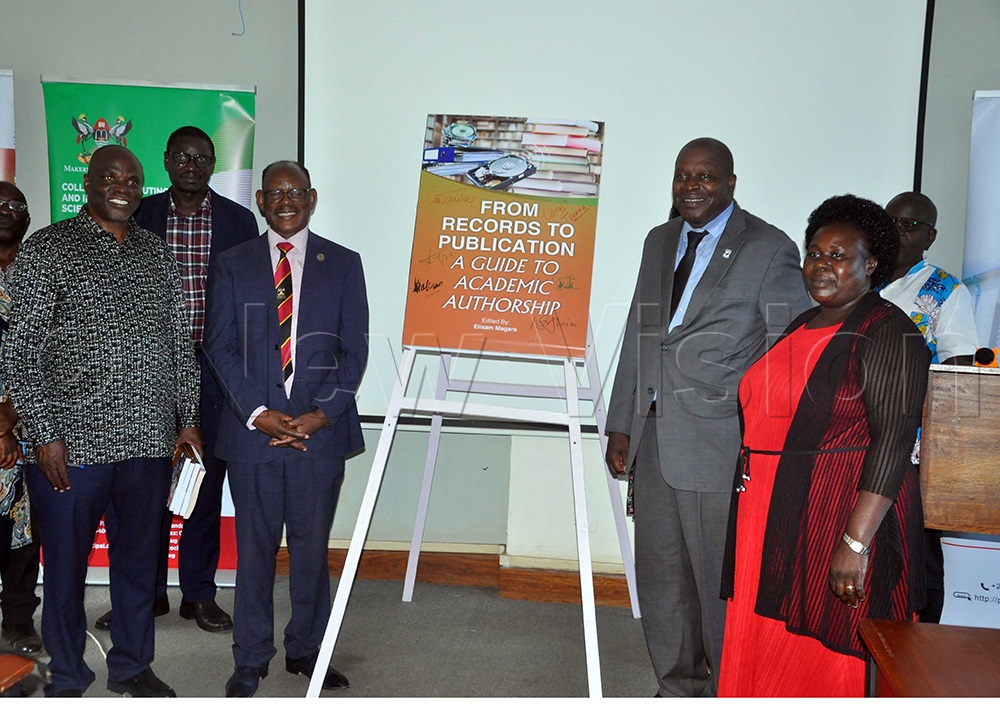
Prof. Magara (Left), Prof. Nawangwe (Second left), Dr Kaddu (First Right), Prof. Oyana (Second Right), discussing during the launch of the book at the Senate Building, Makerere University. Looking on are officials from the university. (Photo by John Odyek)
Prof. Tonny Oyana, Principal of the College of Computing and Information Sciences at Makerere University, emphasised that academic writing and effective communication are skills developed gradually through practice and mentorship. Prof. Oyana urged graduate students and newly appointed lecturers to adopt the newly launched volume as a foundational guide.
He noted that graduate students often react defensively when supervisors ask them to revise draft reports, sometimes interpreting critical feedback as personal criticism rather than part of scholarly development.
“Even junior lecturers still need mentorship. If I were Vice Chancellor, I would make this required reading for every new academic hire", he argued.
Dr Sarah Kaddu, dean of the East African School of Library and Information Sciences, described the launch as a celebration of scholarship and intellectual discipline. “This event recognises the journey of knowledge creation. The book addresses one of the most pressing challenges scholars face: transforming research records into publishable work,” Kaddu said.